1996 · CLOSE READING
The Law is for All
The Law is for All (1996), PDF p. 60
Original page
Enlarge ↗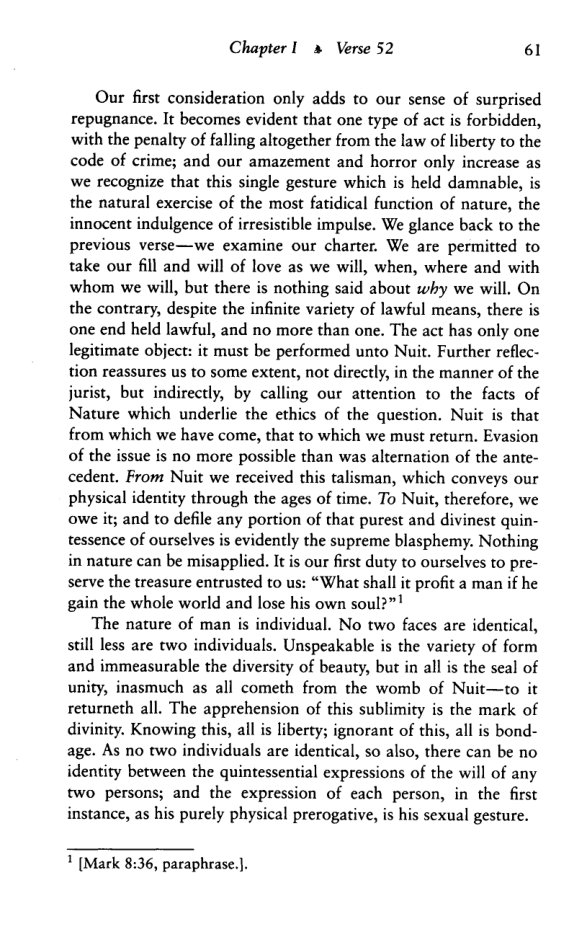
Highlights use the original PDF text layer. OCR-only matches may not be visible on the scan.
Transcription
Download text ↓raw extractionoriginal embedded textReview: unreviewed
Chapter I i Verse 52
61
Our first consideration only adds to our sense of surprised
repugnance. It becomes evident that one type of act is forbidden,
with the penalty of falling altogether from the law of liberty to the
code of crime; and our amazement and horror only increase as
we recognize that this single gesture which is held damnable, is
the natural exercise of the most fatidical function of nature, the
innocent indulgence of irresistible impulse. We glance back to the
previous verse—we examine our charter. We are permitted to
take our fill and will of love as we will, when, where and with
whom we will, but there is nothing said about why we will. On
the contrary, despite the infinite variety of lawful means, there is
one end held lawful, and no more than one. The act has only one
legitimate object: it must be performed unto Nuit. Further reflec
tion reassures us to some extent, not directly, in the manner of the
jurist, but indirectly, by calling our attention to the facts of
Nature which underlie the ethics of the question. Nuit is that
from which we have come, that to which we must return. Evasion
of the issue is no more possible than was alternation of the ante
cedent. From Nuit we received this talisman, which conveys our
physical identity through the ages of time. To Nuit, therefore, we
owe it; and to defile any portion of that purest and divinest quin
tessence of ourselves is evidently the supreme blasphemy. Nothing
in nature can be misapplied. It is our first duty to ourselves to pre
serve the treasure entrusted to us: “What shall it profit a man if he
gain the whole world and lose his own soul?”1
1 [Mark 8:36, paraphrase.].
The nature of man is individual. No two faces are identical,
still less are two individuals. Unspeakable is the variety of form
and immeasurable the diversity of beauty, but in all is the seal of
unity, inasmuch as all cometh from the womb of Nuit—to it
returneth all. The apprehension of this sublimity is the mark of
divinity. Knowing this, all is liberty; ignorant of this, all is bond
age. As no two individuals are identical, so also, there can be no
identity between the quintessential expressions of the will of any
two persons; and the expression of each person, in the first
instance, as his purely physical prerogative, is his sexual gesture.
Page provenance & review flags
Stable page ID: 6528ce4d28e01eb80a128d9c:p00060
Line breaks are preserved. Reading order and OCR accuracy may need review.
Printed page label has not been verified.
- No automated review flags. This does not establish transcription accuracy.