1996 · CLOSE READING
The Law is for All
The Law is for All (1996), PDF p. 59
Original page
Enlarge ↗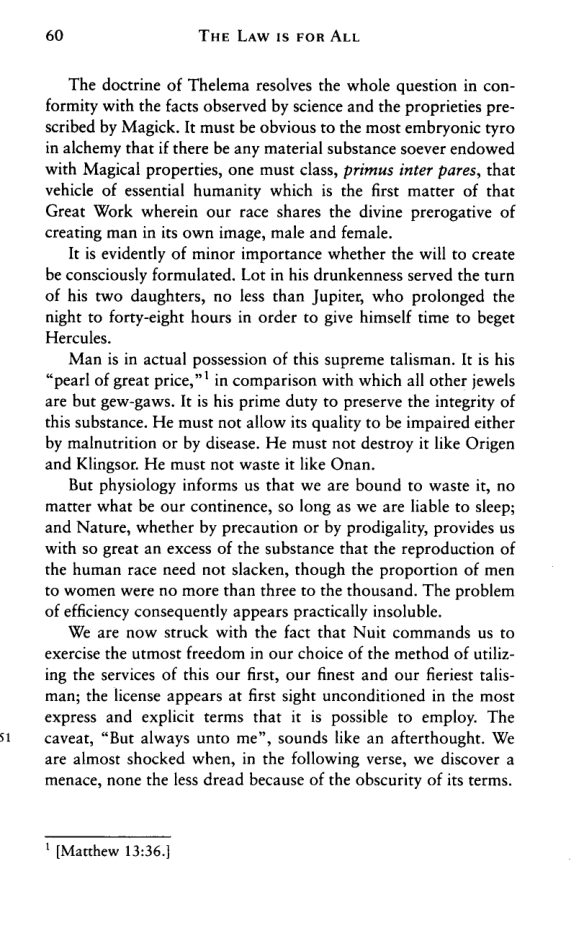
Highlights use the original PDF text layer. OCR-only matches may not be visible on the scan.
Transcription
Download text ↓raw extractionoriginal embedded textReview: unreviewed
60
The Law is for All
The doctrine of Thelema resolves the whole question in con
formity with the facts observed by science and the proprieties pre
scribed by Magick. It must be obvious to the most embryonic tyro
in alchemy that if there be any material substance soever endowed
with Magical properties, one must class, primus inter pares, that
vehicle of essential humanity which is the first matter of that
Great Work wherein our race shares the divine prerogative of
creating man in its own image, male and female.
It is evidently of minor importance whether the will to create
be consciously formulated. Lot in his drunkenness served the turn
of his two daughters, no less than Jupiter, who prolonged the
night to forty-eight hours in order to give himself time to beget
Hercules.
Man is in actual possession of this supreme talisman. It is his
“pearl of great price,”1 in comparison with which all other jewels
are but gew-gaws. It is his prime duty to preserve the integrity of
this substance. He must not allow its quality to be impaired either
by malnutrition or by disease. He must not destroy it like Origen
and Klingsor. He must not waste it like Onan.
1 [Matthew 13:36.]
But physiology informs us that we are bound to waste it, no
matter what be our continence, so long as we are liable to sleep;
and Nature, whether by precaution or by prodigality, provides us
with so great an excess of the substance that the reproduction of
the human race need not slacken, though the proportion of men
to women were no more than three to the thousand. The problem
of efficiency consequently appears practically insoluble.
We are now struck with the fact that Nuit commands us to
exercise the utmost freedom in our choice of the method of utiliz
ing the services of this our first, our finest and our fieriest talis
man; the license appears at first sight unconditioned in the most
express and explicit terms that it is possible to employ. The
caveat, “But always unto me”, sounds like an afterthought. We
are almost shocked when, in the following verse, we discover a
menace, none the less dread because of the obscurity of its terms.
Page provenance & review flags
Stable page ID: 6528ce4d28e01eb80a128d9c:p00059
Line breaks are preserved. Reading order and OCR accuracy may need review.
Printed page label has not been verified.
- No automated review flags. This does not establish transcription accuracy.