1996 · CLOSE READING
The Law is for All
The Law is for All (1996), PDF p. 49
Original page
Enlarge ↗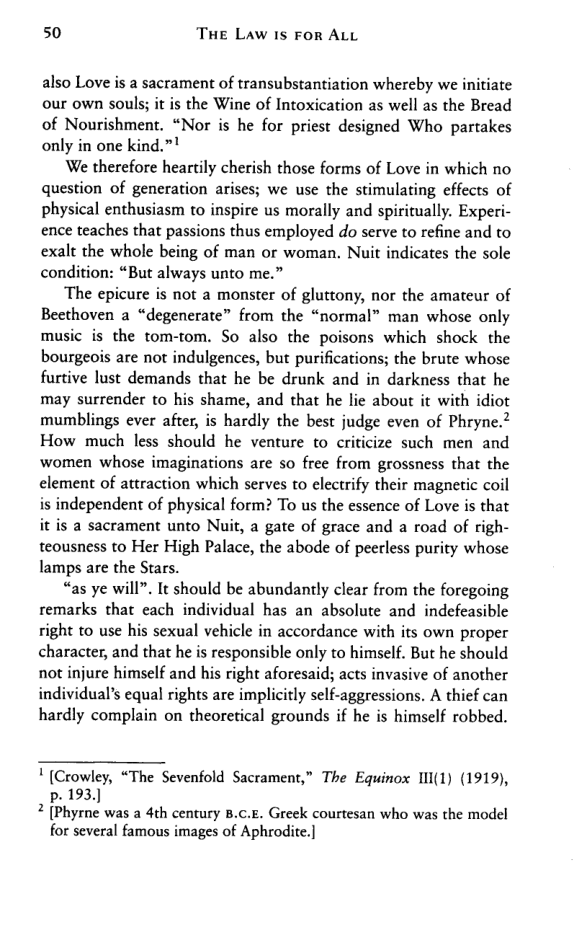
Highlights use the original PDF text layer. OCR-only matches may not be visible on the scan.
Transcription
Download text ↓raw extractionoriginal embedded textReview: unreviewed
50
The Law is for All
also Love is a sacrament of transubstantiation whereby we initiate
our own souls; it is the Wine of Intoxication as well as the Bread
of Nourishment. “Nor is he for priest designed Who partakes
only in one kind.”1
1 [Crowley, “The Sevenfold Sacrament,” The Equinox III(l) (1919),
p. 193.]
2 [Phyrne was a 4th century b.c.e. Greek courtesan who was the model
for several famous images of Aphrodite.]
We therefore heartily cherish those forms of Love in which no
question of generation arises; we use the stimulating effects of
physical enthusiasm to inspire us morally and spiritually. Experi
ence teaches that passions thus employed do serve to refine and to
exalt the whole being of man or woman. Nuit indicates the sole
condition: “But always unto me.”
The epicure is not a monster of gluttony, nor the amateur of
Beethoven a “degenerate” from the “normal” man whose only
music is the tom-tom. So also the poisons which shock the
bourgeois are not indulgences, but purifications; the brute whose
furtive lust demands that he be drunk and in darkness that he
may surrender to his shame, and that he lie about it with idiot
mumblings ever after, is hardly the best judge even of Phryne.1 2
How much less should he venture to criticize such men and
women whose imaginations are so free from grossness that the
element of attraction which serves to electrify their magnetic coil
is independent of physical form? To us the essence of Love is that
it is a sacrament unto Nuit, a gate of grace and a road of righ
teousness to Her High Palace, the abode of peerless purity whose
lamps are the Stars.
“as ye will”. It should be abundantly clear from the foregoing
remarks that each individual has an absolute and indefeasible
right to use his sexual vehicle in accordance with its own proper
character, and that he is responsible only to himself. But he should
not injure himself and his right aforesaid; acts invasive of another
individual’s equal rights are implicitly self-aggressions. A thief can
hardly complain on theoretical grounds if he is himself robbed.
Page provenance & review flags
Stable page ID: 6528ce4d28e01eb80a128d9c:p00049
Line breaks are preserved. Reading order and OCR accuracy may need review.
Printed page label has not been verified.
- No automated review flags. This does not establish transcription accuracy.