1996 · CLOSE READING
The Law is for All
The Law is for All (1996), PDF p. 178
Original page
Enlarge ↗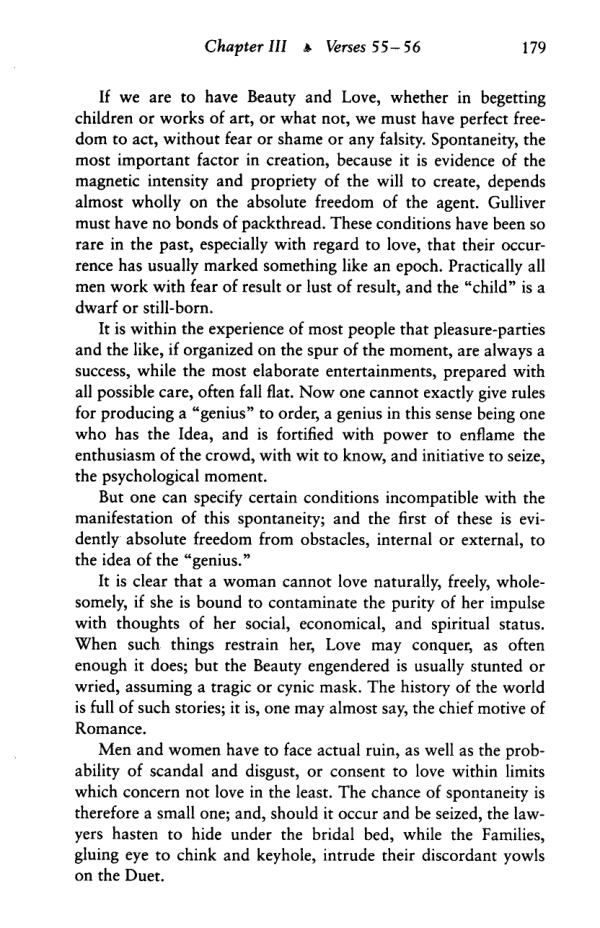
Highlights use the original PDF text layer. OCR-only matches may not be visible on the scan.
Transcription
Download text ↓raw extractionoriginal embedded textReview: unreviewed
Chapter III <#• Verses 55—56
179
If we are to have Beauty and Love, whether in begetting
children or works of art, or what not, we must have perfect free
dom to act, without fear or shame or any falsity. Spontaneity, the
most important factor in creation, because it is evidence of the
magnetic intensity and propriety of the will to create, depends
almost wholly on the absolute freedom of the agent. Gulliver
must have no bonds of packthread. These conditions have been so
rare in the past, especially with regard to love, that their occur
rence has usually marked something like an epoch. Practically all
men work with fear of result or lust of result, and the “child” is a
dwarf or still-born.
It is within the experience of most people that pleasure-parties
and the like, if organized on the spur of the moment, are always a
success, while the most elaborate entertainments, prepared with
all possible care, often fall flat. Now one cannot exactly give rules
for producing a “genius” to order, a genius in this sense being one
who has the Idea, and is fortified with power to enflame the
enthusiasm of the crowd, with wit to know, and initiative to seize,
the psychological moment.
But one can specify certain conditions incompatible with the
manifestation of this spontaneity; and the first of these is evi
dently absolute freedom from obstacles, internal or external, to
the idea of the “genius.”
It is clear that a woman cannot love naturally, freely, whole
somely, if she is bound to contaminate the purity of her impulse
with thoughts of her social, economical, and spiritual status.
When such things restrain her, Love may conquer, as often
enough it does; but the Beauty engendered is usually stunted or
wried, assuming a tragic or cynic mask. The history of the world
is full of such stories; it is, one may almost say, the chief motive of
Romance.
Men and women have to face actual ruin, as well as the prob
ability of scandal and disgust, or consent to love within limits
which concern not love in the least. The chance of spontaneity is
therefore a small one; and, should it occur and be seized, the law
yers hasten to hide under the bridal bed, while the Families,
gluing eye to chink and keyhole, intrude their discordant yowls
on the Duet.
Page provenance & review flags
Stable page ID: 6528ce4d28e01eb80a128d9c:p00178
Line breaks are preserved. Reading order and OCR accuracy may need review.
Printed page label has not been verified.
- No automated review flags. This does not establish transcription accuracy.