1996 · CLOSE READING
The Law is for All
The Law is for All (1996), PDF p. 169
Original page
Enlarge ↗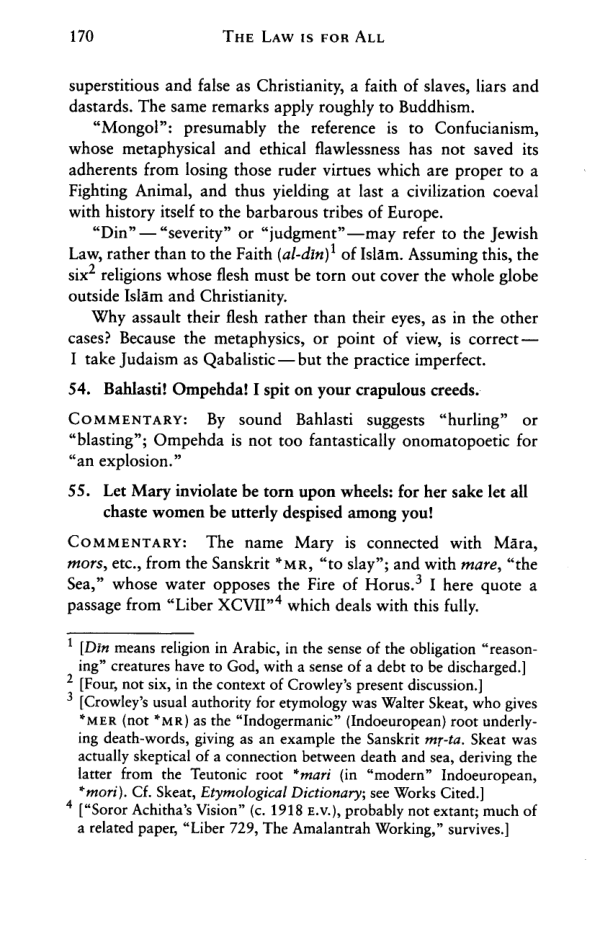
Highlights use the original PDF text layer. OCR-only matches may not be visible on the scan.
Transcription
Download text ↓raw extractionoriginal embedded textReview: unreviewed
170
The Law is for All
superstitious and false as Christianity, a faith of slaves, liars and
dastards. The same remarks apply roughly to Buddhism.
“Mongol”: presumably the reference is to Confucianism,
whose metaphysical and ethical flawlessness has not saved its
adherents from losing those ruder virtues which are proper to a
Fighting Animal, and thus yielding at last a civilization coeval
with history itself to the barbarous tribes of Europe.
“Din” — “severity” or “judgment”—may refer to the Jewish
Law, rather than to the Faith (al-din)1 of Islam. Assuming this, the
six1 2 religions whose flesh must be torn out cover the whole globe
outside Islam and Christianity.
1 [Din means religion in Arabic, in the sense of the obligation “reason
ing” creatures have to God, with a sense of a debt to be discharged.]
2 [Four, not six, in the context of Crowley’s present discussion.]
3 [Crowley’s usual authority for etymology was Walter Skeat, who gives
*mer (not *mr) as the “Indogermanic” (Indoeuropean) root underly
ing death-words, giving as an example the Sanskrit mr-ta. Skeat was
actually skeptical of a connection between death and sea, deriving the
latter from the Teutonic root *mari (in “modern” Indoeuropean,
*mori). Cf. Skeat, Etymological Dictionary; see Works Cited.]
4 [“Soror Achitha’s Vision” (c. 1918 E.v.), probably not extant; much of
a related paper, “Liber 729, The Amalantrah Working,” survives.]
Why assault their flesh rather than their eyes, as in the other
cases? Because the metaphysics, or point of view, is correct —
I take Judaism as Qabalistic — but the practice imperfect.
54. Bahlasti! Ompehda! I spit on your crapulous creeds.
Commentary: By sound Bahlasti suggests “hurling” or
“blasting”; Ompehda is not too fantastically onomatopoetic for
“an explosion.”
55. Let Mary inviolate be torn upon wheels: for her sake let all
chaste women be utterly despised among you!
Commentary: The name Mary is connected with Mara,
mors, etc., from the Sanskrit *mr, “to slay”; and with mare, “the
Sea,” whose water opposes the Fire of Horus.3 I here quote a
passage from “Liber XCVH”4 which deals with this fully.
Page provenance & review flags
Stable page ID: 6528ce4d28e01eb80a128d9c:p00169
Line breaks are preserved. Reading order and OCR accuracy may need review.
Printed page label has not been verified.
- No automated review flags. This does not establish transcription accuracy.