1996 · CLOSE READING
The Law is for All
The Law is for All (1996), PDF p. 161
Original page
Enlarge ↗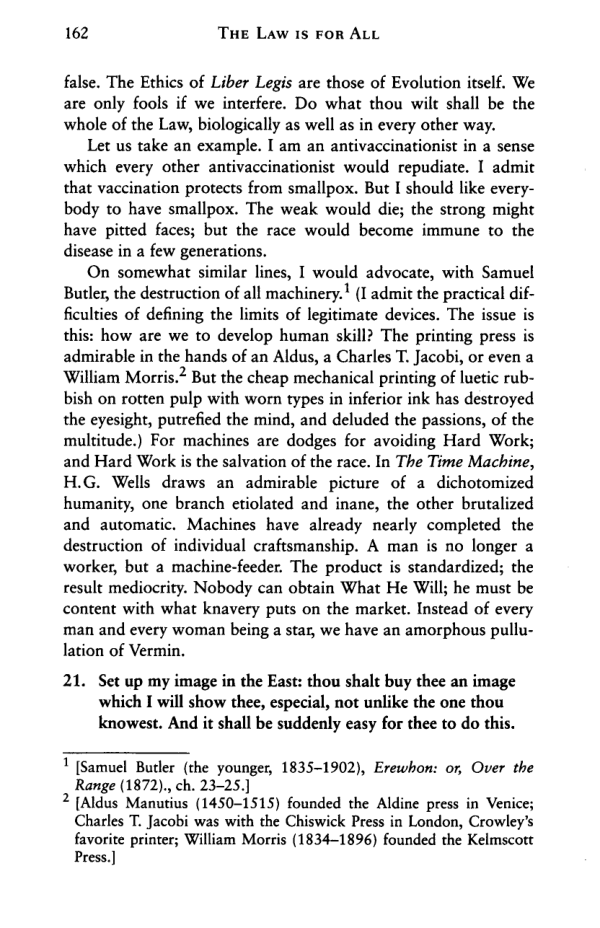
Highlights use the original PDF text layer. OCR-only matches may not be visible on the scan.
Transcription
Download text ↓raw extractionoriginal embedded textReview: unreviewed
162
The Law is for All
false. The Ethics of Liber Legis are those of Evolution itself. We
are only fools if we interfere. Do what thou wilt shall be the
whole of the Law, biologically as well as in every other way.
Let us take an example. I am an antivaccinationist in a sense
which every other antivaccinationist would repudiate. I admit
that vaccination protects from smallpox. But I should like every
body to have smallpox. The weak would die; the strong might
have pitted faces; but the race would become immune to the
disease in a few generations.
On somewhat similar lines, I would advocate, with Samuel
Butler, the destruction of all machinery.1 (I admit the practical dif
ficulties of defining the limits of legitimate devices. The issue is
this: how are we to develop human skill? The printing press is
admirable in the hands of an Aldus, a Charles T. Jacobi, or even a
William Morris.1 2 But the cheap mechanical printing of luetic rub
bish on rotten pulp with worn types in inferior ink has destroyed
the eyesight, putrefied the mind, and deluded the passions, of the
multitude.) For machines are dodges for avoiding Hard Work;
and Hard Work is the salvation of the race. In The Time Machine,
H.G. Wells draws an admirable picture of a dichotomized
humanity, one branch etiolated and inane, the other brutalized
and automatic. Machines have already nearly completed the
destruction of individual craftsmanship. A man is no longer a
worker, but a machine-feeder. The product is standardized; the
result mediocrity. Nobody can obtain What He Will; he must be
content with what knavery puts on the market. Instead of every
man and every woman being a star, we have an amorphous pullu-
lation of Vermin.
1 [Samuel Butler (the younger, 1835-1902), Erewhon: or, Over the
Range (1872)., ch. 23-25.]
2 [Aldus Manutius (1450-1515) founded the Aldine press in Venice;
Charles T. Jacobi was with the Chiswick Press in London, Crowley’s
favorite printer; William Morris (1834-1896) founded the Kelmscott
Press.]
21. Set up my image in the East: thou shalt buy thee an image
which I will show thee, especial, not unlike the one thou
knowest. And it shall be suddenly easy for thee to do this.
Page provenance & review flags
Stable page ID: 6528ce4d28e01eb80a128d9c:p00161
Line breaks are preserved. Reading order and OCR accuracy may need review.
Printed page label has not been verified.
- No automated review flags. This does not establish transcription accuracy.