1996 · CLOSE READING
The Law is for All
The Law is for All (1996), PDF p. 160
Original page
Enlarge ↗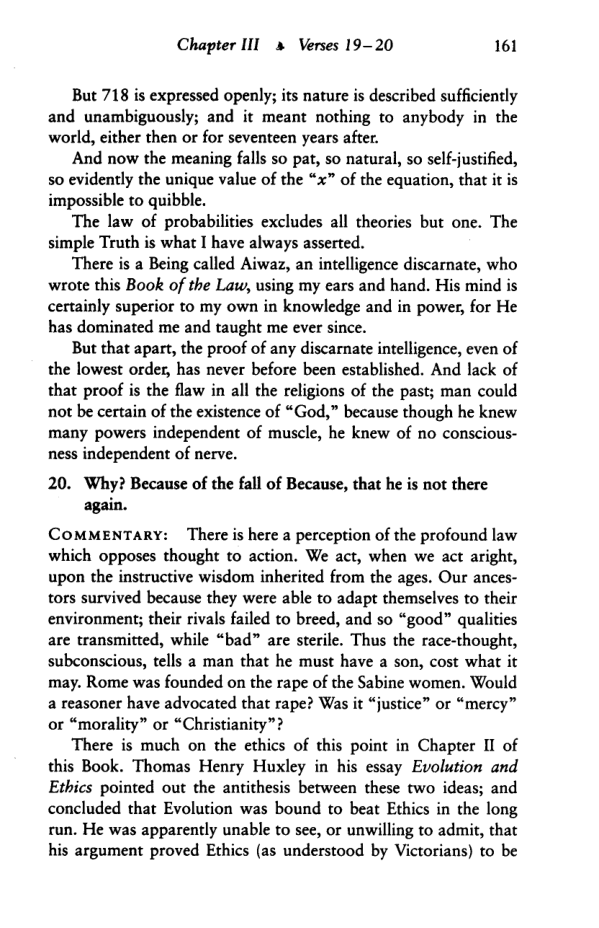
Highlights use the original PDF text layer. OCR-only matches may not be visible on the scan.
Transcription
Download text ↓raw extractionoriginal embedded textReview: unreviewed
Chapter III * Verses 19-20
161
But 718 is expressed openly; its nature is described sufficiently
and unambiguously; and it meant nothing to anybody in the
world, either then or for seventeen years after.
And now the meaning falls so pat, so natural, so self-justified,
so evidently the unique value of the “x” of the equation, that it is
impossible to quibble.
The law of probabilities excludes all theories but one. The
simple Truth is what I have always asserted.
There is a Being called Aiwaz, an intelligence discarnate, who
wrote this Book of the Law, using my ears and hand. His mind is
certainly superior to my own in knowledge and in power, for He
has dominated me and taught me ever since.
But that apart, the proof of any discarnate intelligence, even of
the lowest order, has never before been established. And lack of
that proof is the flaw in all the religions of the past; man could
not be certain of the existence of “God,” because though he knew
many powers independent of muscle, he knew of no conscious
ness independent of nerve.
20. Why? Because of the fall of Because, that he is not there
again.
Commentary: There is here a perception of the profound law
which opposes thought to action. We act, when we act aright,
upon the instructive wisdom inherited from the ages. Our ances
tors survived because they were able to adapt themselves to their
environment; their rivals failed to breed, and so “good” qualities
are transmitted, while “bad” are sterile. Thus the race-thought,
subconscious, tells a man that he must have a son, cost what it
may. Rome was founded on the rape of the Sabine women. Would
a reasoner have advocated that rape? Was it “justice” or “mercy”
or “morality” or “Christianity”?
There is much on the ethics of this point in Chapter II of
this Book. Thomas Henry Huxley in his essay Evolution and
Ethics pointed out the antithesis between these two ideas; and
concluded that Evolution was bound to beat Ethics in the long
run. He was apparently unable to see, or unwilling to admit, that
his argument proved Ethics (as understood by Victorians) to be
Page provenance & review flags
Stable page ID: 6528ce4d28e01eb80a128d9c:p00160
Line breaks are preserved. Reading order and OCR accuracy may need review.
Printed page label has not been verified.
- No automated review flags. This does not establish transcription accuracy.