1996 · CLOSE READING
The Law is for All
The Law is for All (1996), PDF p. 15
Original page
Enlarge ↗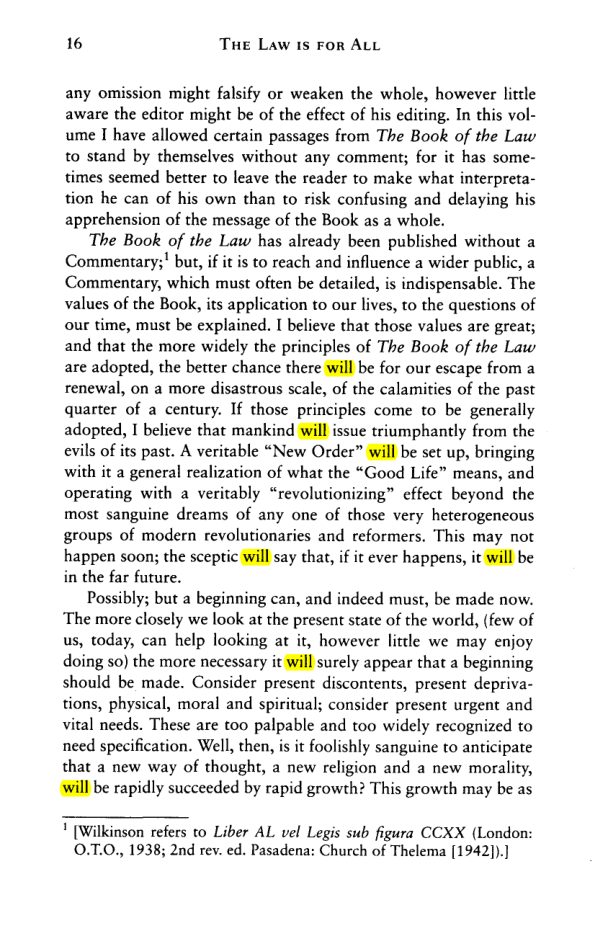
Highlights use the original PDF text layer. OCR-only matches may not be visible on the scan.
Transcription
Download text ↓raw extractionoriginal embedded textReview: unreviewed
16
The Law is for All
any omission might falsify or weaken the whole, however little
aware the editor might be of the effect of his editing. In this vol
ume I have allowed certain passages from The Book of the Law
to stand by themselves without any comment; for it has some
times seemed better to leave the reader to make what interpreta
tion he can of his own than to risk confusing and delaying his
apprehension of the message of the Book as a whole.
The Book of the Law has already been published without a
Commentary;1 but, if it is to reach and influence a wider public, a
Commentary, which must often be detailed, is indispensable. The
values of the Book, its application to our lives, to the questions of
our time, must be explained. I believe that those values are great;
and that the more widely the principles of The Book of the Law
are adopted, the better chance there will be for our escape from a
renewal, on a more disastrous scale, of the calamities of the past
quarter of a century. If those principles come to be generally
adopted, I believe that mankind will issue triumphantly from the
evils of its past. A veritable “New Order” will be set up, bringing
with it a general realization of what the “Good Life” means, and
operating with a veritably “revolutionizing” effect beyond the
most sanguine dreams of any one of those very heterogeneous
groups of modern revolutionaries and reformers. This may not
happen soon; the sceptic will say that, if it ever happens, it will be
in the far future.
1 [Wilkinson refers to Liber AL vel Legis sub figura CCXX (London:
O.T.O., 1938; 2nd rev. ed. Pasadena: Church of Thelema [1942]).]
Possibly; but a beginning can, and indeed must, be made now.
The more closely we look at the present state of the world, (few of
us, today, can help looking at it, however little we may enjoy
doing so) the more necessary it will surely appear that a beginning
should be made. Consider present discontents, present depriva
tions, physical, moral and spiritual; consider present urgent and
vital needs. These are too palpable and too widely recognized to
need specification. Well, then, is it foolishly sanguine to anticipate
that a new way of thought, a new religion and a new morality,
will be rapidly succeeded by rapid growth? This growth may be as
Page provenance & review flags
Stable page ID: 6528ce4d28e01eb80a128d9c:p00015
Line breaks are preserved. Reading order and OCR accuracy may need review.
Printed page label has not been verified.
- No automated review flags. This does not establish transcription accuracy.