1996 · CLOSE READING
The Law is for All
The Law is for All (1996), PDF p. 145
Original page
Enlarge ↗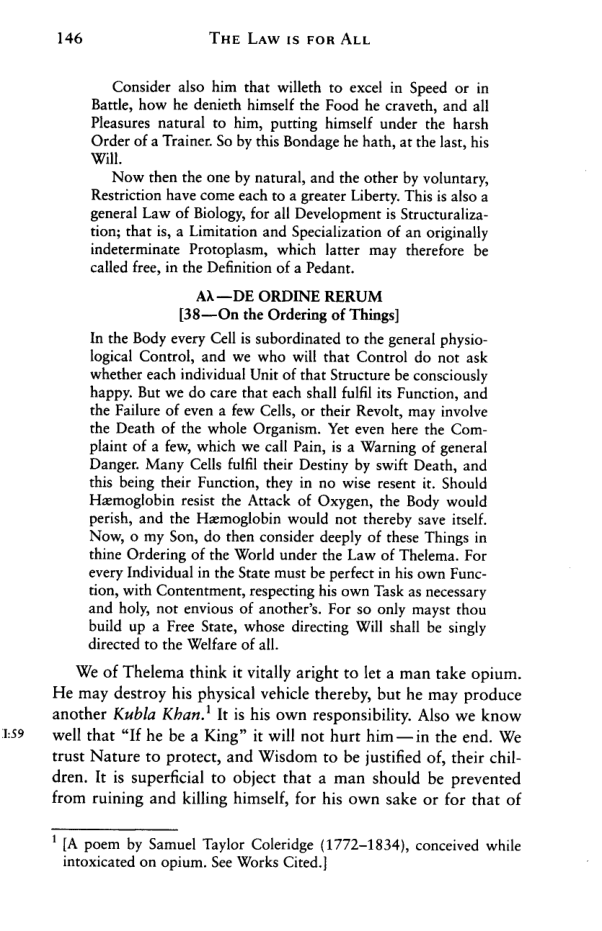
Highlights use the original PDF text layer. OCR-only matches may not be visible on the scan.
Transcription
Download text ↓raw extractionoriginal embedded textReview: unreviewed
146
The Law is for All
1:59
Consider also him that willeth to excel in Speed or in
Battle, how he denieth himself the Food he craveth, and all
Pleasures natural to him, putting himself under the harsh
Order of a Trainer. So by this Bondage he hath, at the last, his
Will.
Now then the one by natural, and the other by voluntary,
Restriction have come each to a greater Liberty. This is also a
general Law of Biology, for all Development is Structuraliza-
tion; that is, a Limitation and Specialization of an originally
indeterminate Protoplasm, which latter may therefore be
called free, in the Definition of a Pedant.
AX—DE ORDINE RERUM
[38—On the Ordering of Things]
In the Body every Cell is subordinated to the general physio
logical Control, and we who will that Control do not ask
whether each individual Unit of that Structure be consciously
happy. But we do care that each shall fulfil its Function, and
the Failure of even a few Cells, or their Revolt, may involve
the Death of the whole Organism. Yet even here the Com
plaint of a few, which we call Pain, is a Warning of general
Danger. Many Cells fulfil their Destiny by swift Death, and
this being their Function, they in no wise resent it. Should
Hsemoglobin resist the Attack of Oxygen, the Body would
perish, and the Haemoglobin would not thereby save itself.
Now, o my Son, do then consider deeply of these Things in
thine Ordering of the World under the Law of Thelema. For
every Individual in the State must be perfect in his own Func
tion, with Contentment, respecting his own Task as necessary
and holy, not envious of another’s. For so only mayst thou
build up a Free State, whose directing Will shall be singly
directed to the Welfare of all.
We of Thelema think it vitally aright to let a man take opium.
He may destroy his physical vehicle thereby, but he may produce
another Kubla Khan.1 It is his own responsibility. Also we know
well that “If he be a King” it will not hurt him — in the end. We
trust Nature to protect, and Wisdom to be justified of, their chil
dren. It is superficial to object that a man should be prevented
from ruining and killing himself, for his own sake or for that of
1 [A poem by Samuel Taylor Coleridge (1772-1834), conceived while
intoxicated on opium. See Works Cited.]
Page provenance & review flags
Stable page ID: 6528ce4d28e01eb80a128d9c:p00145
Line breaks are preserved. Reading order and OCR accuracy may need review.
Printed page label has not been verified.
- No automated review flags. This does not establish transcription accuracy.