1996 · CLOSE READING
The Law is for All
The Law is for All (1996), PDF p. 144
Original page
Enlarge ↗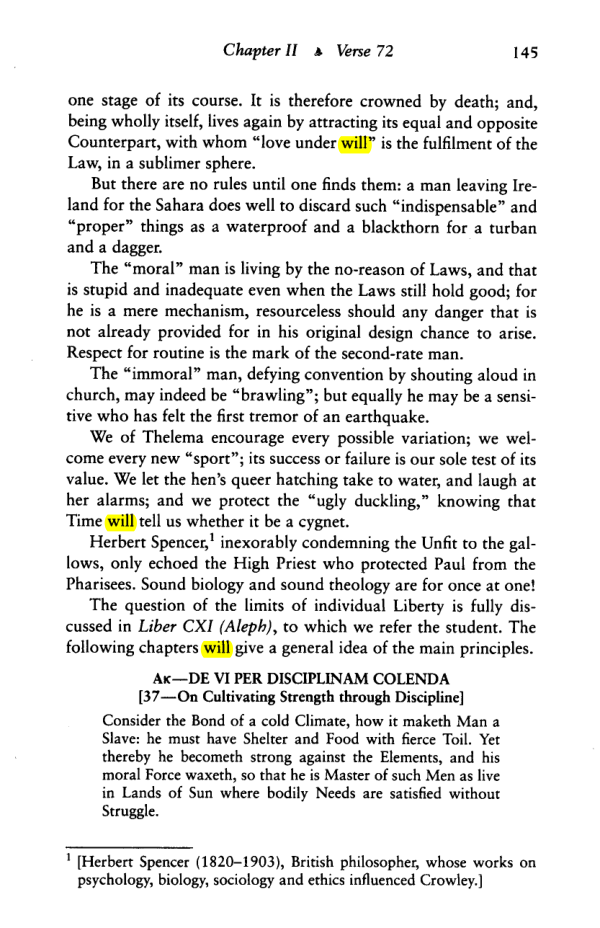
Highlights use the original PDF text layer. OCR-only matches may not be visible on the scan.
Transcription
Download text ↓raw extractionoriginal embedded textReview: unreviewed
Chapter II A Verse 72
145
one stage of its course. It is therefore crowned by death; and,
being wholly itself, lives again by attracting its equal and opposite
Counterpart, with whom “love under will” is the fulfilment of the
Law, in a sublimer sphere.
But there are no rules until one finds them: a man leaving Ire
land for the Sahara does well to discard such “indispensable” and
“proper” things as a waterproof and a blackthorn for a turban
and a dagger.
The “moral” man is living by the no-reason of Laws, and that
is stupid and inadequate even when the Laws still hold good; for
he is a mere mechanism, resourceless should any danger that is
not already provided for in his original design chance to arise.
Respect for routine is the mark of the second-rate man.
The “immoral” man, defying convention by shouting aloud in
church, may indeed be “brawling”; but equally he may be a sensi
tive who has felt the first tremor of an earthquake.
We of Thelema encourage every possible variation; we wel
come every new “sport”; its success or failure is our sole test of its
value. We let the hen’s queer hatching take to water, and laugh at
her alarms; and we protect the “ugly duckling,” knowing that
Time will tell us whether it be a cygnet.
Herbert Spencer,1 inexorably condemning the Unfit to the gal
lows, only echoed the High Priest who protected Paul from the
Pharisees. Sound biology and sound theology are for once at one!
1 [Herbert Spencer (1820-1903), British philosopher, whose works on
psychology, biology, sociology and ethics influenced Crowley.]
The question of the limits of individual Liberty is fully dis
cussed in Liber CXI (Aleph), to which we refer the student. The
following chapters will give a general idea of the main principles.
Ak—DE VI PER DISCIPLINAM COLENDA
[37—On Cultivating Strength through Discipline]
Consider the Bond of a cold Climate, how it maketh Man a
Slave: he must have Shelter and Food with fierce Toil. Yet
thereby he becometh strong against the Elements, and his
moral Force waxeth, so that he is Master of such Men as live
in Lands of Sun where bodily Needs are satisfied without
Struggle.
Page provenance & review flags
Stable page ID: 6528ce4d28e01eb80a128d9c:p00144
Line breaks are preserved. Reading order and OCR accuracy may need review.
Printed page label has not been verified.
- No automated review flags. This does not establish transcription accuracy.