1996 · CLOSE READING
The Law is for All
The Law is for All (1996), PDF p. 132
Original page
Enlarge ↗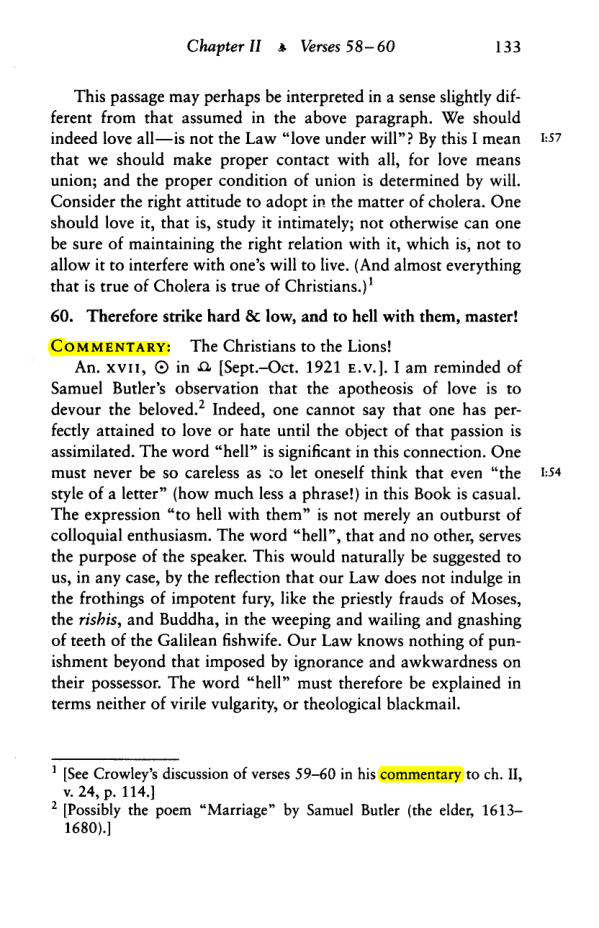
Highlights use the original PDF text layer. OCR-only matches may not be visible on the scan.
Transcription
Download text ↓raw extractionoriginal embedded textReview: unreviewed
Chapter II A Verses 58-60
133
This passage may perhaps be interpreted in a sense slightly dif
ferent from that assumed in the above paragraph. We should
indeed love all—is not the Law “love under will”? By this I mean
that we should make proper contact with all, for love means
union; and the proper condition of union is determined by will.
Consider the right attitude to adopt in the matter of cholera. One
should love it, that is, study it intimately; not otherwise can one
be sure of maintaining the right relation with it, which is, not to
allow it to interfere with one’s will to live. (And almost everything
that is true of Cholera is true of Christians.)1
1 [See Crowley’s discussion of verses 59-60 in his commentary to ch. II,
v. 24, p. 114.]
2 [Possibly the poem “Marriage” by Samuel Butler (the elder, 1613—
1680).]
60. Therefore strike hard & low, and to hell with them, master!
Commentary: The Christians to the Lions!
An. xvii, 0 in [Sept.-Oct. 1921 e.v.]. I am reminded of
Samuel Butler’s observation that the apotheosis of love is to
devour the beloved.1 2 Indeed, one cannot say that one has per
fectly attained to love or hate until the object of that passion is
assimilated. The word “hell” is significant in this connection. One
must never be so careless as to let oneself think that even “the
style of a letter” (how much less a phrase!) in this Book is casual.
The expression “to hell with them” is not merely an outburst of
colloquial enthusiasm. The word “hell”, that and no other, serves
the purpose of the speaker. This would naturally be suggested to
us, in any case, by the reflection that our Law does not indulge in
the frothings of impotent fury, like the priestly frauds of Moses,
the rishis, and Buddha, in the weeping and wailing and gnashing
of teeth of the Galilean fishwife. Our Law knows nothing of pun
ishment beyond that imposed by ignorance and awkwardness on
their possessor. The word “hell” must therefore be explained in
terms neither of virile vulgarity, or theological blackmail.
1:57
1:54
Page provenance & review flags
Stable page ID: 6528ce4d28e01eb80a128d9c:p00132
Line breaks are preserved. Reading order and OCR accuracy may need review.
Printed page label has not been verified.
- No automated review flags. This does not establish transcription accuracy.