1996 · CLOSE READING
The Law is for All
The Law is for All (1996), PDF p. 12
Original page
Enlarge ↗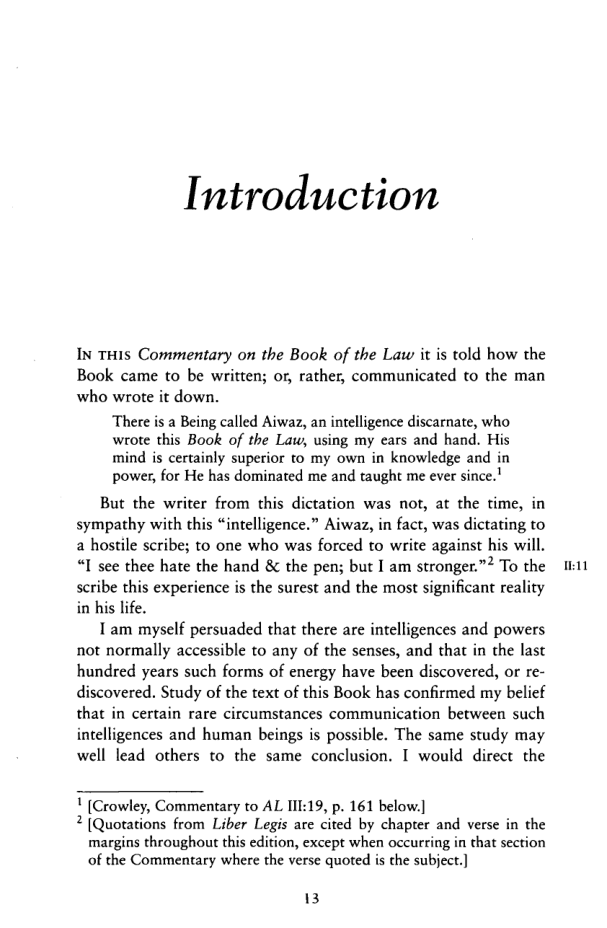
Highlights use the original PDF text layer. OCR-only matches may not be visible on the scan.
Transcription
Download text ↓raw extractionoriginal embedded textReview: unreviewed
Introduction
In this Commentary on the Book of the Law it is told how the
Book came to be written; or, rather, communicated to the man
who wrote it down.
There is a Being called Aiwaz, an intelligence discarnate, who
wrote this Book of the Law, using my ears and hand. His
mind is certainly superior to my own in knowledge and in
power, for He has dominated me and taught me ever since.1
1 [Crowley, Commentary to AL 111:19, p. 161 below.]
2 [Quotations from Liber Legis are cited by chapter and verse in the
margins throughout this edition, except when occurring in that section
of the Commentary where the verse quoted is the subject.]
But the writer from this dictation was not, at the time, in
sympathy with this “intelligence.” Aiwaz, in fact, was dictating to
a hostile scribe; to one who was forced to write against his will.
“I see thee hate the hand & the pen; but I am stronger.”1 2 To the
scribe this experience is the surest and the most significant reality
in his life.
I am myself persuaded that there are intelligences and powers
not normally accessible to any of the senses, and that in the last
hundred years such forms of energy have been discovered, or re
discovered. Study of the text of this Book has confirmed my belief
that in certain rare circumstances communication between such
intelligences and human beings is possible. The same study may
well lead others to the same conclusion. I would direct the
11:11
13
Page provenance & review flags
Stable page ID: 6528ce4d28e01eb80a128d9c:p00012
Line breaks are preserved. Reading order and OCR accuracy may need review.
Printed page label has not been verified.
- No automated review flags. This does not establish transcription accuracy.