1996 · CLOSE READING
The Law is for All
The Law is for All (1996), PDF p. 124
Original page
Enlarge ↗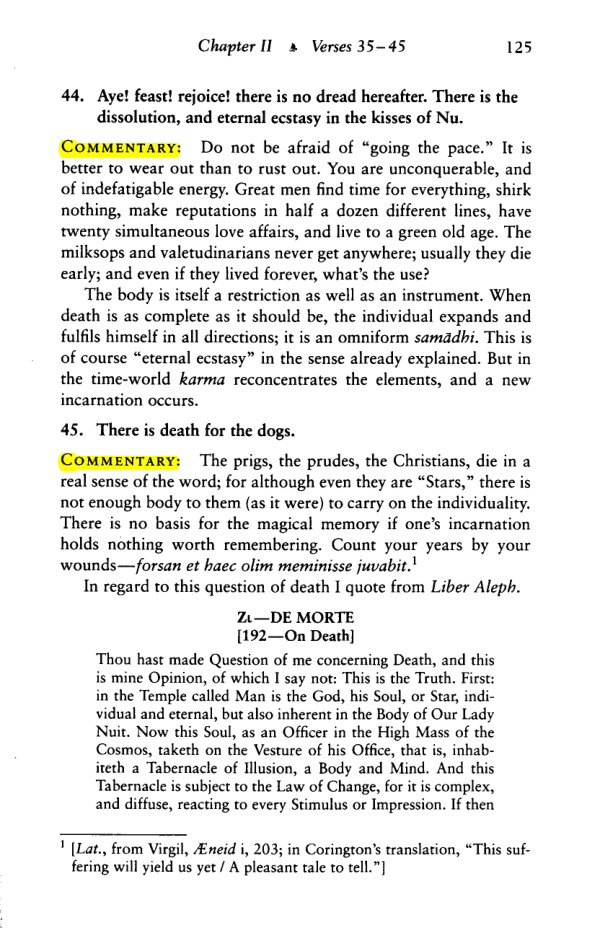
Highlights use the original PDF text layer. OCR-only matches may not be visible on the scan.
Transcription
Download text ↓raw extractionoriginal embedded textReview: unreviewed
Chapter II A Verses 35-45
125
44. Aye! feast! rejoice! there is no dread hereafter. There is the
dissolution, and eternal ecstasy in the kisses of Nu.
Commentary: Do not be afraid of “going the pace.” It is
better to wear out than to rust out. You are unconquerable, and
of indefatigable energy. Great men find time for everything, shirk
nothing, make reputations in half a dozen different lines, have
twenty simultaneous love affairs, and live to a green old age. The
milksops and valetudinarians never get anywhere; usually they die
early; and even if they lived forever, what’s the use?
The body is itself a restriction as well as an instrument. When
death is as complete as it should be, the individual expands and
fulfils himself in all directions; it is an omniform samadhi. This is
of course “eternal ecstasy” in the sense already explained. But in
the time-world karma reconcentrates the elements, and a new
incarnation occurs.
45. There is death for the dogs.
Commentary: The prigs, the prudes, the Christians, die in a
real sense of the word; for although even they are “Stars,” there is
not enough body to them (as it were) to carry on the individuality.
There is no basis for the magical memory if one’s incarnation
holds nothing worth remembering. Count your years by your
wounds—forsan et haec olim meminisse juvabit)
In regard to this question of death I quote from Liber Aleph.
Zi—DE MORTE
[192—On Death]
Thou hast made Question of me concerning Death, and this
is mine Opinion, of which I say not: This is the Truth. First:
in the Temple called Man is the God, his Soul, or Star, indi
vidual and eternal, but also inherent in the Body of Our Lady
Nuit. Now this Soul, as an Officer in the High Mass of the
Cosmos, taketh on the Vesture of his Office, that is, inhab-
iteth a Tabernacle of Illusion, a Body and Mind. And this
Tabernacle is subject to the Law of Change, for it is complex,
and diffuse, reacting to every Stimulus or Impression. If then
1 [Lat., from Virgil, /Eneid i, 203; in Corington’s translation, “This suf
fering will yield us yet / A pleasant tale to tell.”]
Page provenance & review flags
Stable page ID: 6528ce4d28e01eb80a128d9c:p00124
Line breaks are preserved. Reading order and OCR accuracy may need review.
Printed page label has not been verified.
- No automated review flags. This does not establish transcription accuracy.