1996 · CLOSE READING
The Law is for All
The Law is for All (1996), PDF p. 110
Original page
Enlarge ↗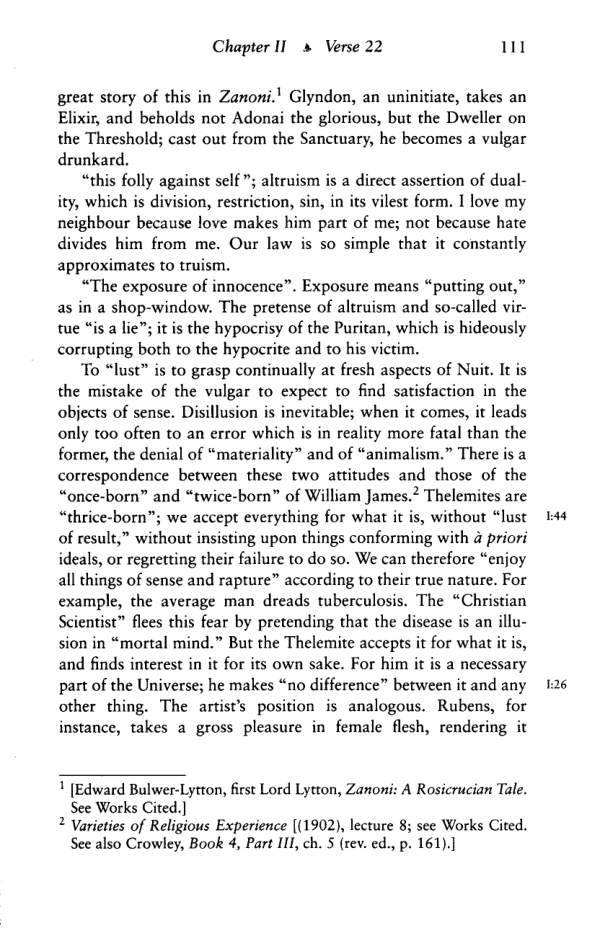
Highlights use the original PDF text layer. OCR-only matches may not be visible on the scan.
Transcription
Download text ↓raw extractionoriginal embedded textReview: unreviewed
Chapter II a Verse 22
111
great story of this in Zanoni.1 Glyndon, an uninitiate, takes an
Elixir, and beholds not Adonai the glorious, but the Dweller on
the Threshold; cast out from the Sanctuary, he becomes a vulgar
drunkard.
1 [Edward Bulwer-Lytton, first Lord Lytton, Zanoni: A Rosicrucian Tale.
See Works Cited.]
2 Varieties of Religious Experience [(1902), lecture 8; see Works Cited.
See also Crowley, Book 4, Part III, ch. 5 (rev. ed., p. 161).]
“this folly against self”; altruism is a direct assertion of dual
ity, which is division, restriction, sin, in its vilest form. I love my
neighbour because love makes him part of me; not because hate
divides him from me. Our law is so simple that it constantly
approximates to truism.
“The exposure of innocence”. Exposure means “putting out,”
as in a shop-window. The pretense of altruism and so-called vir
tue “is a lie”; it is the hypocrisy of the Puritan, which is hideously
corrupting both to the hypocrite and to his victim.
To “lust” is to grasp continually at fresh aspects of Nuit. It is
the mistake of the vulgar to expect to find satisfaction in the
objects of sense. Disillusion is inevitable; when it comes, it leads
only too often to an error which is in reality more fatal than the
former, the denial of “materiality” and of “animalism.” There is a
correspondence between these two attitudes and those of the
“once-born” and “twice-born” of William James.1 2 Thelemites are
“thrice-born”; we accept everything for what it is, without “lust
of result,” without insisting upon things conforming with a priori
ideals, or regretting their failure to do so. We can therefore “enjoy
all things of sense and rapture” according to their true nature. For
example, the average man dreads tuberculosis. The “Christian
Scientist” flees this fear by pretending that the disease is an illu
sion in “mortal mind.” But the Thelemite accepts it for what it is,
and finds interest in it for its own sake. For him it is a necessary
part of the Universe; he makes “no difference” between it and any
other thing. The artist’s position is analogous. Rubens, for
instance, takes a gross pleasure in female flesh, rendering it
1:44
1:26
Page provenance & review flags
Stable page ID: 6528ce4d28e01eb80a128d9c:p00110
Line breaks are preserved. Reading order and OCR accuracy may need review.
Printed page label has not been verified.
- No automated review flags. This does not establish transcription accuracy.