1996 · CLOSE READING
The Law is for All
The Law is for All (1996), PDF p. 108
Original page
Enlarge ↗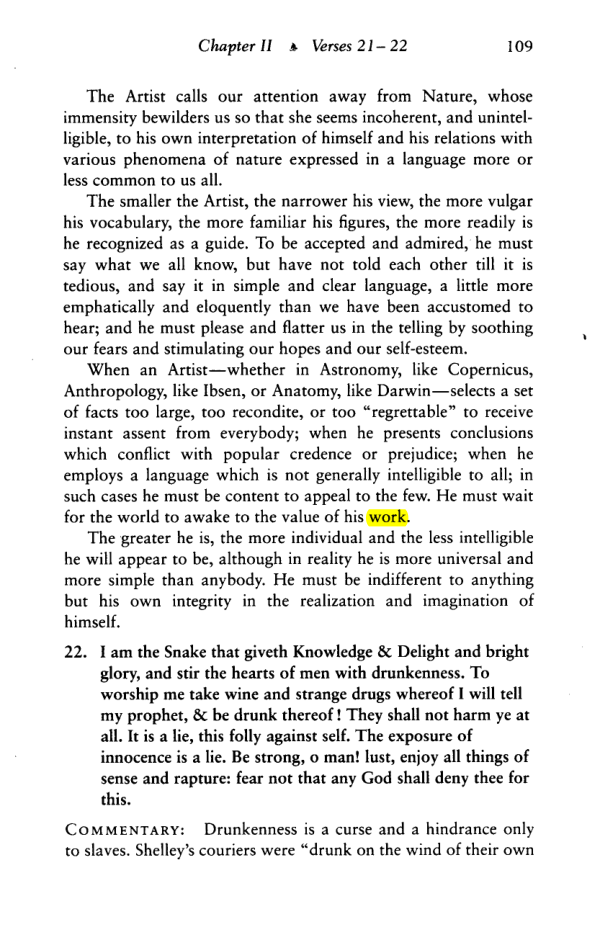
Highlights use the original PDF text layer. OCR-only matches may not be visible on the scan.
Transcription
Download text ↓raw extractionoriginal embedded textReview: unreviewed
Chapter II A Verses 21-22
109
The Artist calls our attention away from Nature, whose
immensity bewilders us so that she seems incoherent, and unintel
ligible, to his own interpretation of himself and his relations with
various phenomena of nature expressed in a language more or
less common to us all.
The smaller the Artist, the narrower his view, the more vulgar
his vocabulary, the more familiar his figures, the more readily is
he recognized as a guide. To be accepted and admired, he must
say what we all know, but have not told each other till it is
tedious, and say it in simple and clear language, a little more
emphatically and eloquently than we have been accustomed to
hear; and he must please and flatter us in the telling by soothing
our fears and stimulating our hopes and our self-esteem.
When an Artist—whether in Astronomy, like Copernicus,
Anthropology, like Ibsen, or Anatomy, like Darwin—selects a set
of facts too large, too recondite, or too “regrettable” to receive
instant assent from everybody; when he presents conclusions
which conflict with popular credence or prejudice; when he
employs a language which is not generally intelligible to all; in
such cases he must be content to appeal to the few. He must wait
for the world to awake to the value of his work.
The greater he is, the more individual and the less intelligible
he will appear to be, although in reality he is more universal and
more simple than anybody. He must be indifferent to anything
but his own integrity in the realization and imagination of
himself.
22. I am the Snake that giveth Knowledge & Delight and bright
glory, and stir the hearts of men with drunkenness. To
worship me take wine and strange drugs whereof I will tell
my prophet, & be drunk thereof! They shall not harm ye at
all. It is a lie, this folly against self. The exposure of
innocence is a lie. Be strong, o man! lust, enjoy all things of
sense and rapture: fear not that any God shall deny thee for
this.
Commentary: Drunkenness is a curse and a hindrance only
to slaves. Shelley’s couriers were “drunk on the wind of their own
Page provenance & review flags
Stable page ID: 6528ce4d28e01eb80a128d9c:p00108
Line breaks are preserved. Reading order and OCR accuracy may need review.
Printed page label has not been verified.
- No automated review flags. This does not establish transcription accuracy.