1996 · CLOSE READING
The Law is for All
The Law is for All (1996), PDF p. 107
Original page
Enlarge ↗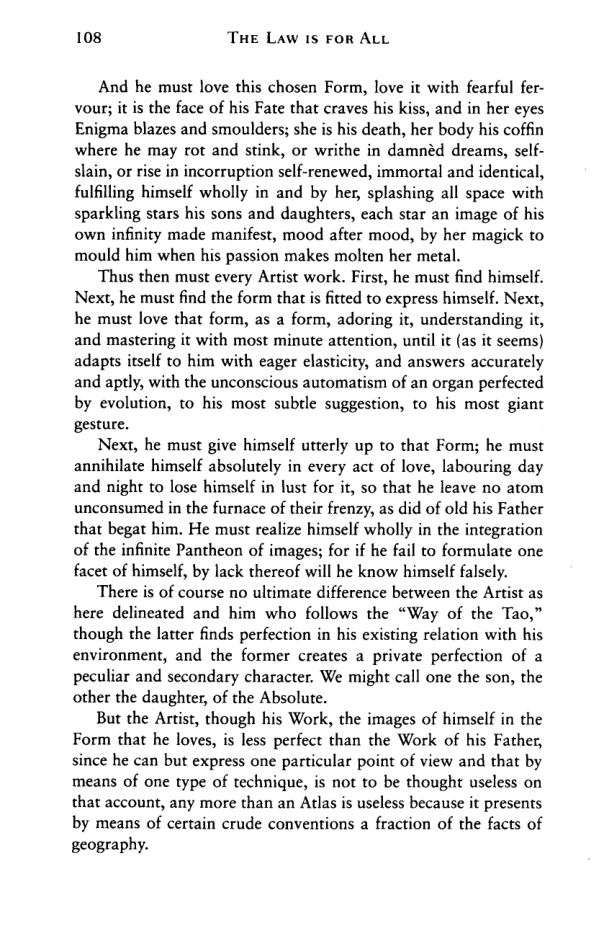
Highlights use the original PDF text layer. OCR-only matches may not be visible on the scan.
Transcription
Download text ↓raw extractionoriginal embedded textReview: unreviewed
108
The Law is for All
And he must love this chosen Form, love it with fearful fer
vour; it is the face of his Fate that craves his kiss, and in her eyes
Enigma blazes and smoulders; she is his death, her body his coffin
where he may rot and stink, or writhe in damned dreams, self
slain, or rise in incorruption self-renewed, immortal and identical,
fulfilling himself wholly in and by her, splashing all space with
sparkling stars his sons and daughters, each star an image of his
own infinity made manifest, mood after mood, by her magick to
mould him when his passion makes molten her metal.
Thus then must every Artist work. First, he must find himself.
Next, he must find the form that is fitted to express himself. Next,
he must love that form, as a form, adoring it, understanding it,
and mastering it with most minute attention, until it (as it seems)
adapts itself to him with eager elasticity, and answers accurately
and aptly, with the unconscious automatism of an organ perfected
by evolution, to his most subtle suggestion, to his most giant
gesture.
Next, he must give himself utterly up to that Form; he must
annihilate himself absolutely in every act of love, labouring day
and night to lose himself in lust for it, so that he leave no atom
unconsumed in the furnace of their frenzy, as did of old his Father
that begat him. He must realize himself wholly in the integration
of the infinite Pantheon of images; for if he fail to formulate one
facet of himself, by lack thereof will he know himself falsely.
There is of course no ultimate difference between the Artist as
here delineated and him who follows the “Way of the Tao,”
though the latter finds perfection in his existing relation with his
environment, and the former creates a private perfection of a
peculiar and secondary character. We might call one the son, the
other the daughter, of the Absolute.
But the Artist, though his Work, the images of himself in the
Form that he loves, is less perfect than the Work of his Father,
since he can but express one particular point of view and that by
means of one type of technique, is not to be thought useless on
that account, any more than an Atlas is useless because it presents
by means of certain crude conventions a fraction of the facts of
geography.
Page provenance & review flags
Stable page ID: 6528ce4d28e01eb80a128d9c:p00107
Line breaks are preserved. Reading order and OCR accuracy may need review.
Printed page label has not been verified.
- No automated review flags. This does not establish transcription accuracy.