1996 · CLOSE READING
The Law is for All
The Law is for All (1996), PDF p. 104
Original page
Enlarge ↗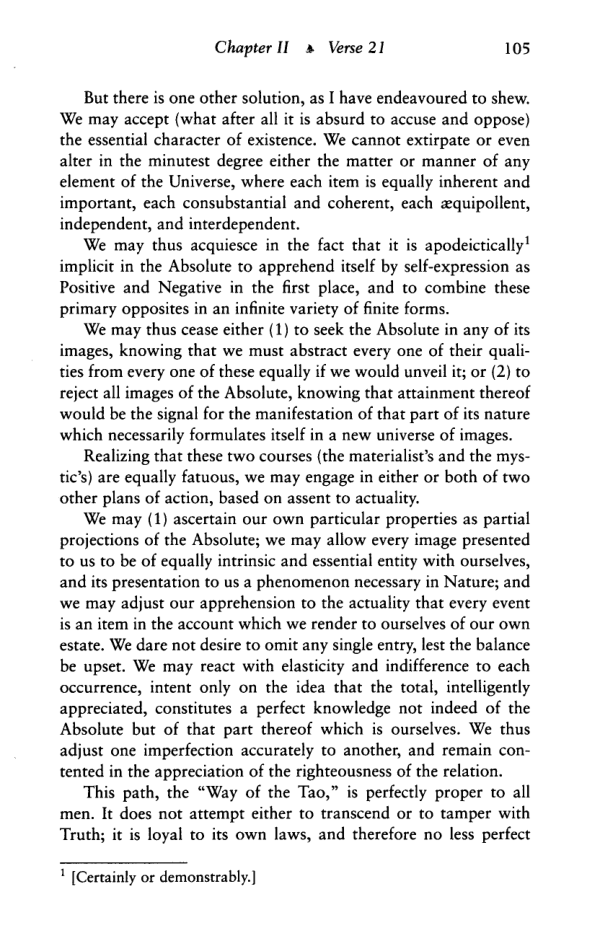
Highlights use the original PDF text layer. OCR-only matches may not be visible on the scan.
Transcription
Download text ↓raw extractionoriginal embedded textReview: unreviewed
Chapter II * Verse 21
105
But there is one other solution, as I have endeavoured to shew.
We may accept (what after all it is absurd to accuse and oppose)
the essential character of existence. We cannot extirpate or even
alter in the minutest degree either the matter or manner of any
element of the Universe, where each item is equally inherent and
important, each consubstantial and coherent, each aequipollent,
independent, and interdependent.
We may thus acquiesce in the fact that it is apodeictically1
implicit in the Absolute to apprehend itself by self-expression as
Positive and Negative in the first place, and to combine these
primary opposites in an infinite variety of finite forms.
1 [Certainly or demonstrably.]
We may thus cease either (1) to seek the Absolute in any of its
images, knowing that we must abstract every one of their quali
ties from every one of these equally if we would unveil it; or (2) to
reject all images of the Absolute, knowing that attainment thereof
would be the signal for the manifestation of that part of its nature
which necessarily formulates itself in a new universe of images.
Realizing that these two courses (the materialist’s and the mys
tic’s) are equally fatuous, we may engage in either or both of two
other plans of action, based on assent to actuality.
We may (1) ascertain our own particular properties as partial
projections of the Absolute; we may allow every image presented
to us to be of equally intrinsic and essential entity with ourselves,
and its presentation to us a phenomenon necessary in Nature; and
we may adjust our apprehension to the actuality that every event
is an item in the account which we render to ourselves of our own
estate. We dare not desire to omit any single entry, lest the balance
be upset. We may react with elasticity and indifference to each
occurrence, intent only on the idea that the total, intelligently
appreciated, constitutes a perfect knowledge not indeed of the
Absolute but of that part thereof which is ourselves. We thus
adjust one imperfection accurately to another, and remain con
tented in the appreciation of the righteousness of the relation.
This path, the “Way of the Tao,” is perfectly proper to all
men. It does not attempt either to transcend or to tamper with
Truth; it is loyal to its own laws, and therefore no less perfect
Page provenance & review flags
Stable page ID: 6528ce4d28e01eb80a128d9c:p00104
Line breaks are preserved. Reading order and OCR accuracy may need review.
Printed page label has not been verified.
- No automated review flags. This does not establish transcription accuracy.