1929 · CLOSE READING
Confessions of Aleister Crowley
Confessions of Aleister Crowley (1929), PDF p. 92
Original page
Enlarge ↗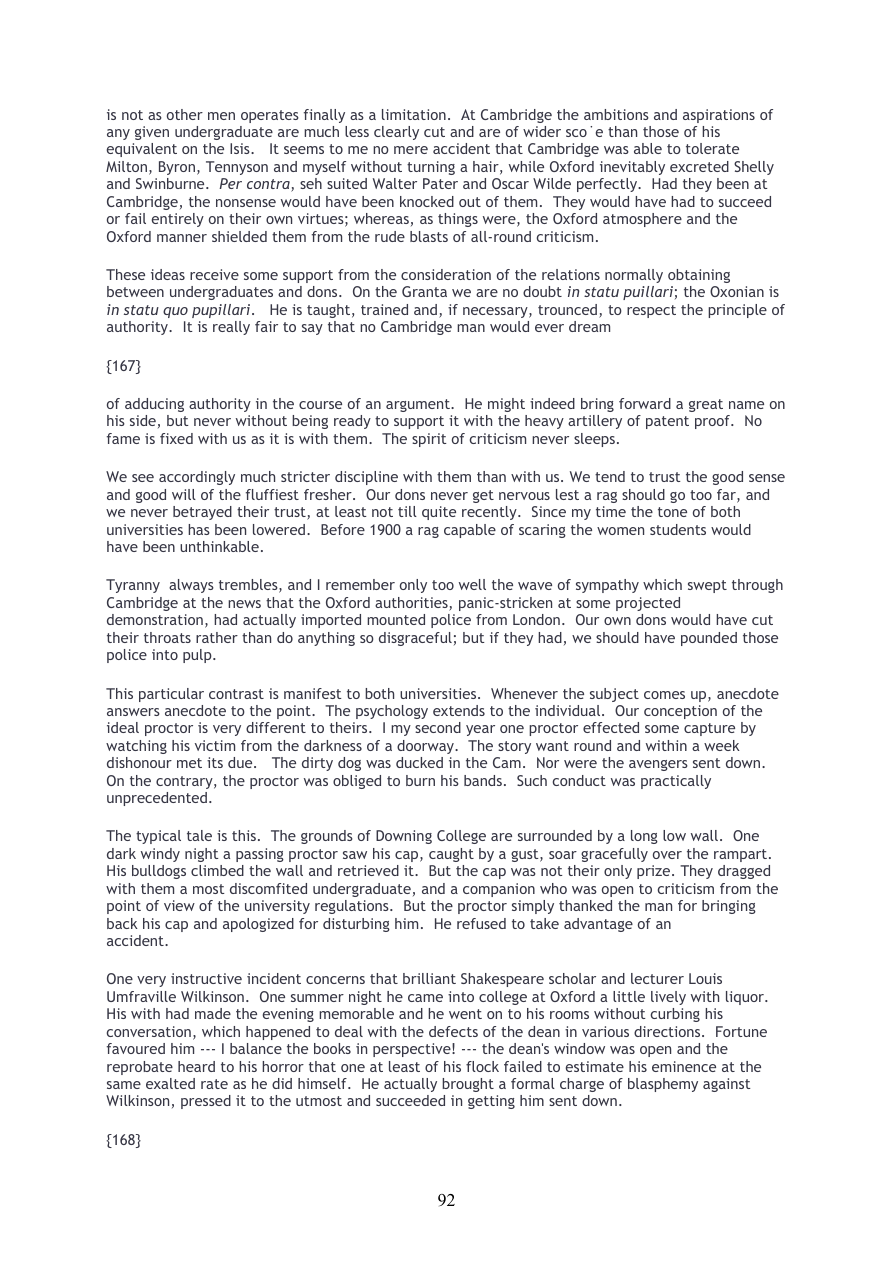
Highlights use the original PDF text layer. OCR-only matches may not be visible on the scan.
Transcription
Download text ↓raw extractionoriginal embedded textReview: unreviewed
92
is not as other men operates finally as a limitation. At Cambridge the ambitions and aspirations of
any given undergraduate are much less clearly cut and are of wider scoúe than those of his
equivalent on the Isis. It seems to me no mere accident that Cambridge was able to tolerate
Milton, Byron, Tennyson and myself without turning a hair, while Oxford inevitably excreted Shelly
and Swinburne. Per contra, seh suited Walter Pater and Oscar Wilde perfectly. Had they been at
Cambridge, the nonsense would have been knocked out of them. They would have had to succeed
or fail entirely on their own virtues; whereas, as things were, the Oxford atmosphere and the
Oxford manner shielded them from the rude blasts of all-round criticism.
These ideas receive some support from the consideration of the relations normally obtaining
between undergraduates and dons. On the Granta we are no doubt in statu puillari; the Oxonian is
in statu quo pupillari. He is taught, trained and, if necessary, trounced, to respect the principle of
authority. It is really fair to say that no Cambridge man would ever dream
{167}
of adducing authority in the course of an argument. He might indeed bring forward a great name on
his side, but never without being ready to support it with the heavy artillery of patent proof. No
fame is fixed with us as it is with them. The spirit of criticism never sleeps.
We see accordingly much stricter discipline with them than with us. We tend to trust the good sense
and good will of the fluffiest fresher. Our dons never get nervous lest a rag should go too far, and
we never betrayed their trust, at least not till quite recently. Since my time the tone of both
universities has been lowered. Before 1900 a rag capable of scaring the women students would
have been unthinkable.
Tyranny always trembles, and I remember only too well the wave of sympathy which swept through
Cambridge at the news that the Oxford authorities, panic-stricken at some projected
demonstration, had actually imported mounted police from London. Our own dons would have cut
their throats rather than do anything so disgraceful; but if they had, we should have pounded those
police into pulp.
This particular contrast is manifest to both universities. Whenever the subject comes up, anecdote
answers anecdote to the point. The psychology extends to the individual. Our conception of the
ideal proctor is very different to theirs. I my second year one proctor effected some capture by
watching his victim from the darkness of a doorway. The story want round and within a week
dishonour met its due. The dirty dog was ducked in the Cam. Nor were the avengers sent down.
On the contrary, the proctor was obliged to burn his bands. Such conduct was practically
unprecedented.
The typical tale is this. The grounds of Downing College are surrounded by a long low wall. One
dark windy night a passing proctor saw his cap, caught by a gust, soar gracefully over the rampart.
His bulldogs climbed the wall and retrieved it. But the cap was not their only prize. They dragged
with them a most discomfited undergraduate, and a companion who was open to criticism from the
point of view of the university regulations. But the proctor simply thanked the man for bringing
back his cap and apologized for disturbing him. He refused to take advantage of an
accident.
One very instructive incident concerns that brilliant Shakespeare scholar and lecturer Louis
Umfraville Wilkinson. One summer night he came into college at Oxford a little lively with liquor.
His with had made the evening memorable and he went on to his rooms without curbing his
conversation, which happened to deal with the defects of the dean in various directions. Fortune
favoured him --- I balance the books in perspective! --- the dean's window was open and the
reprobate heard to his horror that one at least of his flock failed to estimate his eminence at the
same exalted rate as he did himself. He actually brought a formal charge of blasphemy against
Wilkinson, pressed it to the utmost and succeeded in getting him sent down.
{168}
Page provenance & review flags
Stable page ID: 5ef44b98d8f9c4af5f6f86e1:p00092
Line breaks are preserved. Reading order and OCR accuracy may need review.
Printed page label has not been verified.
- No automated review flags. This does not establish transcription accuracy.