1929 · CLOSE READING
Confessions of Aleister Crowley
Confessions of Aleister Crowley (1929), PDF p. 85
Original page
Enlarge ↗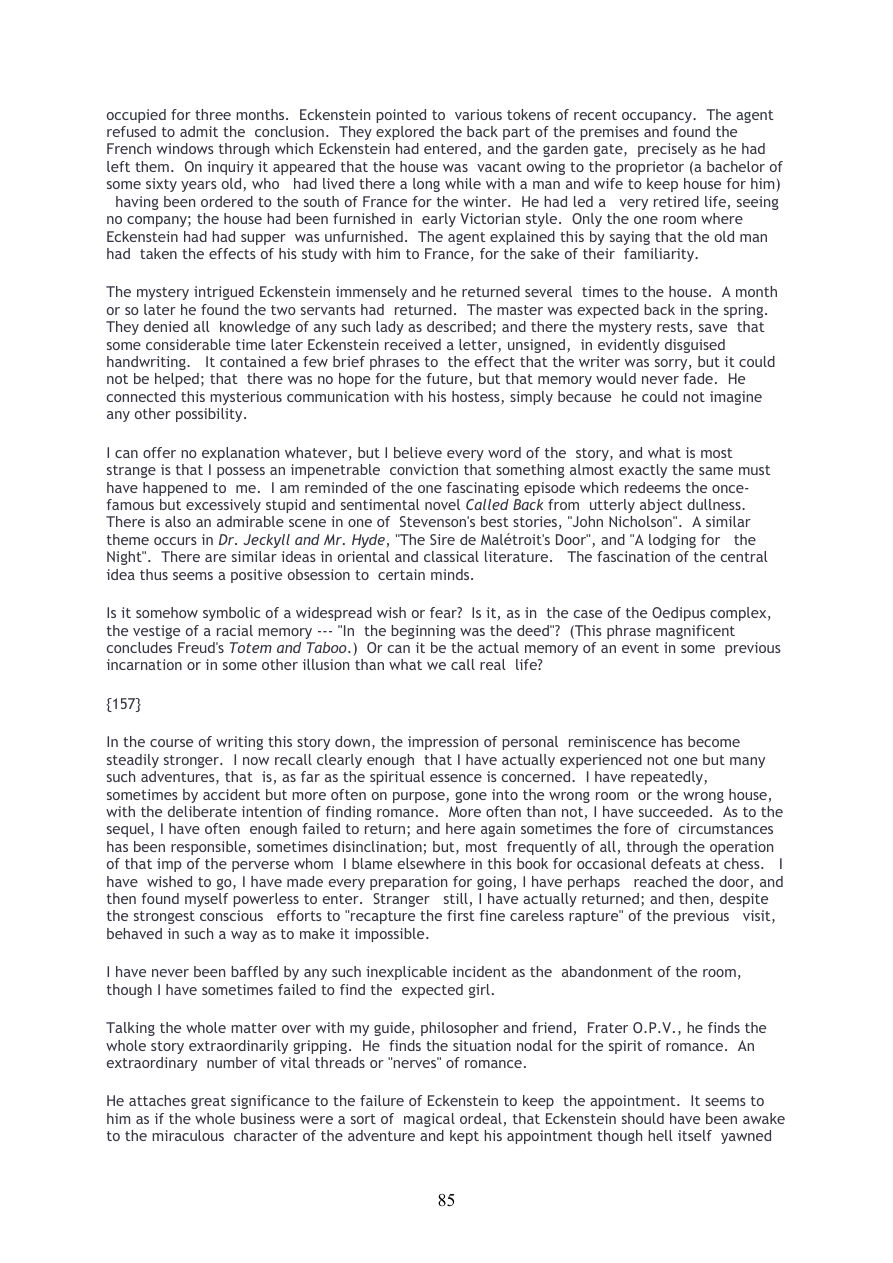
Highlights use the original PDF text layer. OCR-only matches may not be visible on the scan.
Transcription
Download text ↓raw extractionoriginal embedded textReview: unreviewed
85
occupied for three months. Eckenstein pointed to various tokens of recent occupancy. The agent
refused to admit the conclusion. They explored the back part of the premises and found the
French windows through which Eckenstein had entered, and the garden gate, precisely as he had
left them. On inquiry it appeared that the house was vacant owing to the proprietor (a bachelor of
some sixty years old, who had lived there a long while with a man and wife to keep house for him)
having been ordered to the south of France for the winter. He had led a very retired life, seeing
no company; the house had been furnished in early Victorian style. Only the one room where
Eckenstein had had supper was unfurnished. The agent explained this by saying that the old man
had taken the effects of his study with him to France, for the sake of their familiarity.
The mystery intrigued Eckenstein immensely and he returned several times to the house. A month
or so later he found the two servants had returned. The master was expected back in the spring.
They denied all knowledge of any such lady as described; and there the mystery rests, save that
some considerable time later Eckenstein received a letter, unsigned, in evidently disguised
handwriting. It contained a few brief phrases to the effect that the writer was sorry, but it could
not be helped; that there was no hope for the future, but that memory would never fade. He
connected this mysterious communication with his hostess, simply because he could not imagine
any other possibility.
I can offer no explanation whatever, but I believe every word of the story, and what is most
strange is that I possess an impenetrable conviction that something almost exactly the same must
have happened to me. I am reminded of the one fascinating episode which redeems the once-
famous but excessively stupid and sentimental novel Called Back from utterly abject dullness.
There is also an admirable scene in one of Stevenson's best stories, "John Nicholson". A similar
theme occurs in Dr. Jeckyll and Mr. Hyde, "The Sire de Malétroit's Door", and "A lodging for the
Night". There are similar ideas in oriental and classical literature. The fascination of the central
idea thus seems a positive obsession to certain minds.
Is it somehow symbolic of a widespread wish or fear? Is it, as in the case of the Oedipus complex,
the vestige of a racial memory --- "In the beginning was the deed"? (This phrase magnificent
concludes Freud's Totem and Taboo.) Or can it be the actual memory of an event in some previous
incarnation or in some other illusion than what we call real life?
{157}
In the course of writing this story down, the impression of personal reminiscence has become
steadily stronger. I now recall clearly enough that I have actually experienced not one but many
such adventures, that is, as far as the spiritual essence is concerned. I have repeatedly,
sometimes by accident but more often on purpose, gone into the wrong room or the wrong house,
with the deliberate intention of finding romance. More often than not, I have succeeded. As to the
sequel, I have often enough failed to return; and here again sometimes the fore of circumstances
has been responsible, sometimes disinclination; but, most frequently of all, through the operation
of that imp of the perverse whom I blame elsewhere in this book for occasional defeats at chess. I
have wished to go, I have made every preparation for going, I have perhaps reached the door, and
then found myself powerless to enter. Stranger still, I have actually returned; and then, despite
the strongest conscious efforts to "recapture the first fine careless rapture" of the previous visit,
behaved in such a way as to make it impossible.
I have never been baffled by any such inexplicable incident as the abandonment of the room,
though I have sometimes failed to find the expected girl.
Talking the whole matter over with my guide, philosopher and friend, Frater O.P.V., he finds the
whole story extraordinarily gripping. He finds the situation nodal for the spirit of romance. An
extraordinary number of vital threads or "nerves" of romance.
He attaches great significance to the failure of Eckenstein to keep the appointment. It seems to
him as if the whole business were a sort of magical ordeal, that Eckenstein should have been awake
to the miraculous character of the adventure and kept his appointment though hell itself yawned
Page provenance & review flags
Stable page ID: 5ef44b98d8f9c4af5f6f86e1:p00085
Line breaks are preserved. Reading order and OCR accuracy may need review.
Printed page label has not been verified.
- No automated review flags. This does not establish transcription accuracy.