1929 · CLOSE READING
Confessions of Aleister Crowley
Confessions of Aleister Crowley (1929), PDF p. 80
Original page
Enlarge ↗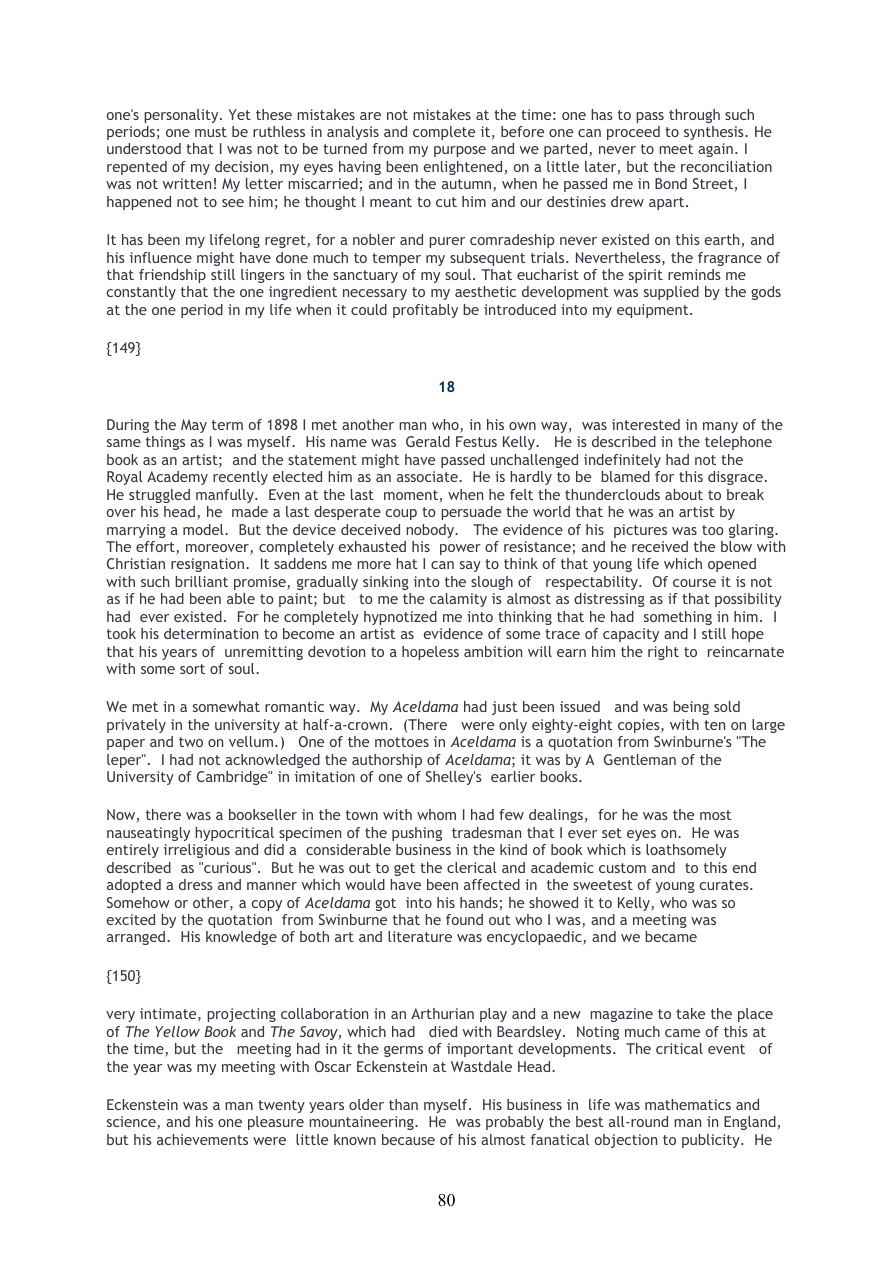
Highlights use the original PDF text layer. OCR-only matches may not be visible on the scan.
Transcription
Download text ↓raw extractionoriginal embedded textReview: unreviewed
80
one's personality. Yet these mistakes are not mistakes at the time: one has to pass through such
periods; one must be ruthless in analysis and complete it, before one can proceed to synthesis. He
understood that I was not to be turned from my purpose and we parted, never to meet again. I
repented of my decision, my eyes having been enlightened, on a little later, but the reconciliation
was not written! My letter miscarried; and in the autumn, when he passed me in Bond Street, I
happened not to see him; he thought I meant to cut him and our destinies drew apart.
It has been my lifelong regret, for a nobler and purer comradeship never existed on this earth, and
his influence might have done much to temper my subsequent trials. Nevertheless, the fragrance of
that friendship still lingers in the sanctuary of my soul. That eucharist of the spirit reminds me
constantly that the one ingredient necessary to my aesthetic development was supplied by the gods
at the one period in my life when it could profitably be introduced into my equipment.
{149}
18
During the May term of 1898 I met another man who, in his own way, was interested in many of the
same things as I was myself. His name was Gerald Festus Kelly. He is described in the telephone
book as an artist; and the statement might have passed unchallenged indefinitely had not the
Royal Academy recently elected him as an associate. He is hardly to be blamed for this disgrace.
He struggled manfully. Even at the last moment, when he felt the thunderclouds about to break
over his head, he made a last desperate coup to persuade the world that he was an artist by
marrying a model. But the device deceived nobody. The evidence of his pictures was too glaring.
The effort, moreover, completely exhausted his power of resistance; and he received the blow with
Christian resignation. It saddens me more hat I can say to think of that young life which opened
with such brilliant promise, gradually sinking into the slough of respectability. Of course it is not
as if he had been able to paint; but to me the calamity is almost as distressing as if that possibility
had ever existed. For he completely hypnotized me into thinking that he had something in him. I
took his determination to become an artist as evidence of some trace of capacity and I still hope
that his years of unremitting devotion to a hopeless ambition will earn him the right to reincarnate
with some sort of soul.
We met in a somewhat romantic way. My Aceldama had just been issued and was being sold
privately in the university at half-a-crown. (There were only eighty-eight copies, with ten on large
paper and two on vellum.) One of the mottoes in Aceldama is a quotation from Swinburne's "The
leper". I had not acknowledged the authorship of Aceldama; it was by A Gentleman of the
University of Cambridge" in imitation of one of Shelley's earlier books.
Now, there was a bookseller in the town with whom I had few dealings, for he was the most
nauseatingly hypocritical specimen of the pushing tradesman that I ever set eyes on. He was
entirely irreligious and did a considerable business in the kind of book which is loathsomely
described as "curious". But he was out to get the clerical and academic custom and to this end
adopted a dress and manner which would have been affected in the sweetest of young curates.
Somehow or other, a copy of Aceldama got into his hands; he showed it to Kelly, who was so
excited by the quotation from Swinburne that he found out who I was, and a meeting was
arranged. His knowledge of both art and literature was encyclopaedic, and we became
{150}
very intimate, projecting collaboration in an Arthurian play and a new magazine to take the place
of The Yellow Book and The Savoy, which had died with Beardsley. Noting much came of this at
the time, but the meeting had in it the germs of important developments. The critical event of
the year was my meeting with Oscar Eckenstein at Wastdale Head.
Eckenstein was a man twenty years older than myself. His business in life was mathematics and
science, and his one pleasure mountaineering. He was probably the best all-round man in England,
but his achievements were little known because of his almost fanatical objection to publicity. He
Page provenance & review flags
Stable page ID: 5ef44b98d8f9c4af5f6f86e1:p00080
Line breaks are preserved. Reading order and OCR accuracy may need review.
Printed page label has not been verified.
- No automated review flags. This does not establish transcription accuracy.