1929 · CLOSE READING
Confessions of Aleister Crowley
Confessions of Aleister Crowley (1929), PDF p. 75
Original page
Enlarge ↗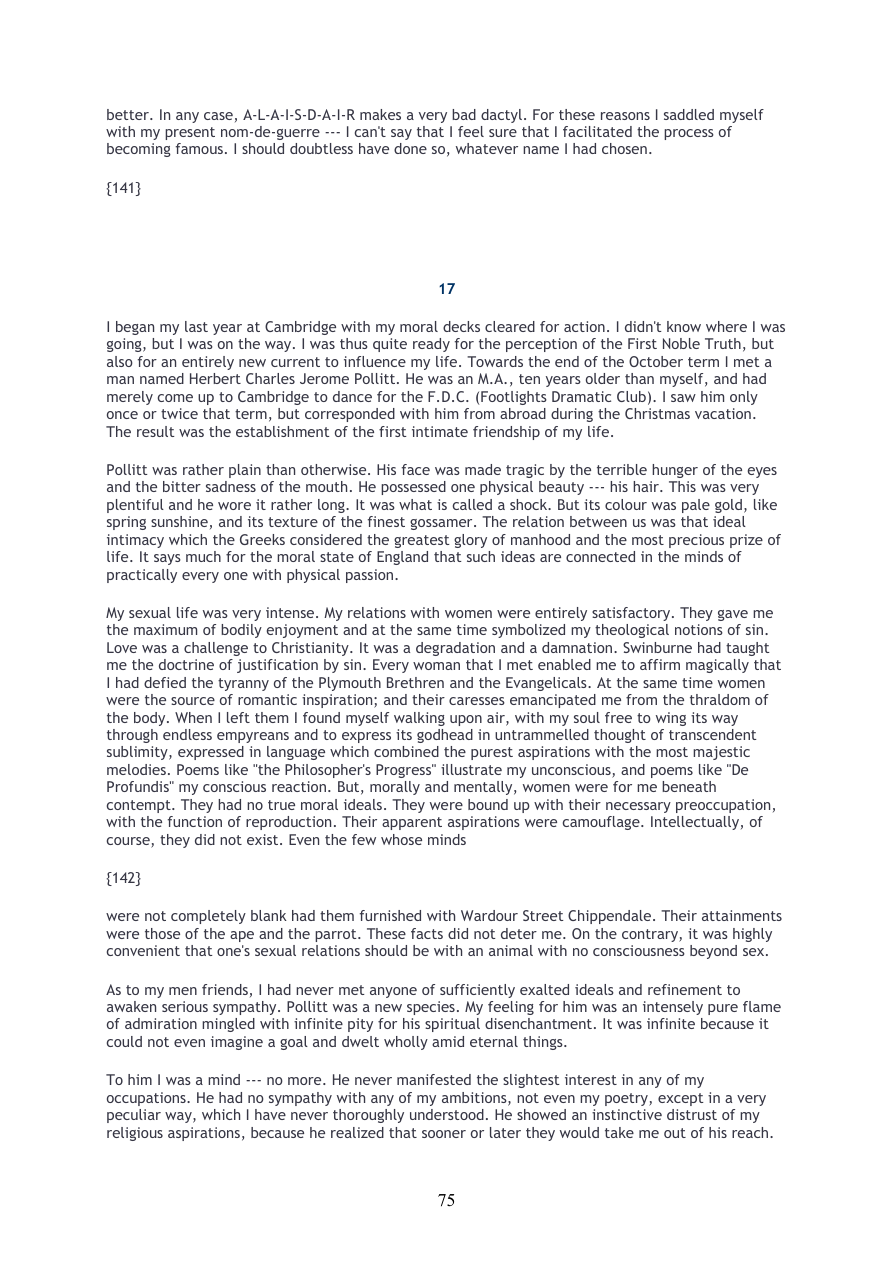
Highlights use the original PDF text layer. OCR-only matches may not be visible on the scan.
Transcription
Download text ↓raw extractionoriginal embedded textReview: unreviewed
75
better. In any case, A-L-A-I-S-D-A-I-R makes a very bad dactyl. For these reasons I saddled myself
with my present nom-de-guerre --- I can't say that I feel sure that I facilitated the process of
becoming famous. I should doubtless have done so, whatever name I had chosen.
{141}
17
I began my last year at Cambridge with my moral decks cleared for action. I didn't know where I was
going, but I was on the way. I was thus quite ready for the perception of the First Noble Truth, but
also for an entirely new current to influence my life. Towards the end of the October term I met a
man named Herbert Charles Jerome Pollitt. He was an M.A., ten years older than myself, and had
merely come up to Cambridge to dance for the F.D.C. (Footlights Dramatic Club). I saw him only
once or twice that term, but corresponded with him from abroad during the Christmas vacation.
The result was the establishment of the first intimate friendship of my life.
Pollitt was rather plain than otherwise. His face was made tragic by the terrible hunger of the eyes
and the bitter sadness of the mouth. He possessed one physical beauty --- his hair. This was very
plentiful and he wore it rather long. It was what is called a shock. But its colour was pale gold, like
spring sunshine, and its texture of the finest gossamer. The relation between us was that ideal
intimacy which the Greeks considered the greatest glory of manhood and the most precious prize of
life. It says much for the moral state of England that such ideas are connected in the minds of
practically every one with physical passion.
My sexual life was very intense. My relations with women were entirely satisfactory. They gave me
the maximum of bodily enjoyment and at the same time symbolized my theological notions of sin.
Love was a challenge to Christianity. It was a degradation and a damnation. Swinburne had taught
me the doctrine of justification by sin. Every woman that I met enabled me to affirm magically that
I had defied the tyranny of the Plymouth Brethren and the Evangelicals. At the same time women
were the source of romantic inspiration; and their caresses emancipated me from the thraldom of
the body. When I left them I found myself walking upon air, with my soul free to wing its way
through endless empyreans and to express its godhead in untrammelled thought of transcendent
sublimity, expressed in language which combined the purest aspirations with the most majestic
melodies. Poems like "the Philosopher's Progress" illustrate my unconscious, and poems like "De
Profundis" my conscious reaction. But, morally and mentally, women were for me beneath
contempt. They had no true moral ideals. They were bound up with their necessary preoccupation,
with the function of reproduction. Their apparent aspirations were camouflage. Intellectually, of
course, they did not exist. Even the few whose minds
{142}
were not completely blank had them furnished with Wardour Street Chippendale. Their attainments
were those of the ape and the parrot. These facts did not deter me. On the contrary, it was highly
convenient that one's sexual relations should be with an animal with no consciousness beyond sex.
As to my men friends, I had never met anyone of sufficiently exalted ideals and refinement to
awaken serious sympathy. Pollitt was a new species. My feeling for him was an intensely pure flame
of admiration mingled with infinite pity for his spiritual disenchantment. It was infinite because it
could not even imagine a goal and dwelt wholly amid eternal things.
To him I was a mind --- no more. He never manifested the slightest interest in any of my
occupations. He had no sympathy with any of my ambitions, not even my poetry, except in a very
peculiar way, which I have never thoroughly understood. He showed an instinctive distrust of my
religious aspirations, because he realized that sooner or later they would take me out of his reach.
Page provenance & review flags
Stable page ID: 5ef44b98d8f9c4af5f6f86e1:p00075
Line breaks are preserved. Reading order and OCR accuracy may need review.
Printed page label has not been verified.
- No automated review flags. This does not establish transcription accuracy.