1929 · CLOSE READING
Confessions of Aleister Crowley
Confessions of Aleister Crowley (1929), PDF p. 74
Original page
Enlarge ↗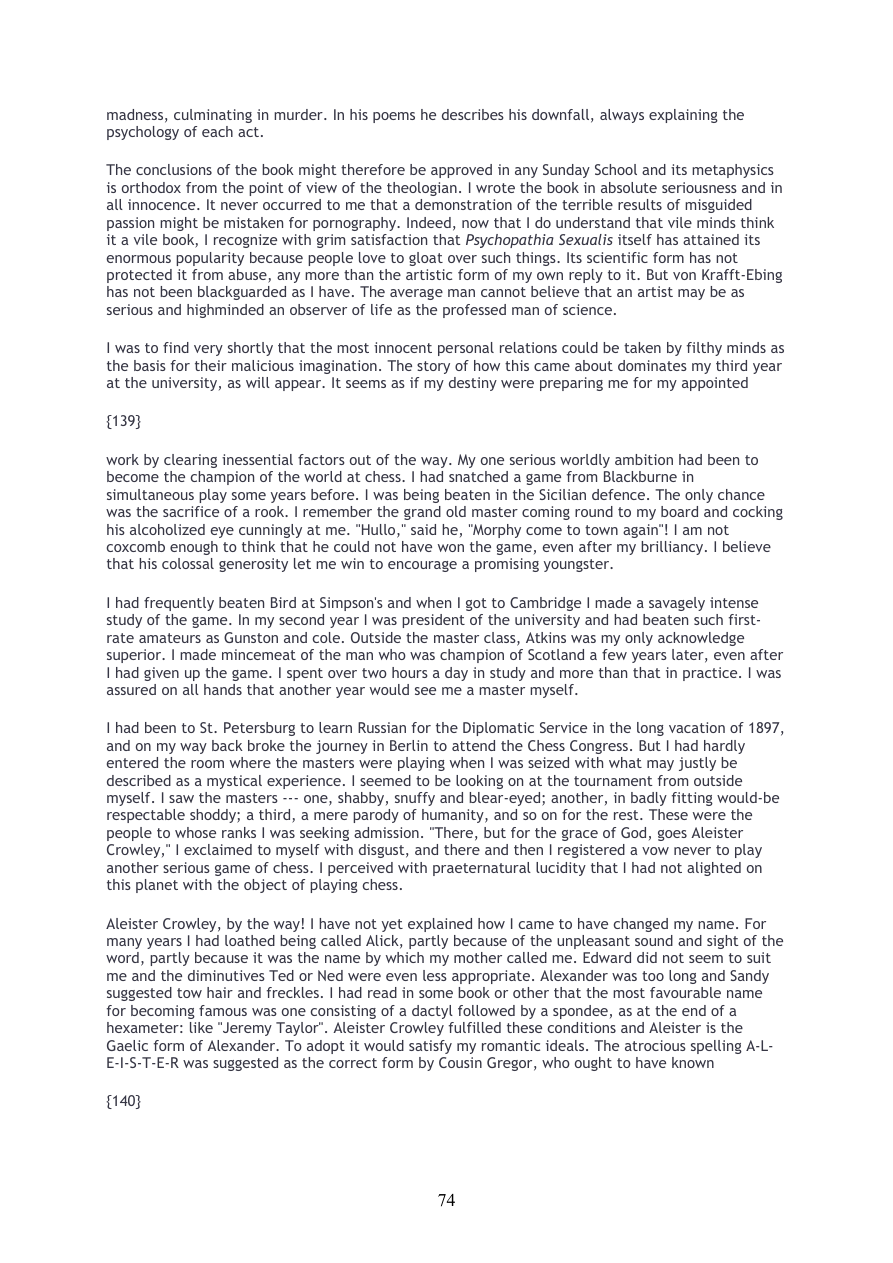
Highlights use the original PDF text layer. OCR-only matches may not be visible on the scan.
Transcription
Download text ↓raw extractionoriginal embedded textReview: unreviewed
74
madness, culminating in murder. In his poems he describes his downfall, always explaining the
psychology of each act.
The conclusions of the book might therefore be approved in any Sunday School and its metaphysics
is orthodox from the point of view of the theologian. I wrote the book in absolute seriousness and in
all innocence. It never occurred to me that a demonstration of the terrible results of misguided
passion might be mistaken for pornography. Indeed, now that I do understand that vile minds think
it a vile book, I recognize with grim satisfaction that Psychopathia Sexualis itself has attained its
enormous popularity because people love to gloat over such things. Its scientific form has not
protected it from abuse, any more than the artistic form of my own reply to it. But von Krafft-Ebing
has not been blackguarded as I have. The average man cannot believe that an artist may be as
serious and highminded an observer of life as the professed man of science.
I was to find very shortly that the most innocent personal relations could be taken by filthy minds as
the basis for their malicious imagination. The story of how this came about dominates my third year
at the university, as will appear. It seems as if my destiny were preparing me for my appointed
{139}
work by clearing inessential factors out of the way. My one serious worldly ambition had been to
become the champion of the world at chess. I had snatched a game from Blackburne in
simultaneous play some years before. I was being beaten in the Sicilian defence. The only chance
was the sacrifice of a rook. I remember the grand old master coming round to my board and cocking
his alcoholized eye cunningly at me. "Hullo," said he, "Morphy come to town again"! I am not
coxcomb enough to think that he could not have won the game, even after my brilliancy. I believe
that his colossal generosity let me win to encourage a promising youngster.
I had frequently beaten Bird at Simpson's and when I got to Cambridge I made a savagely intense
study of the game. In my second year I was president of the university and had beaten such first-
rate amateurs as Gunston and cole. Outside the master class, Atkins was my only acknowledge
superior. I made mincemeat of the man who was champion of Scotland a few years later, even after
I had given up the game. I spent over two hours a day in study and more than that in practice. I was
assured on all hands that another year would see me a master myself.
I had been to St. Petersburg to learn Russian for the Diplomatic Service in the long vacation of 1897,
and on my way back broke the journey in Berlin to attend the Chess Congress. But I had hardly
entered the room where the masters were playing when I was seized with what may justly be
described as a mystical experience. I seemed to be looking on at the tournament from outside
myself. I saw the masters --- one, shabby, snuffy and blear-eyed; another, in badly fitting would-be
respectable shoddy; a third, a mere parody of humanity, and so on for the rest. These were the
people to whose ranks I was seeking admission. "There, but for the grace of God, goes Aleister
Crowley," I exclaimed to myself with disgust, and there and then I registered a vow never to play
another serious game of chess. I perceived with praeternatural lucidity that I had not alighted on
this planet with the object of playing chess.
Aleister Crowley, by the way! I have not yet explained how I came to have changed my name. For
many years I had loathed being called Alick, partly because of the unpleasant sound and sight of the
word, partly because it was the name by which my mother called me. Edward did not seem to suit
me and the diminutives Ted or Ned were even less appropriate. Alexander was too long and Sandy
suggested tow hair and freckles. I had read in some book or other that the most favourable name
for becoming famous was one consisting of a dactyl followed by a spondee, as at the end of a
hexameter: like "Jeremy Taylor". Aleister Crowley fulfilled these conditions and Aleister is the
Gaelic form of Alexander. To adopt it would satisfy my romantic ideals. The atrocious spelling A-L-
E-I-S-T-E-R was suggested as the correct form by Cousin Gregor, who ought to have known
{140}
Page provenance & review flags
Stable page ID: 5ef44b98d8f9c4af5f6f86e1:p00074
Line breaks are preserved. Reading order and OCR accuracy may need review.
Printed page label has not been verified.
- No automated review flags. This does not establish transcription accuracy.