1929 · CLOSE READING
Confessions of Aleister Crowley
Confessions of Aleister Crowley (1929), PDF p. 71
Original page
Enlarge ↗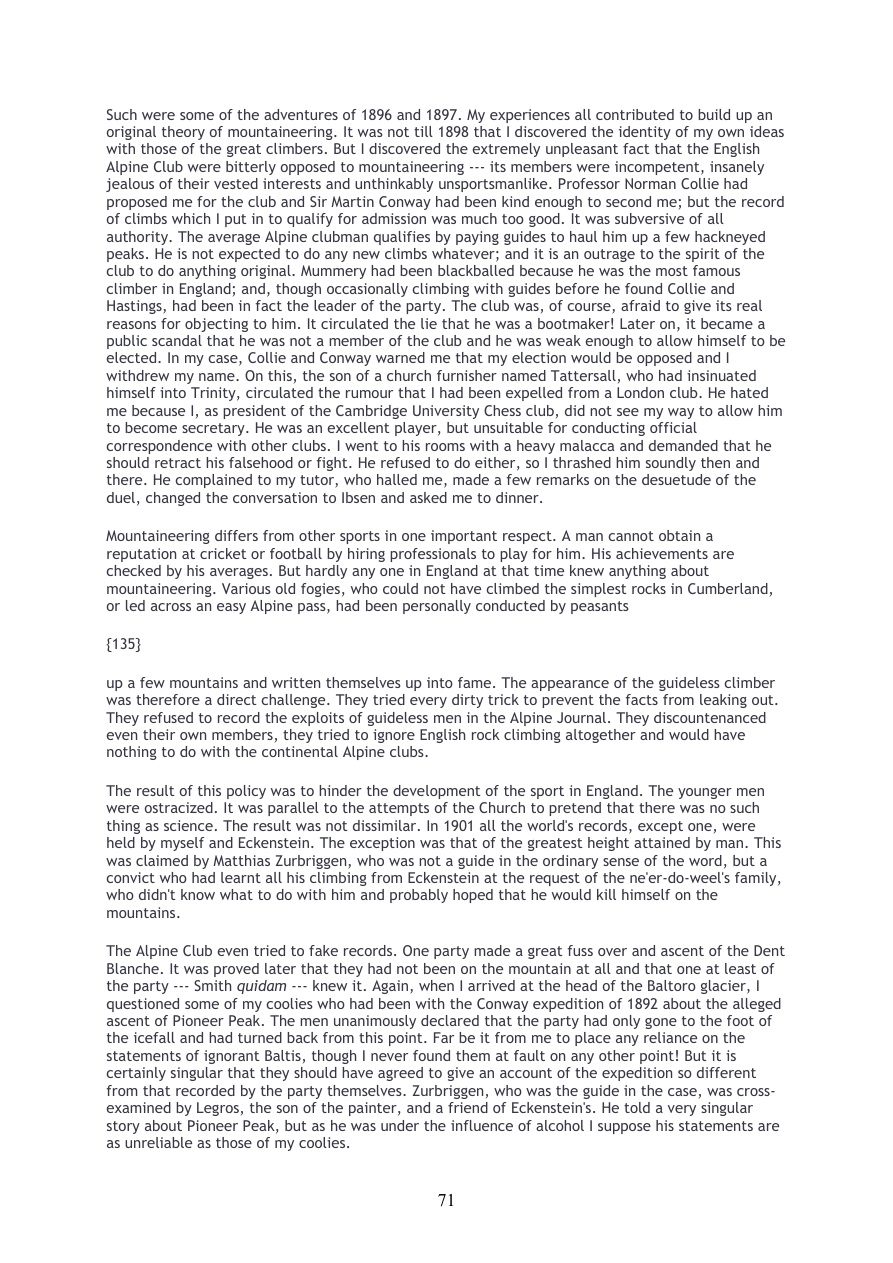
Highlights use the original PDF text layer. OCR-only matches may not be visible on the scan.
Transcription
Download text ↓raw extractionoriginal embedded textReview: unreviewed
71
Such were some of the adventures of 1896 and 1897. My experiences all contributed to build up an
original theory of mountaineering. It was not till 1898 that I discovered the identity of my own ideas
with those of the great climbers. But I discovered the extremely unpleasant fact that the English
Alpine Club were bitterly opposed to mountaineering --- its members were incompetent, insanely
jealous of their vested interests and unthinkably unsportsmanlike. Professor Norman Collie had
proposed me for the club and Sir Martin Conway had been kind enough to second me; but the record
of climbs which I put in to qualify for admission was much too good. It was subversive of all
authority. The average Alpine clubman qualifies by paying guides to haul him up a few hackneyed
peaks. He is not expected to do any new climbs whatever; and it is an outrage to the spirit of the
club to do anything original. Mummery had been blackballed because he was the most famous
climber in England; and, though occasionally climbing with guides before he found Collie and
Hastings, had been in fact the leader of the party. The club was, of course, afraid to give its real
reasons for objecting to him. It circulated the lie that he was a bootmaker! Later on, it became a
public scandal that he was not a member of the club and he was weak enough to allow himself to be
elected. In my case, Collie and Conway warned me that my election would be opposed and I
withdrew my name. On this, the son of a church furnisher named Tattersall, who had insinuated
himself into Trinity, circulated the rumour that I had been expelled from a London club. He hated
me because I, as president of the Cambridge University Chess club, did not see my way to allow him
to become secretary. He was an excellent player, but unsuitable for conducting official
correspondence with other clubs. I went to his rooms with a heavy malacca and demanded that he
should retract his falsehood or fight. He refused to do either, so I thrashed him soundly then and
there. He complained to my tutor, who halled me, made a few remarks on the desuetude of the
duel, changed the conversation to Ibsen and asked me to dinner.
Mountaineering differs from other sports in one important respect. A man cannot obtain a
reputation at cricket or football by hiring professionals to play for him. His achievements are
checked by his averages. But hardly any one in England at that time knew anything about
mountaineering. Various old fogies, who could not have climbed the simplest rocks in Cumberland,
or led across an easy Alpine pass, had been personally conducted by peasants
{135}
up a few mountains and written themselves up into fame. The appearance of the guideless climber
was therefore a direct challenge. They tried every dirty trick to prevent the facts from leaking out.
They refused to record the exploits of guideless men in the Alpine Journal. They discountenanced
even their own members, they tried to ignore English rock climbing altogether and would have
nothing to do with the continental Alpine clubs.
The result of this policy was to hinder the development of the sport in England. The younger men
were ostracized. It was parallel to the attempts of the Church to pretend that there was no such
thing as science. The result was not dissimilar. In 1901 all the world's records, except one, were
held by myself and Eckenstein. The exception was that of the greatest height attained by man. This
was claimed by Matthias Zurbriggen, who was not a guide in the ordinary sense of the word, but a
convict who had learnt all his climbing from Eckenstein at the request of the ne'er-do-weel's family,
who didn't know what to do with him and probably hoped that he would kill himself on the
mountains.
The Alpine Club even tried to fake records. One party made a great fuss over and ascent of the Dent
Blanche. It was proved later that they had not been on the mountain at all and that one at least of
the party --- Smith quidam --- knew it. Again, when I arrived at the head of the Baltoro glacier, I
questioned some of my coolies who had been with the Conway expedition of 1892 about the alleged
ascent of Pioneer Peak. The men unanimously declared that the party had only gone to the foot of
the icefall and had turned back from this point. Far be it from me to place any reliance on the
statements of ignorant Baltis, though I never found them at fault on any other point! But it is
certainly singular that they should have agreed to give an account of the expedition so different
from that recorded by the party themselves. Zurbriggen, who was the guide in the case, was cross-
examined by Legros, the son of the painter, and a friend of Eckenstein's. He told a very singular
story about Pioneer Peak, but as he was under the influence of alcohol I suppose his statements are
as unreliable as those of my coolies.
Page provenance & review flags
Stable page ID: 5ef44b98d8f9c4af5f6f86e1:p00071
Line breaks are preserved. Reading order and OCR accuracy may need review.
Printed page label has not been verified.
- No automated review flags. This does not establish transcription accuracy.