1929 · CLOSE READING
Confessions of Aleister Crowley
Confessions of Aleister Crowley (1929), PDF p. 5
Original page
Enlarge ↗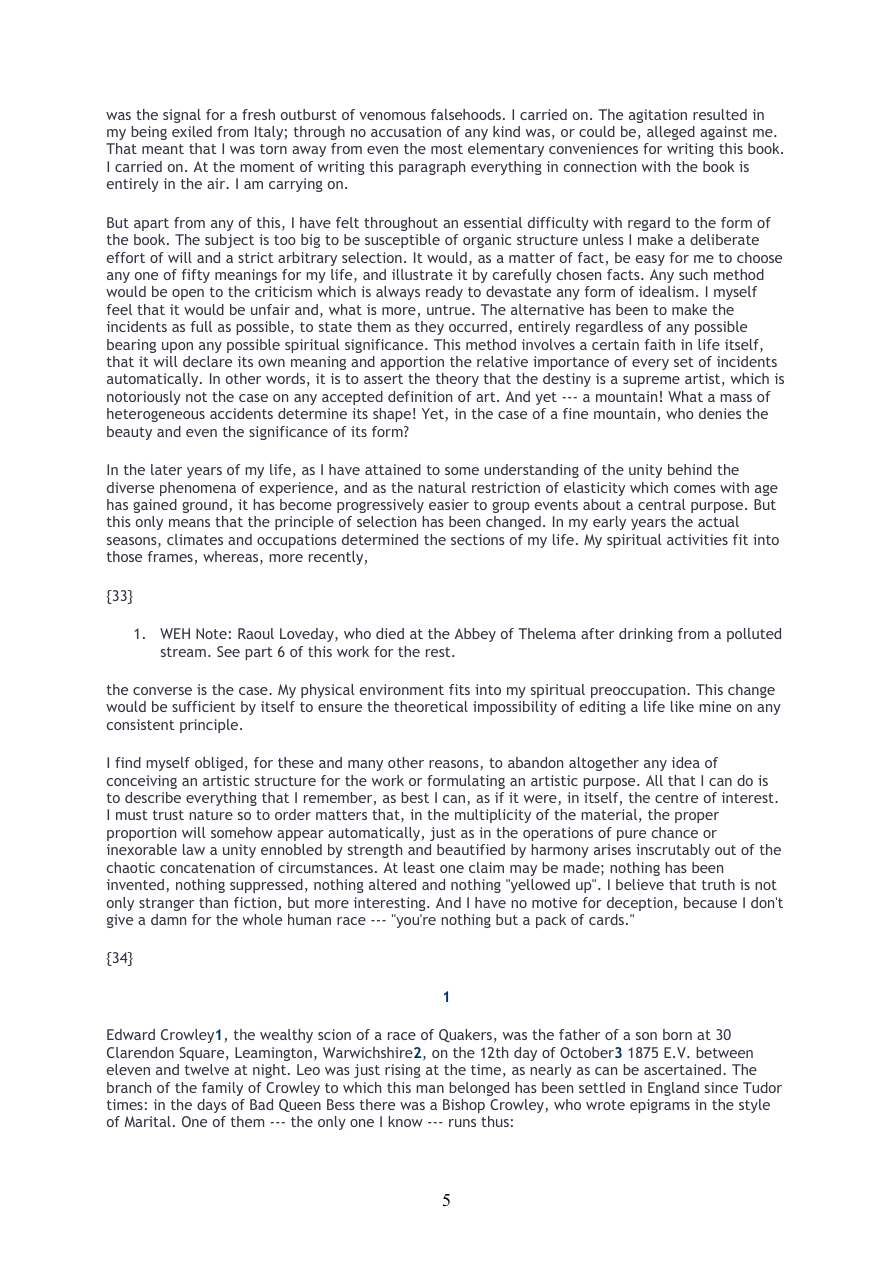
Highlights use the original PDF text layer. OCR-only matches may not be visible on the scan.
Transcription
Download text ↓raw extractionoriginal embedded textReview: unreviewed
5
was the signal for a fresh outburst of venomous falsehoods. I carried on. The agitation resulted in
my being exiled from Italy; through no accusation of any kind was, or could be, alleged against me.
That meant that I was torn away from even the most elementary conveniences for writing this book.
I carried on. At the moment of writing this paragraph everything in connection with the book is
entirely in the air. I am carrying on.
But apart from any of this, I have felt throughout an essential difficulty with regard to the form of
the book. The subject is too big to be susceptible of organic structure unless I make a deliberate
effort of will and a strict arbitrary selection. It would, as a matter of fact, be easy for me to choose
any one of fifty meanings for my life, and illustrate it by carefully chosen facts. Any such method
would be open to the criticism which is always ready to devastate any form of idealism. I myself
feel that it would be unfair and, what is more, untrue. The alternative has been to make the
incidents as full as possible, to state them as they occurred, entirely regardless of any possible
bearing upon any possible spiritual significance. This method involves a certain faith in life itself,
that it will declare its own meaning and apportion the relative importance of every set of incidents
automatically. In other words, it is to assert the theory that the destiny is a supreme artist, which is
notoriously not the case on any accepted definition of art. And yet --- a mountain! What a mass of
heterogeneous accidents determine its shape! Yet, in the case of a fine mountain, who denies the
beauty and even the significance of its form?
In the later years of my life, as I have attained to some understanding of the unity behind the
diverse phenomena of experience, and as the natural restriction of elasticity which comes with age
has gained ground, it has become progressively easier to group events about a central purpose. But
this only means that the principle of selection has been changed. In my early years the actual
seasons, climates and occupations determined the sections of my life. My spiritual activities fit into
those frames, whereas, more recently,
{33}
1. WEH Note: Raoul Loveday, who died at the Abbey of Thelema after drinking from a polluted
stream. See part 6 of this work for the rest.
the converse is the case. My physical environment fits into my spiritual preoccupation. This change
would be sufficient by itself to ensure the theoretical impossibility of editing a life like mine on any
consistent principle.
I find myself obliged, for these and many other reasons, to abandon altogether any idea of
conceiving an artistic structure for the work or formulating an artistic purpose. All that I can do is
to describe everything that I remember, as best I can, as if it were, in itself, the centre of interest.
I must trust nature so to order matters that, in the multiplicity of the material, the proper
proportion will somehow appear automatically, just as in the operations of pure chance or
inexorable law a unity ennobled by strength and beautified by harmony arises inscrutably out of the
chaotic concatenation of circumstances. At least one claim may be made; nothing has been
invented, nothing suppressed, nothing altered and nothing "yellowed up". I believe that truth is not
only stranger than fiction, but more interesting. And I have no motive for deception, because I don't
give a damn for the whole human race --- "you're nothing but a pack of cards."
{34}
1
Edward Crowley1, the wealthy scion of a race of Quakers, was the father of a son born at 30
Clarendon Square, Leamington, Warwichshire2, on the 12th day of October3 1875 E.V. between
eleven and twelve at night. Leo was just rising at the time, as nearly as can be ascertained. The
branch of the family of Crowley to which this man belonged has been settled in England since Tudor
times: in the days of Bad Queen Bess there was a Bishop Crowley, who wrote epigrams in the style
of Marital. One of them --- the only one I know --- runs thus:
Page provenance & review flags
Stable page ID: 5ef44b98d8f9c4af5f6f86e1:p00005
Line breaks are preserved. Reading order and OCR accuracy may need review.
Printed page label has not been verified.
- No automated review flags. This does not establish transcription accuracy.