1929 · CLOSE READING
Confessions of Aleister Crowley
Confessions of Aleister Crowley (1929), PDF p. 58
Original page
Enlarge ↗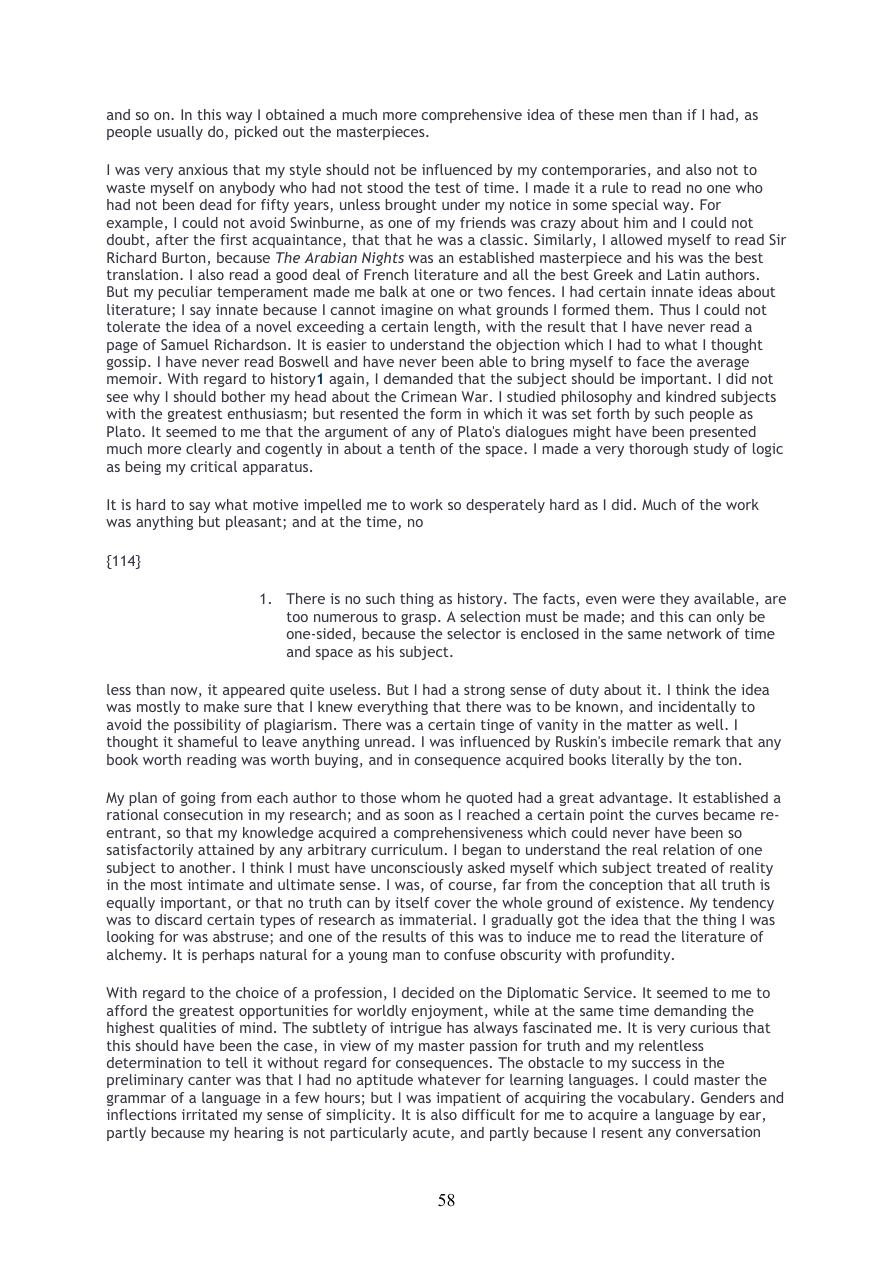
Highlights use the original PDF text layer. OCR-only matches may not be visible on the scan.
Transcription
Download text ↓raw extractionoriginal embedded textReview: unreviewed
58
and so on. In this way I obtained a much more comprehensive idea of these men than if I had, as
people usually do, picked out the masterpieces.
I was very anxious that my style should not be influenced by my contemporaries, and also not to
waste myself on anybody who had not stood the test of time. I made it a rule to read no one who
had not been dead for fifty years, unless brought under my notice in some special way. For
example, I could not avoid Swinburne, as one of my friends was crazy about him and I could not
doubt, after the first acquaintance, that that he was a classic. Similarly, I allowed myself to read Sir
Richard Burton, because The Arabian Nights was an established masterpiece and his was the best
translation. I also read a good deal of French literature and all the best Greek and Latin authors.
But my peculiar temperament made me balk at one or two fences. I had certain innate ideas about
literature; I say innate because I cannot imagine on what grounds I formed them. Thus I could not
tolerate the idea of a novel exceeding a certain length, with the result that I have never read a
page of Samuel Richardson. It is easier to understand the objection which I had to what I thought
gossip. I have never read Boswell and have never been able to bring myself to face the average
memoir. With regard to history1 again, I demanded that the subject should be important. I did not
see why I should bother my head about the Crimean War. I studied philosophy and kindred subjects
with the greatest enthusiasm; but resented the form in which it was set forth by such people as
Plato. It seemed to me that the argument of any of Plato's dialogues might have been presented
much more clearly and cogently in about a tenth of the space. I made a very thorough study of logic
as being my critical apparatus.
It is hard to say what motive impelled me to work so desperately hard as I did. Much of the work
was anything but pleasant; and at the time, no
{114}
1. There is no such thing as history. The facts, even were they available, are
too numerous to grasp. A selection must be made; and this can only be
one-sided, because the selector is enclosed in the same network of time
and space as his subject.
less than now, it appeared quite useless. But I had a strong sense of duty about it. I think the idea
was mostly to make sure that I knew everything that there was to be known, and incidentally to
avoid the possibility of plagiarism. There was a certain tinge of vanity in the matter as well. I
thought it shameful to leave anything unread. I was influenced by Ruskin's imbecile remark that any
book worth reading was worth buying, and in consequence acquired books literally by the ton.
My plan of going from each author to those whom he quoted had a great advantage. It established a
rational consecution in my research; and as soon as I reached a certain point the curves became re-
entrant, so that my knowledge acquired a comprehensiveness which could never have been so
satisfactorily attained by any arbitrary curriculum. I began to understand the real relation of one
subject to another. I think I must have unconsciously asked myself which subject treated of reality
in the most intimate and ultimate sense. I was, of course, far from the conception that all truth is
equally important, or that no truth can by itself cover the whole ground of existence. My tendency
was to discard certain types of research as immaterial. I gradually got the idea that the thing I was
looking for was abstruse; and one of the results of this was to induce me to read the literature of
alchemy. It is perhaps natural for a young man to confuse obscurity with profundity.
With regard to the choice of a profession, I decided on the Diplomatic Service. It seemed to me to
afford the greatest opportunities for worldly enjoyment, while at the same time demanding the
highest qualities of mind. The subtlety of intrigue has always fascinated me. It is very curious that
this should have been the case, in view of my master passion for truth and my relentless
determination to tell it without regard for consequences. The obstacle to my success in the
preliminary canter was that I had no aptitude whatever for learning languages. I could master the
grammar of a language in a few hours; but I was impatient of acquiring the vocabulary. Genders and
inflections irritated my sense of simplicity. It is also difficult for me to acquire a language by ear,
partly because my hearing is not particularly acute, and partly because I resent any conversation
Page provenance & review flags
Stable page ID: 5ef44b98d8f9c4af5f6f86e1:p00058
Line breaks are preserved. Reading order and OCR accuracy may need review.
Printed page label has not been verified.
- No automated review flags. This does not establish transcription accuracy.