1929 · CLOSE READING
Confessions of Aleister Crowley
Confessions of Aleister Crowley (1929), PDF p. 561
Original page
Enlarge ↗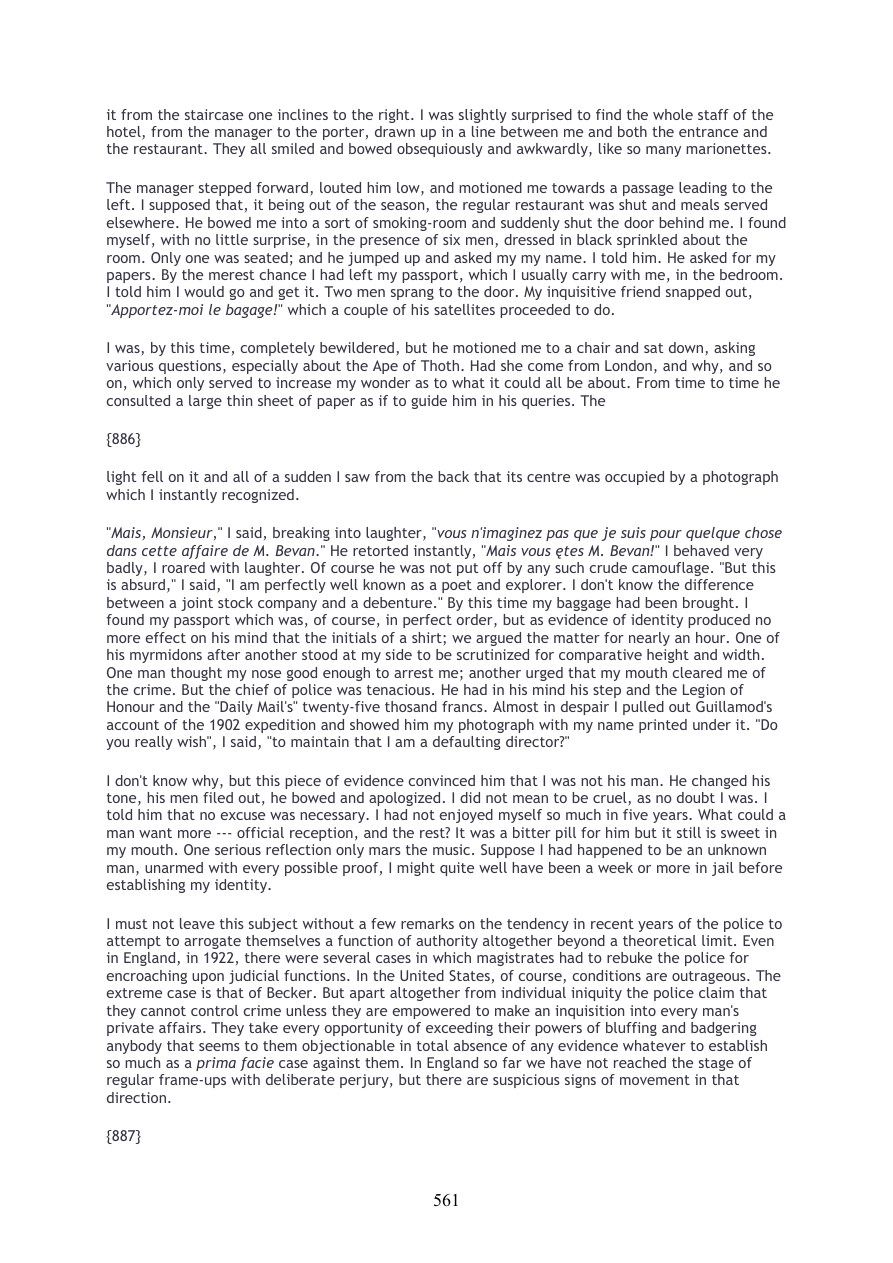
Highlights use the original PDF text layer. OCR-only matches may not be visible on the scan.
Transcription
Download text ↓raw extractionoriginal embedded textReview: unreviewed
561
it from the staircase one inclines to the right. I was slightly surprised to find the whole staff of the
hotel, from the manager to the porter, drawn up in a line between me and both the entrance and
the restaurant. They all smiled and bowed obsequiously and awkwardly, like so many marionettes.
The manager stepped forward, louted him low, and motioned me towards a passage leading to the
left. I supposed that, it being out of the season, the regular restaurant was shut and meals served
elsewhere. He bowed me into a sort of smoking-room and suddenly shut the door behind me. I found
myself, with no little surprise, in the presence of six men, dressed in black sprinkled about the
room. Only one was seated; and he jumped up and asked my my name. I told him. He asked for my
papers. By the merest chance I had left my passport, which I usually carry with me, in the bedroom.
I told him I would go and get it. Two men sprang to the door. My inquisitive friend snapped out,
"Apportez-moi le bagage!" which a couple of his satellites proceeded to do.
I was, by this time, completely bewildered, but he motioned me to a chair and sat down, asking
various questions, especially about the Ape of Thoth. Had she come from London, and why, and so
on, which only served to increase my wonder as to what it could all be about. From time to time he
consulted a large thin sheet of paper as if to guide him in his queries. The
{886}
light fell on it and all of a sudden I saw from the back that its centre was occupied by a photograph
which I instantly recognized.
"Mais, Monsieur," I said, breaking into laughter, "vous n'imaginez pas que je suis pour quelque chose
dans cette affaire de M. Bevan." He retorted instantly, "Mais vous ętes M. Bevan!" I behaved very
badly, I roared with laughter. Of course he was not put off by any such crude camouflage. "But this
is absurd," I said, "I am perfectly well known as a poet and explorer. I don't know the difference
between a joint stock company and a debenture." By this time my baggage had been brought. I
found my passport which was, of course, in perfect order, but as evidence of identity produced no
more effect on his mind that the initials of a shirt; we argued the matter for nearly an hour. One of
his myrmidons after another stood at my side to be scrutinized for comparative height and width.
One man thought my nose good enough to arrest me; another urged that my mouth cleared me of
the crime. But the chief of police was tenacious. He had in his mind his step and the Legion of
Honour and the "Daily Mail's" twenty-five thosand francs. Almost in despair I pulled out Guillamod's
account of the 1902 expedition and showed him my photograph with my name printed under it. "Do
you really wish", I said, "to maintain that I am a defaulting director?"
I don't know why, but this piece of evidence convinced him that I was not his man. He changed his
tone, his men filed out, he bowed and apologized. I did not mean to be cruel, as no doubt I was. I
told him that no excuse was necessary. I had not enjoyed myself so much in five years. What could a
man want more --- official reception, and the rest? It was a bitter pill for him but it still is sweet in
my mouth. One serious reflection only mars the music. Suppose I had happened to be an unknown
man, unarmed with every possible proof, I might quite well have been a week or more in jail before
establishing my identity.
I must not leave this subject without a few remarks on the tendency in recent years of the police to
attempt to arrogate themselves a function of authority altogether beyond a theoretical limit. Even
in England, in 1922, there were several cases in which magistrates had to rebuke the police for
encroaching upon judicial functions. In the United States, of course, conditions are outrageous. The
extreme case is that of Becker. But apart altogether from individual iniquity the police claim that
they cannot control crime unless they are empowered to make an inquisition into every man's
private affairs. They take every opportunity of exceeding their powers of bluffing and badgering
anybody that seems to them objectionable in total absence of any evidence whatever to establish
so much as a prima facie case against them. In England so far we have not reached the stage of
regular frame-ups with deliberate perjury, but there are suspicious signs of movement in that
direction.
{887}
Page provenance & review flags
Stable page ID: 5ef44b98d8f9c4af5f6f86e1:p00561
Line breaks are preserved. Reading order and OCR accuracy may need review.
Printed page label has not been verified.
- No automated review flags. This does not establish transcription accuracy.