1929 · CLOSE READING
Confessions of Aleister Crowley
Confessions of Aleister Crowley (1929), PDF p. 55
Original page
Enlarge ↗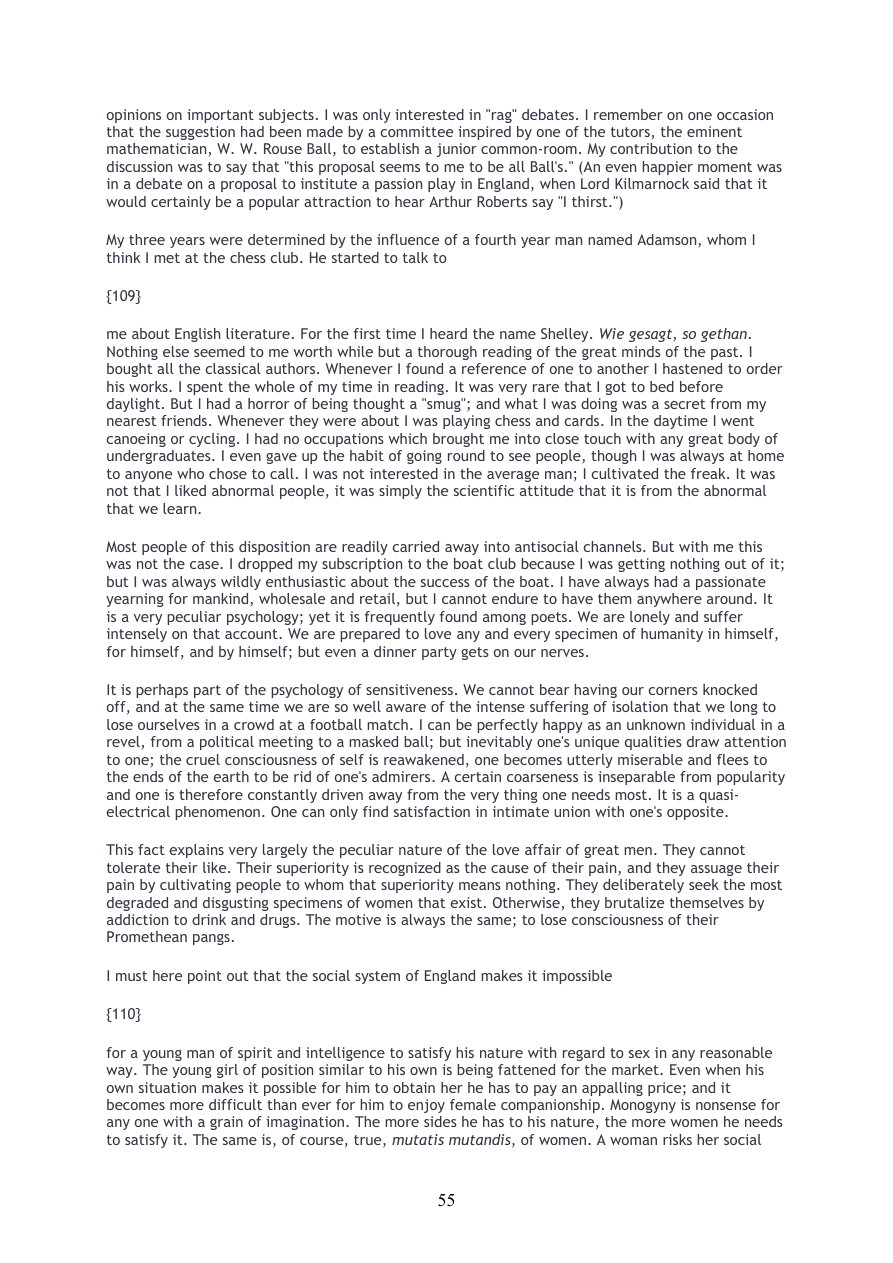
Highlights use the original PDF text layer. OCR-only matches may not be visible on the scan.
Transcription
Download text ↓raw extractionoriginal embedded textReview: unreviewed
55
opinions on important subjects. I was only interested in "rag" debates. I remember on one occasion
that the suggestion had been made by a committee inspired by one of the tutors, the eminent
mathematician, W. W. Rouse Ball, to establish a junior common-room. My contribution to the
discussion was to say that "this proposal seems to me to be all Ball's." (An even happier moment was
in a debate on a proposal to institute a passion play in England, when Lord Kilmarnock said that it
would certainly be a popular attraction to hear Arthur Roberts say "I thirst.")
My three years were determined by the influence of a fourth year man named Adamson, whom I
think I met at the chess club. He started to talk to
{109}
me about English literature. For the first time I heard the name Shelley. Wie gesagt, so gethan.
Nothing else seemed to me worth while but a thorough reading of the great minds of the past. I
bought all the classical authors. Whenever I found a reference of one to another I hastened to order
his works. I spent the whole of my time in reading. It was very rare that I got to bed before
daylight. But I had a horror of being thought a "smug"; and what I was doing was a secret from my
nearest friends. Whenever they were about I was playing chess and cards. In the daytime I went
canoeing or cycling. I had no occupations which brought me into close touch with any great body of
undergraduates. I even gave up the habit of going round to see people, though I was always at home
to anyone who chose to call. I was not interested in the average man; I cultivated the freak. It was
not that I liked abnormal people, it was simply the scientific attitude that it is from the abnormal
that we learn.
Most people of this disposition are readily carried away into antisocial channels. But with me this
was not the case. I dropped my subscription to the boat club because I was getting nothing out of it;
but I was always wildly enthusiastic about the success of the boat. I have always had a passionate
yearning for mankind, wholesale and retail, but I cannot endure to have them anywhere around. It
is a very peculiar psychology; yet it is frequently found among poets. We are lonely and suffer
intensely on that account. We are prepared to love any and every specimen of humanity in himself,
for himself, and by himself; but even a dinner party gets on our nerves.
It is perhaps part of the psychology of sensitiveness. We cannot bear having our corners knocked
off, and at the same time we are so well aware of the intense suffering of isolation that we long to
lose ourselves in a crowd at a football match. I can be perfectly happy as an unknown individual in a
revel, from a political meeting to a masked ball; but inevitably one's unique qualities draw attention
to one; the cruel consciousness of self is reawakened, one becomes utterly miserable and flees to
the ends of the earth to be rid of one's admirers. A certain coarseness is inseparable from popularity
and one is therefore constantly driven away from the very thing one needs most. It is a quasi-
electrical phenomenon. One can only find satisfaction in intimate union with one's opposite.
This fact explains very largely the peculiar nature of the love affair of great men. They cannot
tolerate their like. Their superiority is recognized as the cause of their pain, and they assuage their
pain by cultivating people to whom that superiority means nothing. They deliberately seek the most
degraded and disgusting specimens of women that exist. Otherwise, they brutalize themselves by
addiction to drink and drugs. The motive is always the same; to lose consciousness of their
Promethean pangs.
I must here point out that the social system of England makes it impossible
{110}
for a young man of spirit and intelligence to satisfy his nature with regard to sex in any reasonable
way. The young girl of position similar to his own is being fattened for the market. Even when his
own situation makes it possible for him to obtain her he has to pay an appalling price; and it
becomes more difficult than ever for him to enjoy female companionship. Monogyny is nonsense for
any one with a grain of imagination. The more sides he has to his nature, the more women he needs
to satisfy it. The same is, of course, true, mutatis mutandis, of women. A woman risks her social
Page provenance & review flags
Stable page ID: 5ef44b98d8f9c4af5f6f86e1:p00055
Line breaks are preserved. Reading order and OCR accuracy may need review.
Printed page label has not been verified.
- No automated review flags. This does not establish transcription accuracy.