1929 · CLOSE READING
Confessions of Aleister Crowley
Confessions of Aleister Crowley (1929), PDF p. 551
Original page
Enlarge ↗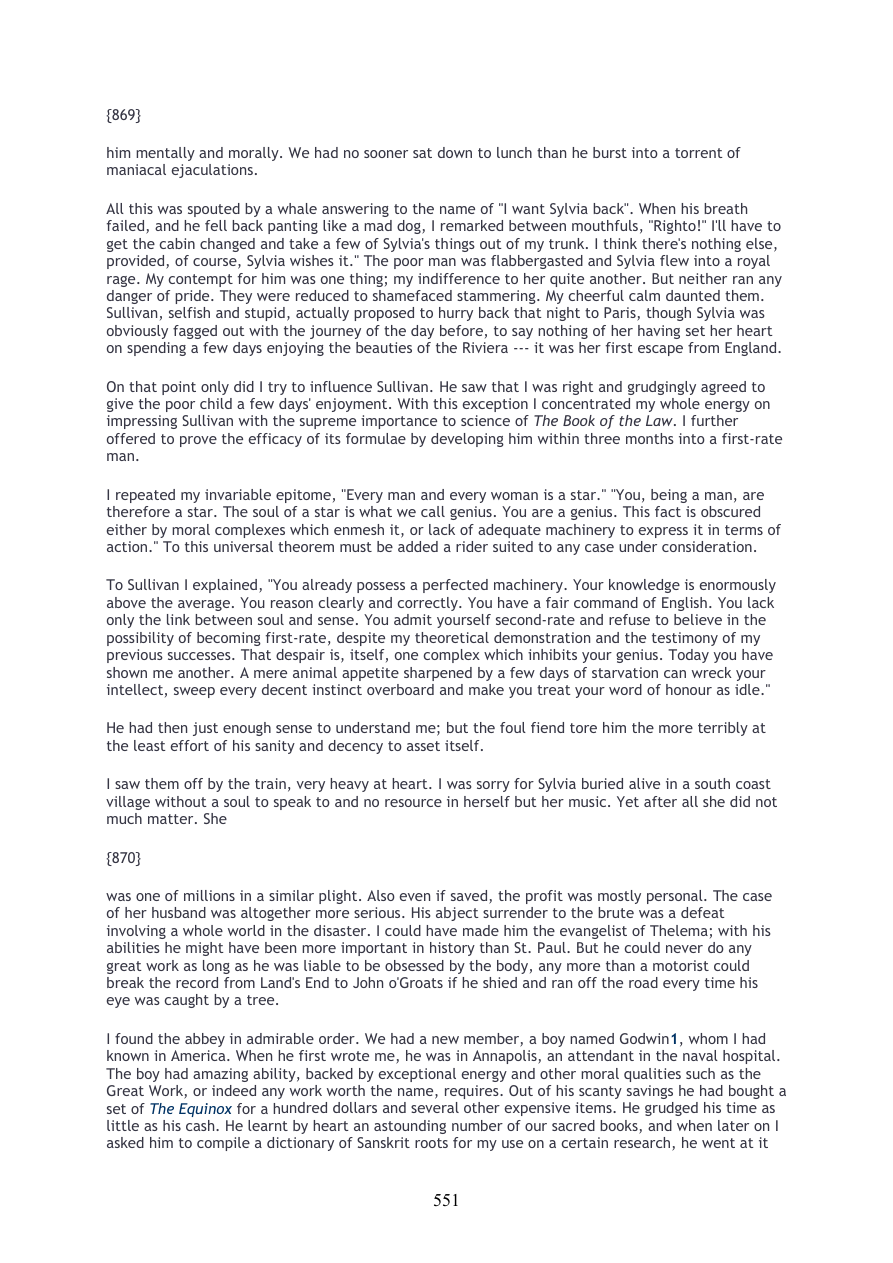
Highlights use the original PDF text layer. OCR-only matches may not be visible on the scan.
Transcription
Download text ↓raw extractionoriginal embedded textReview: unreviewed
551
{869}
him mentally and morally. We had no sooner sat down to lunch than he burst into a torrent of
maniacal ejaculations.
All this was spouted by a whale answering to the name of "I want Sylvia back". When his breath
failed, and he fell back panting like a mad dog, I remarked between mouthfuls, "Righto!" I'll have to
get the cabin changed and take a few of Sylvia's things out of my trunk. I think there's nothing else,
provided, of course, Sylvia wishes it." The poor man was flabbergasted and Sylvia flew into a royal
rage. My contempt for him was one thing; my indifference to her quite another. But neither ran any
danger of pride. They were reduced to shamefaced stammering. My cheerful calm daunted them.
Sullivan, selfish and stupid, actually proposed to hurry back that night to Paris, though Sylvia was
obviously fagged out with the journey of the day before, to say nothing of her having set her heart
on spending a few days enjoying the beauties of the Riviera --- it was her first escape from England.
On that point only did I try to influence Sullivan. He saw that I was right and grudgingly agreed to
give the poor child a few days' enjoyment. With this exception I concentrated my whole energy on
impressing Sullivan with the supreme importance to science of The Book of the Law. I further
offered to prove the efficacy of its formulae by developing him within three months into a first-rate
man.
I repeated my invariable epitome, "Every man and every woman is a star." "You, being a man, are
therefore a star. The soul of a star is what we call genius. You are a genius. This fact is obscured
either by moral complexes which enmesh it, or lack of adequate machinery to express it in terms of
action." To this universal theorem must be added a rider suited to any case under consideration.
To Sullivan I explained, "You already possess a perfected machinery. Your knowledge is enormously
above the average. You reason clearly and correctly. You have a fair command of English. You lack
only the link between soul and sense. You admit yourself second-rate and refuse to believe in the
possibility of becoming first-rate, despite my theoretical demonstration and the testimony of my
previous successes. That despair is, itself, one complex which inhibits your genius. Today you have
shown me another. A mere animal appetite sharpened by a few days of starvation can wreck your
intellect, sweep every decent instinct overboard and make you treat your word of honour as idle."
He had then just enough sense to understand me; but the foul fiend tore him the more terribly at
the least effort of his sanity and decency to asset itself.
I saw them off by the train, very heavy at heart. I was sorry for Sylvia buried alive in a south coast
village without a soul to speak to and no resource in herself but her music. Yet after all she did not
much matter. She
{870}
was one of millions in a similar plight. Also even if saved, the profit was mostly personal. The case
of her husband was altogether more serious. His abject surrender to the brute was a defeat
involving a whole world in the disaster. I could have made him the evangelist of Thelema; with his
abilities he might have been more important in history than St. Paul. But he could never do any
great work as long as he was liable to be obsessed by the body, any more than a motorist could
break the record from Land's End to John o'Groats if he shied and ran off the road every time his
eye was caught by a tree.
I found the abbey in admirable order. We had a new member, a boy named Godwin1, whom I had
known in America. When he first wrote me, he was in Annapolis, an attendant in the naval hospital.
The boy had amazing ability, backed by exceptional energy and other moral qualities such as the
Great Work, or indeed any work worth the name, requires. Out of his scanty savings he had bought a
set of The Equinox for a hundred dollars and several other expensive items. He grudged his time as
little as his cash. He learnt by heart an astounding number of our sacred books, and when later on I
asked him to compile a dictionary of Sanskrit roots for my use on a certain research, he went at it
Page provenance & review flags
Stable page ID: 5ef44b98d8f9c4af5f6f86e1:p00551
Line breaks are preserved. Reading order and OCR accuracy may need review.
Printed page label has not been verified.
- No automated review flags. This does not establish transcription accuracy.