1929 · CLOSE READING
Confessions of Aleister Crowley
Confessions of Aleister Crowley (1929), PDF p. 540
Original page
Enlarge ↗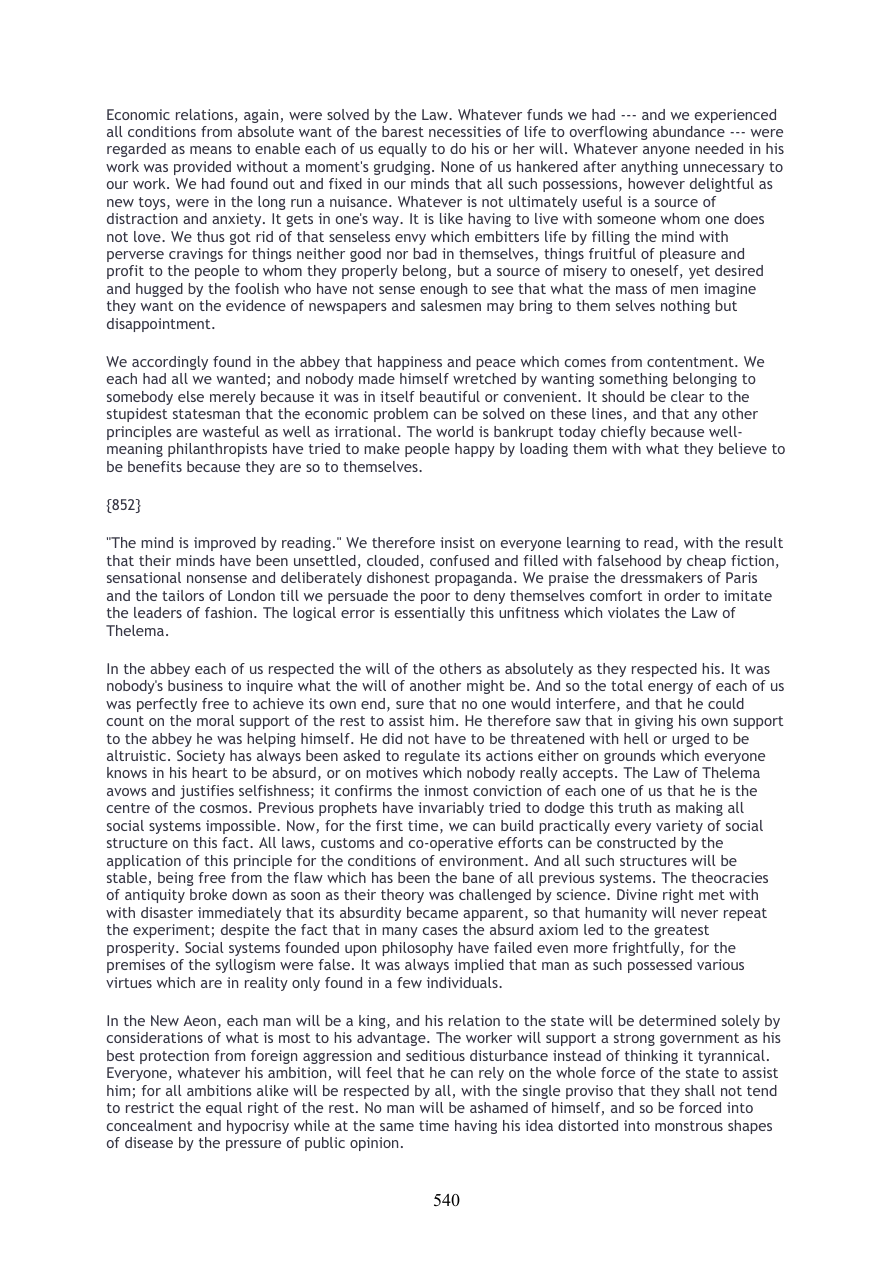
Highlights use the original PDF text layer. OCR-only matches may not be visible on the scan.
Transcription
Download text ↓raw extractionoriginal embedded textReview: unreviewed
540
Economic relations, again, were solved by the Law. Whatever funds we had --- and we experienced
all conditions from absolute want of the barest necessities of life to overflowing abundance --- were
regarded as means to enable each of us equally to do his or her will. Whatever anyone needed in his
work was provided without a moment's grudging. None of us hankered after anything unnecessary to
our work. We had found out and fixed in our minds that all such possessions, however delightful as
new toys, were in the long run a nuisance. Whatever is not ultimately useful is a source of
distraction and anxiety. It gets in one's way. It is like having to live with someone whom one does
not love. We thus got rid of that senseless envy which embitters life by filling the mind with
perverse cravings for things neither good nor bad in themselves, things fruitful of pleasure and
profit to the people to whom they properly belong, but a source of misery to oneself, yet desired
and hugged by the foolish who have not sense enough to see that what the mass of men imagine
they want on the evidence of newspapers and salesmen may bring to them selves nothing but
disappointment.
We accordingly found in the abbey that happiness and peace which comes from contentment. We
each had all we wanted; and nobody made himself wretched by wanting something belonging to
somebody else merely because it was in itself beautiful or convenient. It should be clear to the
stupidest statesman that the economic problem can be solved on these lines, and that any other
principles are wasteful as well as irrational. The world is bankrupt today chiefly because well-
meaning philanthropists have tried to make people happy by loading them with what they believe to
be benefits because they are so to themselves.
{852}
"The mind is improved by reading." We therefore insist on everyone learning to read, with the result
that their minds have been unsettled, clouded, confused and filled with falsehood by cheap fiction,
sensational nonsense and deliberately dishonest propaganda. We praise the dressmakers of Paris
and the tailors of London till we persuade the poor to deny themselves comfort in order to imitate
the leaders of fashion. The logical error is essentially this unfitness which violates the Law of
Thelema.
In the abbey each of us respected the will of the others as absolutely as they respected his. It was
nobody's business to inquire what the will of another might be. And so the total energy of each of us
was perfectly free to achieve its own end, sure that no one would interfere, and that he could
count on the moral support of the rest to assist him. He therefore saw that in giving his own support
to the abbey he was helping himself. He did not have to be threatened with hell or urged to be
altruistic. Society has always been asked to regulate its actions either on grounds which everyone
knows in his heart to be absurd, or on motives which nobody really accepts. The Law of Thelema
avows and justifies selfishness; it confirms the inmost conviction of each one of us that he is the
centre of the cosmos. Previous prophets have invariably tried to dodge this truth as making all
social systems impossible. Now, for the first time, we can build practically every variety of social
structure on this fact. All laws, customs and co-operative efforts can be constructed by the
application of this principle for the conditions of environment. And all such structures will be
stable, being free from the flaw which has been the bane of all previous systems. The theocracies
of antiquity broke down as soon as their theory was challenged by science. Divine right met with
with disaster immediately that its absurdity became apparent, so that humanity will never repeat
the experiment; despite the fact that in many cases the absurd axiom led to the greatest
prosperity. Social systems founded upon philosophy have failed even more frightfully, for the
premises of the syllogism were false. It was always implied that man as such possessed various
virtues which are in reality only found in a few individuals.
In the New Aeon, each man will be a king, and his relation to the state will be determined solely by
considerations of what is most to his advantage. The worker will support a strong government as his
best protection from foreign aggression and seditious disturbance instead of thinking it tyrannical.
Everyone, whatever his ambition, will feel that he can rely on the whole force of the state to assist
him; for all ambitions alike will be respected by all, with the single proviso that they shall not tend
to restrict the equal right of the rest. No man will be ashamed of himself, and so be forced into
concealment and hypocrisy while at the same time having his idea distorted into monstrous shapes
of disease by the pressure of public opinion.
Page provenance & review flags
Stable page ID: 5ef44b98d8f9c4af5f6f86e1:p00540
Line breaks are preserved. Reading order and OCR accuracy may need review.
Printed page label has not been verified.
- No automated review flags. This does not establish transcription accuracy.