1929 · CLOSE READING
Confessions of Aleister Crowley
Confessions of Aleister Crowley (1929), PDF p. 537
Original page
Enlarge ↗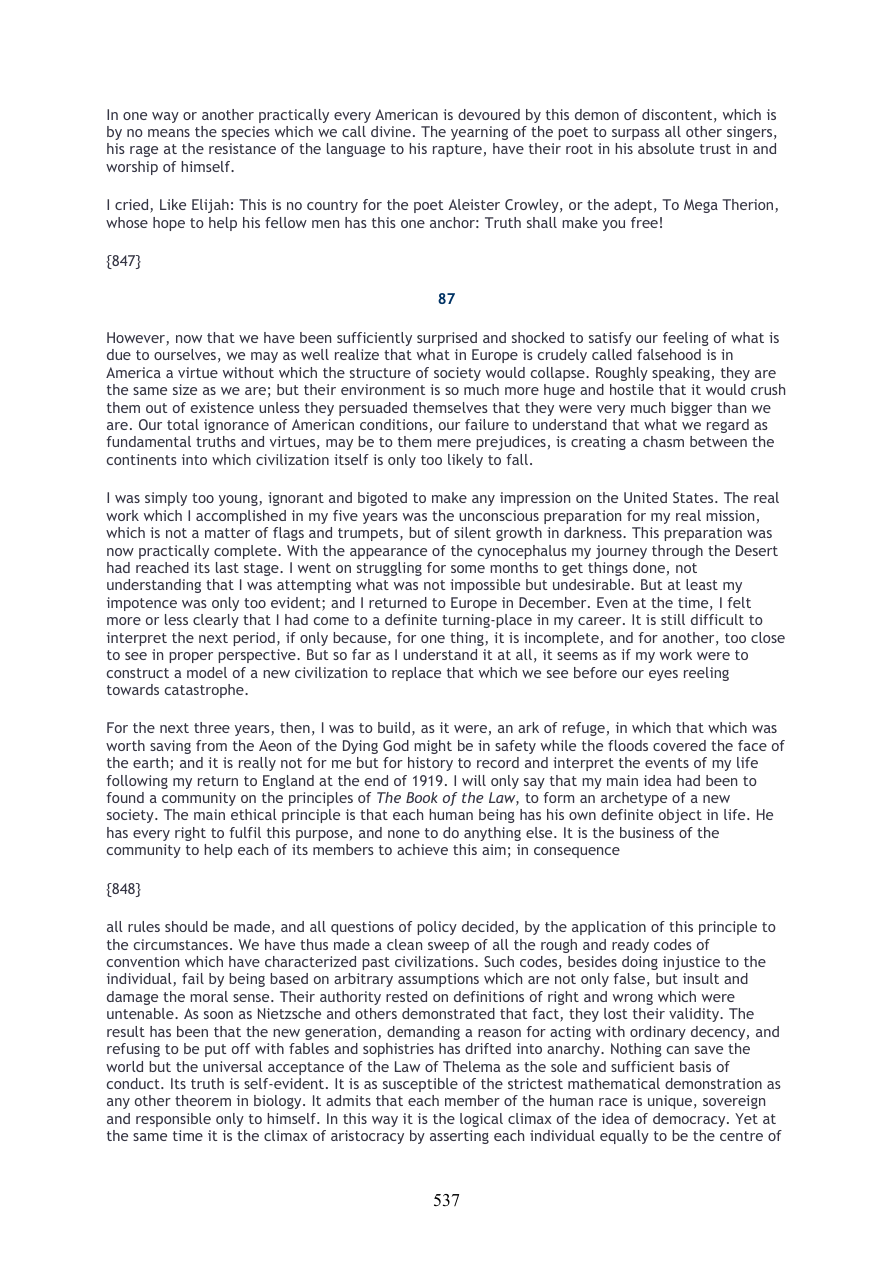
Highlights use the original PDF text layer. OCR-only matches may not be visible on the scan.
Transcription
Download text ↓raw extractionoriginal embedded textReview: unreviewed
537
In one way or another practically every American is devoured by this demon of discontent, which is
by no means the species which we call divine. The yearning of the poet to surpass all other singers,
his rage at the resistance of the language to his rapture, have their root in his absolute trust in and
worship of himself.
I cried, Like Elijah: This is no country for the poet Aleister Crowley, or the adept, To Mega Therion,
whose hope to help his fellow men has this one anchor: Truth shall make you free!
{847}
87
However, now that we have been sufficiently surprised and shocked to satisfy our feeling of what is
due to ourselves, we may as well realize that what in Europe is crudely called falsehood is in
America a virtue without which the structure of society would collapse. Roughly speaking, they are
the same size as we are; but their environment is so much more huge and hostile that it would crush
them out of existence unless they persuaded themselves that they were very much bigger than we
are. Our total ignorance of American conditions, our failure to understand that what we regard as
fundamental truths and virtues, may be to them mere prejudices, is creating a chasm between the
continents into which civilization itself is only too likely to fall.
I was simply too young, ignorant and bigoted to make any impression on the United States. The real
work which I accomplished in my five years was the unconscious preparation for my real mission,
which is not a matter of flags and trumpets, but of silent growth in darkness. This preparation was
now practically complete. With the appearance of the cynocephalus my journey through the Desert
had reached its last stage. I went on struggling for some months to get things done, not
understanding that I was attempting what was not impossible but undesirable. But at least my
impotence was only too evident; and I returned to Europe in December. Even at the time, I felt
more or less clearly that I had come to a definite turning-place in my career. It is still difficult to
interpret the next period, if only because, for one thing, it is incomplete, and for another, too close
to see in proper perspective. But so far as I understand it at all, it seems as if my work were to
construct a model of a new civilization to replace that which we see before our eyes reeling
towards catastrophe.
For the next three years, then, I was to build, as it were, an ark of refuge, in which that which was
worth saving from the Aeon of the Dying God might be in safety while the floods covered the face of
the earth; and it is really not for me but for history to record and interpret the events of my life
following my return to England at the end of 1919. I will only say that my main idea had been to
found a community on the principles of The Book of the Law, to form an archetype of a new
society. The main ethical principle is that each human being has his own definite object in life. He
has every right to fulfil this purpose, and none to do anything else. It is the business of the
community to help each of its members to achieve this aim; in consequence
{848}
all rules should be made, and all questions of policy decided, by the application of this principle to
the circumstances. We have thus made a clean sweep of all the rough and ready codes of
convention which have characterized past civilizations. Such codes, besides doing injustice to the
individual, fail by being based on arbitrary assumptions which are not only false, but insult and
damage the moral sense. Their authority rested on definitions of right and wrong which were
untenable. As soon as Nietzsche and others demonstrated that fact, they lost their validity. The
result has been that the new generation, demanding a reason for acting with ordinary decency, and
refusing to be put off with fables and sophistries has drifted into anarchy. Nothing can save the
world but the universal acceptance of the Law of Thelema as the sole and sufficient basis of
conduct. Its truth is self-evident. It is as susceptible of the strictest mathematical demonstration as
any other theorem in biology. It admits that each member of the human race is unique, sovereign
and responsible only to himself. In this way it is the logical climax of the idea of democracy. Yet at
the same time it is the climax of aristocracy by asserting each individual equally to be the centre of
Page provenance & review flags
Stable page ID: 5ef44b98d8f9c4af5f6f86e1:p00537
Line breaks are preserved. Reading order and OCR accuracy may need review.
Printed page label has not been verified.
- No automated review flags. This does not establish transcription accuracy.