1929 · CLOSE READING
Confessions of Aleister Crowley
Confessions of Aleister Crowley (1929), PDF p. 526
Original page
Enlarge ↗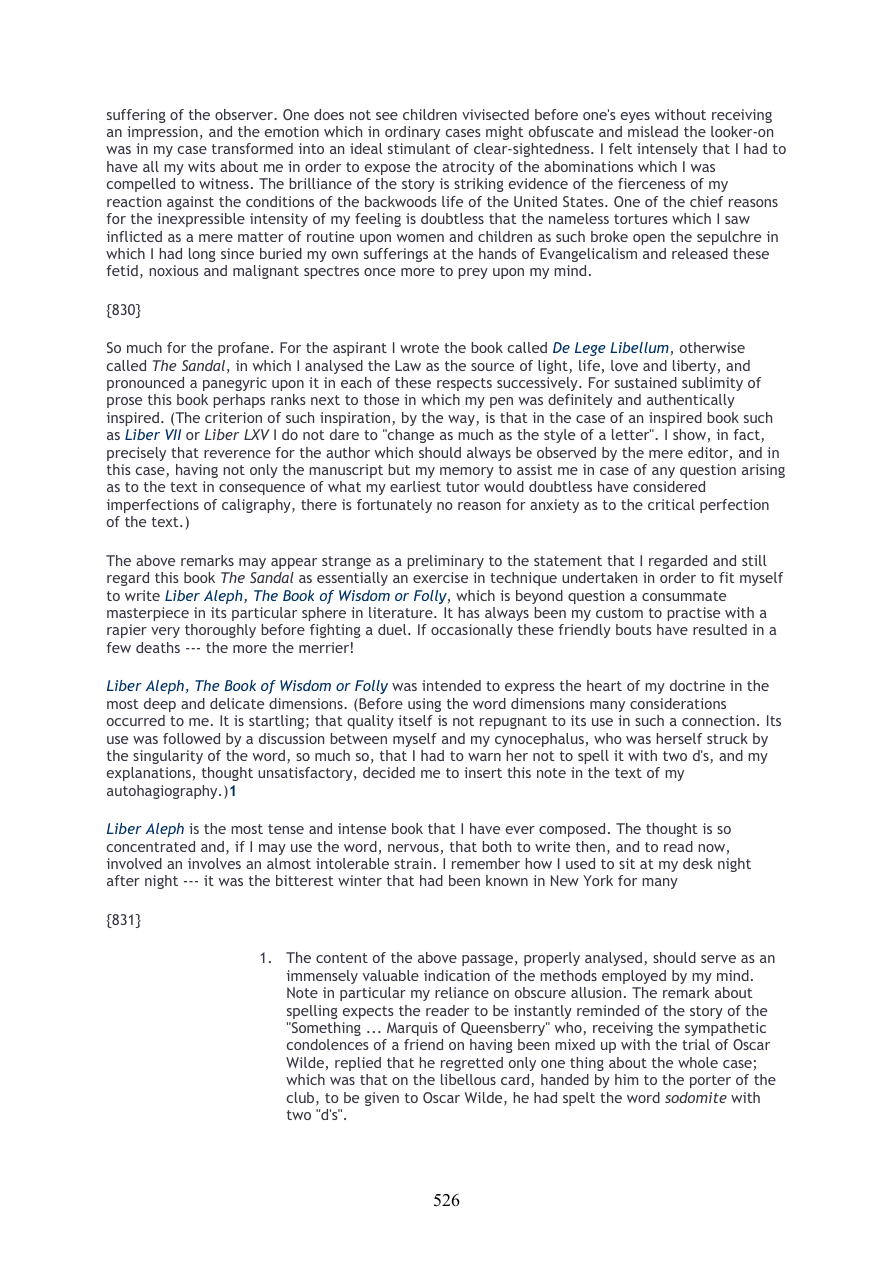
Highlights use the original PDF text layer. OCR-only matches may not be visible on the scan.
Transcription
Download text ↓raw extractionoriginal embedded textReview: unreviewed
526
suffering of the observer. One does not see children vivisected before one's eyes without receiving
an impression, and the emotion which in ordinary cases might obfuscate and mislead the looker-on
was in my case transformed into an ideal stimulant of clear-sightedness. I felt intensely that I had to
have all my wits about me in order to expose the atrocity of the abominations which I was
compelled to witness. The brilliance of the story is striking evidence of the fierceness of my
reaction against the conditions of the backwoods life of the United States. One of the chief reasons
for the inexpressible intensity of my feeling is doubtless that the nameless tortures which I saw
inflicted as a mere matter of routine upon women and children as such broke open the sepulchre in
which I had long since buried my own sufferings at the hands of Evangelicalism and released these
fetid, noxious and malignant spectres once more to prey upon my mind.
{830}
So much for the profane. For the aspirant I wrote the book called De Lege Libellum, otherwise
called The Sandal, in which I analysed the Law as the source of light, life, love and liberty, and
pronounced a panegyric upon it in each of these respects successively. For sustained sublimity of
prose this book perhaps ranks next to those in which my pen was definitely and authentically
inspired. (The criterion of such inspiration, by the way, is that in the case of an inspired book such
as Liber VII or Liber LXV I do not dare to "change as much as the style of a letter". I show, in fact,
precisely that reverence for the author which should always be observed by the mere editor, and in
this case, having not only the manuscript but my memory to assist me in case of any question arising
as to the text in consequence of what my earliest tutor would doubtless have considered
imperfections of caligraphy, there is fortunately no reason for anxiety as to the critical perfection
of the text.)
The above remarks may appear strange as a preliminary to the statement that I regarded and still
regard this book The Sandal as essentially an exercise in technique undertaken in order to fit myself
to write Liber Aleph, The Book of Wisdom or Folly, which is beyond question a consummate
masterpiece in its particular sphere in literature. It has always been my custom to practise with a
rapier very thoroughly before fighting a duel. If occasionally these friendly bouts have resulted in a
few deaths --- the more the merrier!
Liber Aleph, The Book of Wisdom or Folly was intended to express the heart of my doctrine in the
most deep and delicate dimensions. (Before using the word dimensions many considerations
occurred to me. It is startling; that quality itself is not repugnant to its use in such a connection. Its
use was followed by a discussion between myself and my cynocephalus, who was herself struck by
the singularity of the word, so much so, that I had to warn her not to spell it with two d's, and my
explanations, thought unsatisfactory, decided me to insert this note in the text of my
autohagiography.)1
Liber Aleph is the most tense and intense book that I have ever composed. The thought is so
concentrated and, if I may use the word, nervous, that both to write then, and to read now,
involved an involves an almost intolerable strain. I remember how I used to sit at my desk night
after night --- it was the bitterest winter that had been known in New York for many
{831}
1. The content of the above passage, properly analysed, should serve as an
immensely valuable indication of the methods employed by my mind.
Note in particular my reliance on obscure allusion. The remark about
spelling expects the reader to be instantly reminded of the story of the
"Something ... Marquis of Queensberry" who, receiving the sympathetic
condolences of a friend on having been mixed up with the trial of Oscar
Wilde, replied that he regretted only one thing about the whole case;
which was that on the libellous card, handed by him to the porter of the
club, to be given to Oscar Wilde, he had spelt the word sodomite with
two "d's".
Page provenance & review flags
Stable page ID: 5ef44b98d8f9c4af5f6f86e1:p00526
Line breaks are preserved. Reading order and OCR accuracy may need review.
Printed page label has not been verified.
- No automated review flags. This does not establish transcription accuracy.