1929 · CLOSE READING
Confessions of Aleister Crowley
Confessions of Aleister Crowley (1929), PDF p. 520
Original page
Enlarge ↗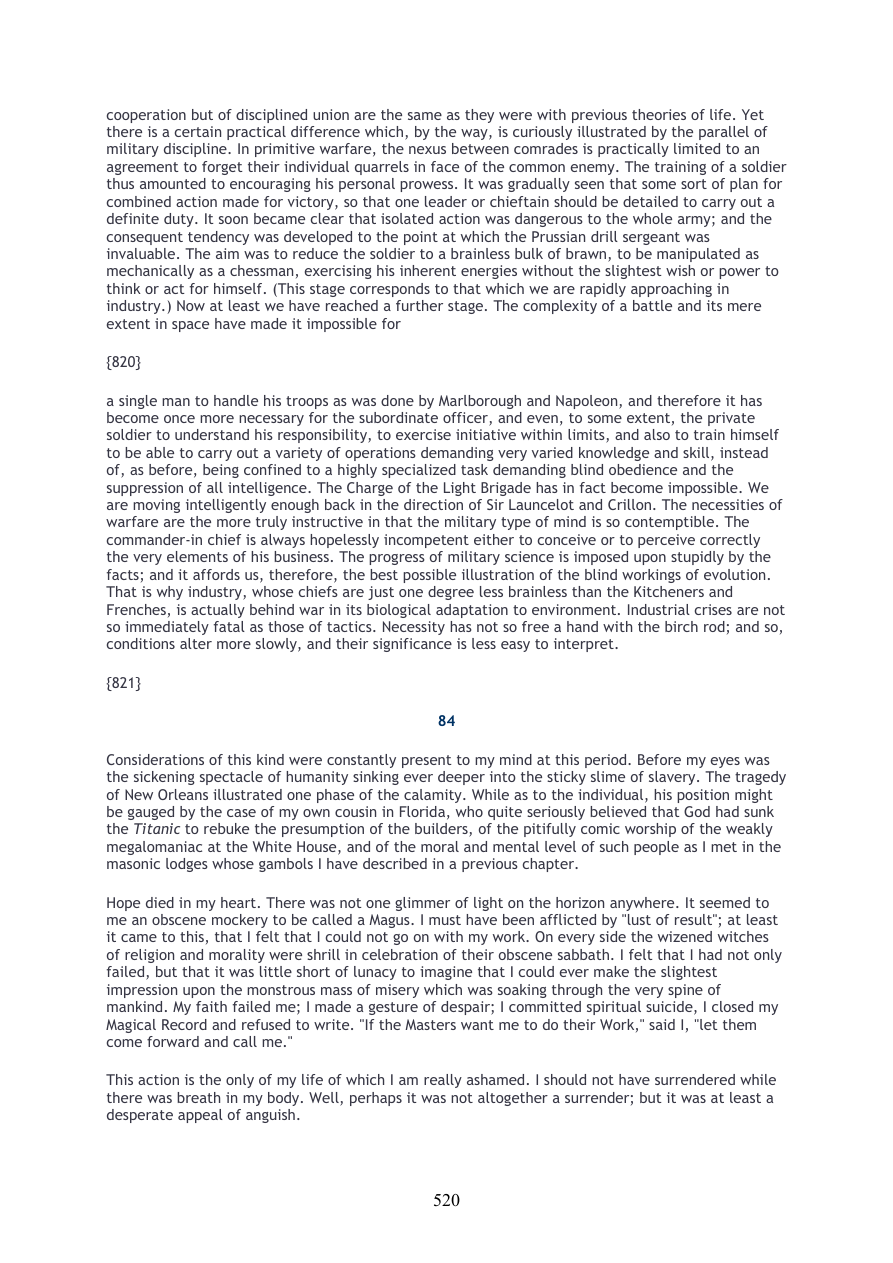
Highlights use the original PDF text layer. OCR-only matches may not be visible on the scan.
Transcription
Download text ↓raw extractionoriginal embedded textReview: unreviewed
520
cooperation but of disciplined union are the same as they were with previous theories of life. Yet
there is a certain practical difference which, by the way, is curiously illustrated by the parallel of
military discipline. In primitive warfare, the nexus between comrades is practically limited to an
agreement to forget their individual quarrels in face of the common enemy. The training of a soldier
thus amounted to encouraging his personal prowess. It was gradually seen that some sort of plan for
combined action made for victory, so that one leader or chieftain should be detailed to carry out a
definite duty. It soon became clear that isolated action was dangerous to the whole army; and the
consequent tendency was developed to the point at which the Prussian drill sergeant was
invaluable. The aim was to reduce the soldier to a brainless bulk of brawn, to be manipulated as
mechanically as a chessman, exercising his inherent energies without the slightest wish or power to
think or act for himself. (This stage corresponds to that which we are rapidly approaching in
industry.) Now at least we have reached a further stage. The complexity of a battle and its mere
extent in space have made it impossible for
{820}
a single man to handle his troops as was done by Marlborough and Napoleon, and therefore it has
become once more necessary for the subordinate officer, and even, to some extent, the private
soldier to understand his responsibility, to exercise initiative within limits, and also to train himself
to be able to carry out a variety of operations demanding very varied knowledge and skill, instead
of, as before, being confined to a highly specialized task demanding blind obedience and the
suppression of all intelligence. The Charge of the Light Brigade has in fact become impossible. We
are moving intelligently enough back in the direction of Sir Launcelot and Crillon. The necessities of
warfare are the more truly instructive in that the military type of mind is so contemptible. The
commander-in chief is always hopelessly incompetent either to conceive or to perceive correctly
the very elements of his business. The progress of military science is imposed upon stupidly by the
facts; and it affords us, therefore, the best possible illustration of the blind workings of evolution.
That is why industry, whose chiefs are just one degree less brainless than the Kitcheners and
Frenches, is actually behind war in its biological adaptation to environment. Industrial crises are not
so immediately fatal as those of tactics. Necessity has not so free a hand with the birch rod; and so,
conditions alter more slowly, and their significance is less easy to interpret.
{821}
84
Considerations of this kind were constantly present to my mind at this period. Before my eyes was
the sickening spectacle of humanity sinking ever deeper into the sticky slime of slavery. The tragedy
of New Orleans illustrated one phase of the calamity. While as to the individual, his position might
be gauged by the case of my own cousin in Florida, who quite seriously believed that God had sunk
the Titanic to rebuke the presumption of the builders, of the pitifully comic worship of the weakly
megalomaniac at the White House, and of the moral and mental level of such people as I met in the
masonic lodges whose gambols I have described in a previous chapter.
Hope died in my heart. There was not one glimmer of light on the horizon anywhere. It seemed to
me an obscene mockery to be called a Magus. I must have been afflicted by "lust of result"; at least
it came to this, that I felt that I could not go on with my work. On every side the wizened witches
of religion and morality were shrill in celebration of their obscene sabbath. I felt that I had not only
failed, but that it was little short of lunacy to imagine that I could ever make the slightest
impression upon the monstrous mass of misery which was soaking through the very spine of
mankind. My faith failed me; I made a gesture of despair; I committed spiritual suicide, I closed my
Magical Record and refused to write. "If the Masters want me to do their Work," said I, "let them
come forward and call me."
This action is the only of my life of which I am really ashamed. I should not have surrendered while
there was breath in my body. Well, perhaps it was not altogether a surrender; but it was at least a
desperate appeal of anguish.
Page provenance & review flags
Stable page ID: 5ef44b98d8f9c4af5f6f86e1:p00520
Line breaks are preserved. Reading order and OCR accuracy may need review.
Printed page label has not been verified.
- No automated review flags. This does not establish transcription accuracy.