1929 · CLOSE READING
Confessions of Aleister Crowley
Confessions of Aleister Crowley (1929), PDF p. 512
Original page
Enlarge ↗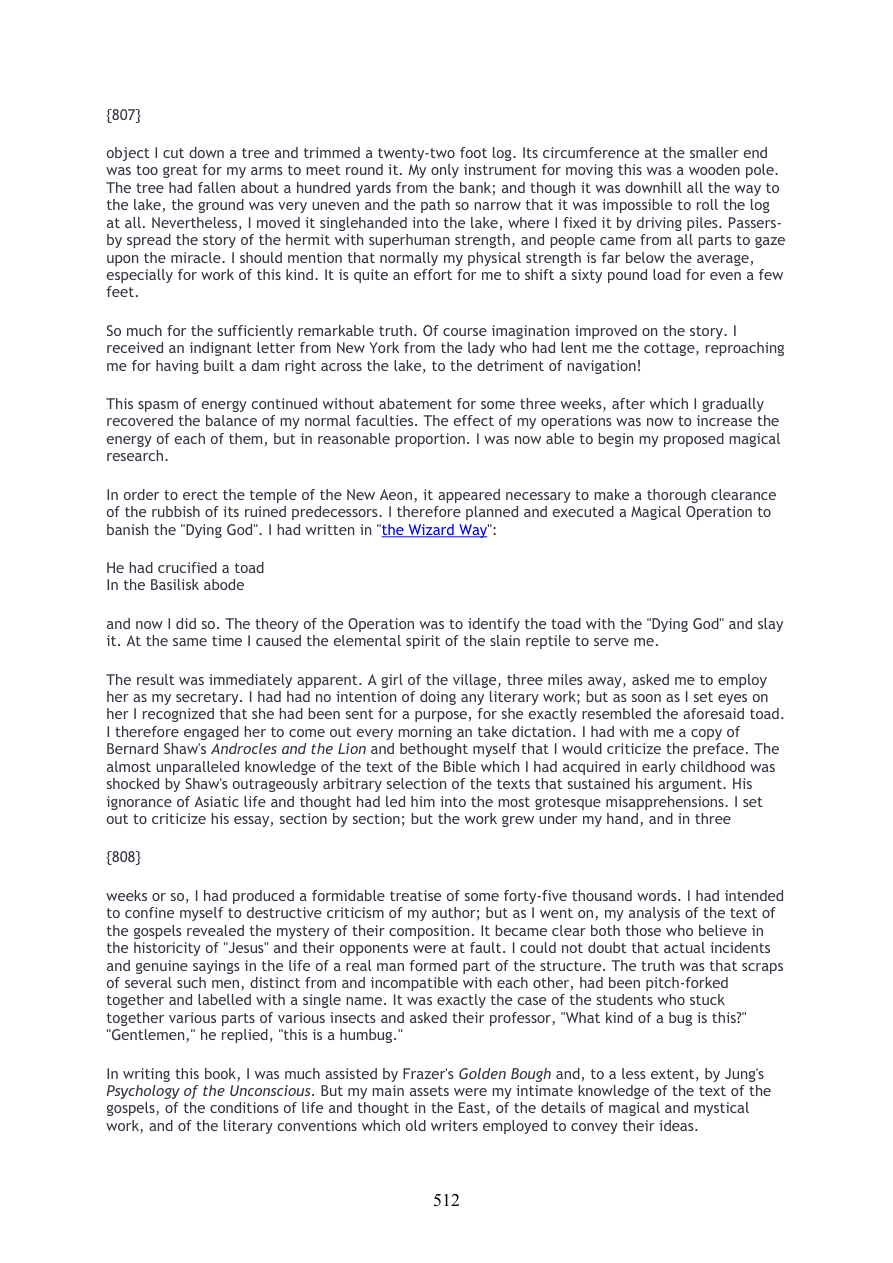
Highlights use the original PDF text layer. OCR-only matches may not be visible on the scan.
Transcription
Download text ↓raw extractionoriginal embedded textReview: unreviewed
512
{807}
object I cut down a tree and trimmed a twenty-two foot log. Its circumference at the smaller end
was too great for my arms to meet round it. My only instrument for moving this was a wooden pole.
The tree had fallen about a hundred yards from the bank; and though it was downhill all the way to
the lake, the ground was very uneven and the path so narrow that it was impossible to roll the log
at all. Nevertheless, I moved it singlehanded into the lake, where I fixed it by driving piles. Passers-
by spread the story of the hermit with superhuman strength, and people came from all parts to gaze
upon the miracle. I should mention that normally my physical strength is far below the average,
especially for work of this kind. It is quite an effort for me to shift a sixty pound load for even a few
feet.
So much for the sufficiently remarkable truth. Of course imagination improved on the story. I
received an indignant letter from New York from the lady who had lent me the cottage, reproaching
me for having built a dam right across the lake, to the detriment of navigation!
This spasm of energy continued without abatement for some three weeks, after which I gradually
recovered the balance of my normal faculties. The effect of my operations was now to increase the
energy of each of them, but in reasonable proportion. I was now able to begin my proposed magical
research.
In order to erect the temple of the New Aeon, it appeared necessary to make a thorough clearance
of the rubbish of its ruined predecessors. I therefore planned and executed a Magical Operation to
banish the "Dying God". I had written in "the Wizard Way":
He had crucified a toad
In the Basilisk abode
and now I did so. The theory of the Operation was to identify the toad with the "Dying God" and slay
it. At the same time I caused the elemental spirit of the slain reptile to serve me.
The result was immediately apparent. A girl of the village, three miles away, asked me to employ
her as my secretary. I had had no intention of doing any literary work; but as soon as I set eyes on
her I recognized that she had been sent for a purpose, for she exactly resembled the aforesaid toad.
I therefore engaged her to come out every morning an take dictation. I had with me a copy of
Bernard Shaw's Androcles and the Lion and bethought myself that I would criticize the preface. The
almost unparalleled knowledge of the text of the Bible which I had acquired in early childhood was
shocked by Shaw's outrageously arbitrary selection of the texts that sustained his argument. His
ignorance of Asiatic life and thought had led him into the most grotesque misapprehensions. I set
out to criticize his essay, section by section; but the work grew under my hand, and in three
{808}
weeks or so, I had produced a formidable treatise of some forty-five thousand words. I had intended
to confine myself to destructive criticism of my author; but as I went on, my analysis of the text of
the gospels revealed the mystery of their composition. It became clear both those who believe in
the historicity of "Jesus" and their opponents were at fault. I could not doubt that actual incidents
and genuine sayings in the life of a real man formed part of the structure. The truth was that scraps
of several such men, distinct from and incompatible with each other, had been pitch-forked
together and labelled with a single name. It was exactly the case of the students who stuck
together various parts of various insects and asked their professor, "What kind of a bug is this?"
"Gentlemen," he replied, "this is a humbug."
In writing this book, I was much assisted by Frazer's Golden Bough and, to a less extent, by Jung's
Psychology of the Unconscious. But my main assets were my intimate knowledge of the text of the
gospels, of the conditions of life and thought in the East, of the details of magical and mystical
work, and of the literary conventions which old writers employed to convey their ideas.
Page provenance & review flags
Stable page ID: 5ef44b98d8f9c4af5f6f86e1:p00512
Line breaks are preserved. Reading order and OCR accuracy may need review.
Printed page label has not been verified.
- No automated review flags. This does not establish transcription accuracy.