1929 · CLOSE READING
Confessions of Aleister Crowley
Confessions of Aleister Crowley (1929), PDF p. 4
Original page
Enlarge ↗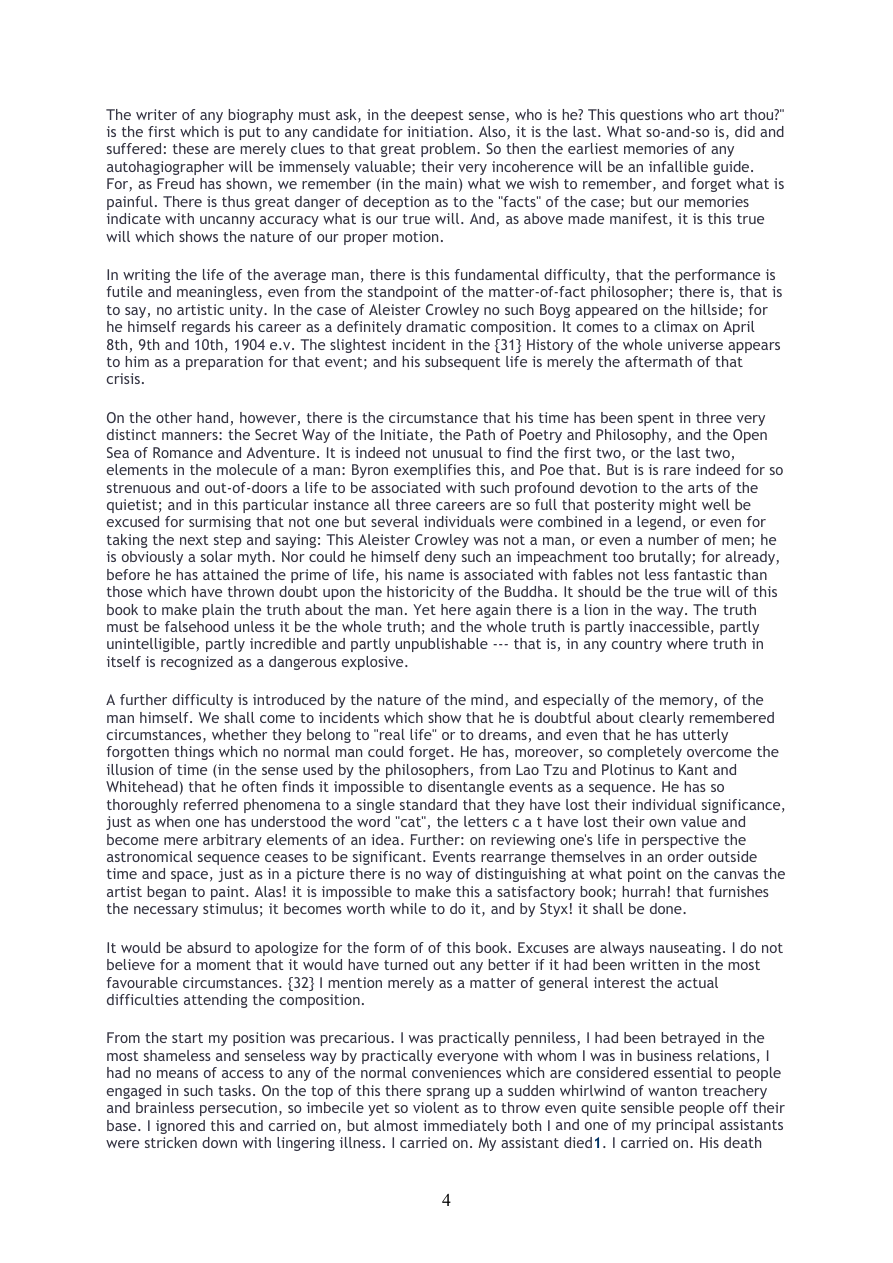
Highlights use the original PDF text layer. OCR-only matches may not be visible on the scan.
Transcription
Download text ↓raw extractionoriginal embedded textReview: unreviewed
4
The writer of any biography must ask, in the deepest sense, who is he? This questions who art thou?"
is the first which is put to any candidate for initiation. Also, it is the last. What so-and-so is, did and
suffered: these are merely clues to that great problem. So then the earliest memories of any
autohagiographer will be immensely valuable; their very incoherence will be an infallible guide.
For, as Freud has shown, we remember (in the main) what we wish to remember, and forget what is
painful. There is thus great danger of deception as to the "facts" of the case; but our memories
indicate with uncanny accuracy what is our true will. And, as above made manifest, it is this true
will which shows the nature of our proper motion.
In writing the life of the average man, there is this fundamental difficulty, that the performance is
futile and meaningless, even from the standpoint of the matter-of-fact philosopher; there is, that is
to say, no artistic unity. In the case of Aleister Crowley no such Boyg appeared on the hillside; for
he himself regards his career as a definitely dramatic composition. It comes to a climax on April
8th, 9th and 10th, 1904 e.v. The slightest incident in the {31} History of the whole universe appears
to him as a preparation for that event; and his subsequent life is merely the aftermath of that
crisis.
On the other hand, however, there is the circumstance that his time has been spent in three very
distinct manners: the Secret Way of the Initiate, the Path of Poetry and Philosophy, and the Open
Sea of Romance and Adventure. It is indeed not unusual to find the first two, or the last two,
elements in the molecule of a man: Byron exemplifies this, and Poe that. But is is rare indeed for so
strenuous and out-of-doors a life to be associated with such profound devotion to the arts of the
quietist; and in this particular instance all three careers are so full that posterity might well be
excused for surmising that not one but several individuals were combined in a legend, or even for
taking the next step and saying: This Aleister Crowley was not a man, or even a number of men; he
is obviously a solar myth. Nor could he himself deny such an impeachment too brutally; for already,
before he has attained the prime of life, his name is associated with fables not less fantastic than
those which have thrown doubt upon the historicity of the Buddha. It should be the true will of this
book to make plain the truth about the man. Yet here again there is a lion in the way. The truth
must be falsehood unless it be the whole truth; and the whole truth is partly inaccessible, partly
unintelligible, partly incredible and partly unpublishable --- that is, in any country where truth in
itself is recognized as a dangerous explosive.
A further difficulty is introduced by the nature of the mind, and especially of the memory, of the
man himself. We shall come to incidents which show that he is doubtful about clearly remembered
circumstances, whether they belong to "real life" or to dreams, and even that he has utterly
forgotten things which no normal man could forget. He has, moreover, so completely overcome the
illusion of time (in the sense used by the philosophers, from Lao Tzu and Plotinus to Kant and
Whitehead) that he often finds it impossible to disentangle events as a sequence. He has so
thoroughly referred phenomena to a single standard that they have lost their individual significance,
just as when one has understood the word "cat", the letters c a t have lost their own value and
become mere arbitrary elements of an idea. Further: on reviewing one's life in perspective the
astronomical sequence ceases to be significant. Events rearrange themselves in an order outside
time and space, just as in a picture there is no way of distinguishing at what point on the canvas the
artist began to paint. Alas! it is impossible to make this a satisfactory book; hurrah! that furnishes
the necessary stimulus; it becomes worth while to do it, and by Styx! it shall be done.
It would be absurd to apologize for the form of of this book. Excuses are always nauseating. I do not
believe for a moment that it would have turned out any better if it had been written in the most
favourable circumstances. {32} I mention merely as a matter of general interest the actual
difficulties attending the composition.
From the start my position was precarious. I was practically penniless, I had been betrayed in the
most shameless and senseless way by practically everyone with whom I was in business relations, I
had no means of access to any of the normal conveniences which are considered essential to people
engaged in such tasks. On the top of this there sprang up a sudden whirlwind of wanton treachery
and brainless persecution, so imbecile yet so violent as to throw even quite sensible people off their
base. I ignored this and carried on, but almost immediately both I and one of my principal assistants
were stricken down with lingering illness. I carried on. My assistant died1. I carried on. His death
Page provenance & review flags
Stable page ID: 5ef44b98d8f9c4af5f6f86e1:p00004
Line breaks are preserved. Reading order and OCR accuracy may need review.
Printed page label has not been verified.
- No automated review flags. This does not establish transcription accuracy.