1929 · CLOSE READING
Confessions of Aleister Crowley
Confessions of Aleister Crowley (1929), PDF p. 479
Original page
Enlarge ↗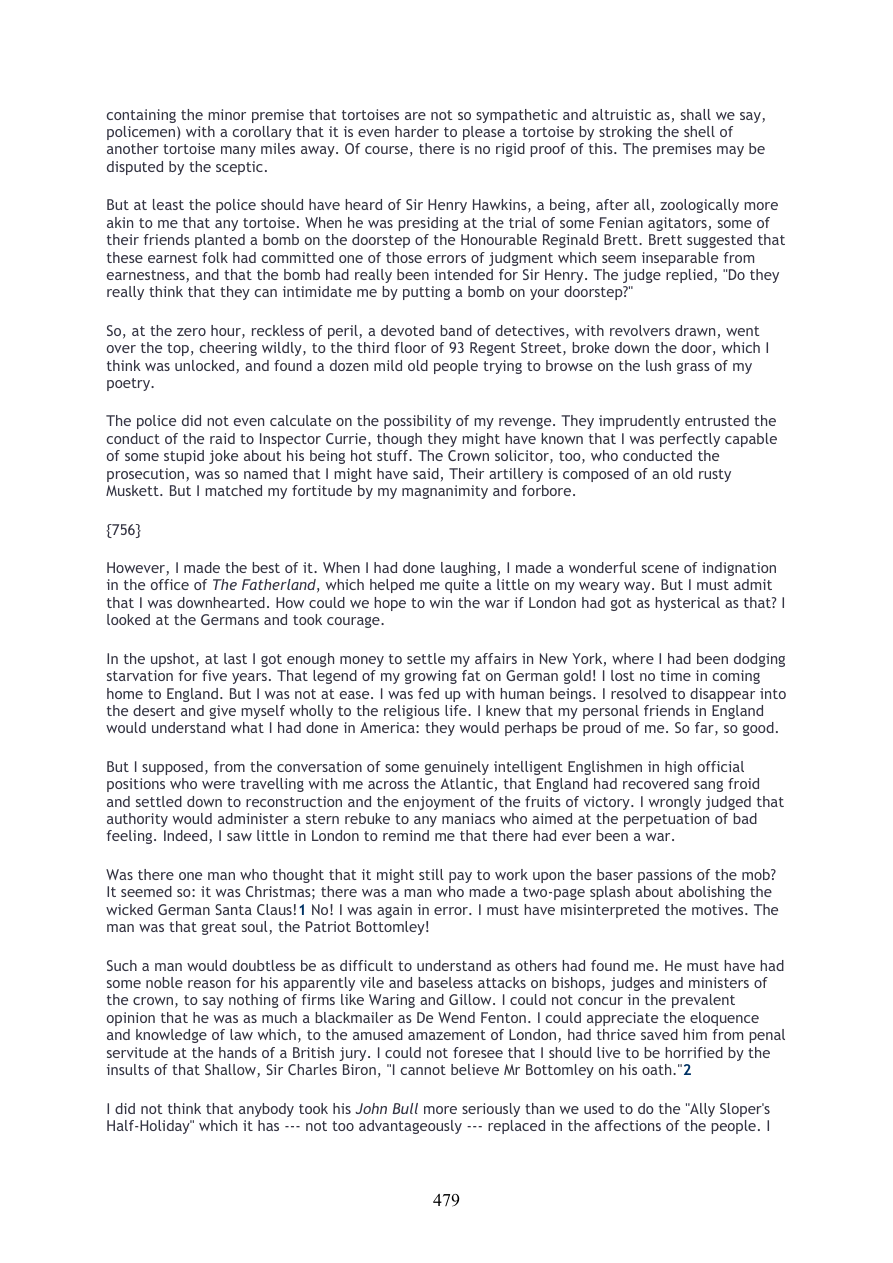
Highlights use the original PDF text layer. OCR-only matches may not be visible on the scan.
Transcription
Download text ↓raw extractionoriginal embedded textReview: unreviewed
479
containing the minor premise that tortoises are not so sympathetic and altruistic as, shall we say,
policemen) with a corollary that it is even harder to please a tortoise by stroking the shell of
another tortoise many miles away. Of course, there is no rigid proof of this. The premises may be
disputed by the sceptic.
But at least the police should have heard of Sir Henry Hawkins, a being, after all, zoologically more
akin to me that any tortoise. When he was presiding at the trial of some Fenian agitators, some of
their friends planted a bomb on the doorstep of the Honourable Reginald Brett. Brett suggested that
these earnest folk had committed one of those errors of judgment which seem inseparable from
earnestness, and that the bomb had really been intended for Sir Henry. The judge replied, "Do they
really think that they can intimidate me by putting a bomb on your doorstep?"
So, at the zero hour, reckless of peril, a devoted band of detectives, with revolvers drawn, went
over the top, cheering wildly, to the third floor of 93 Regent Street, broke down the door, which I
think was unlocked, and found a dozen mild old people trying to browse on the lush grass of my
poetry.
The police did not even calculate on the possibility of my revenge. They imprudently entrusted the
conduct of the raid to Inspector Currie, though they might have known that I was perfectly capable
of some stupid joke about his being hot stuff. The Crown solicitor, too, who conducted the
prosecution, was so named that I might have said, Their artillery is composed of an old rusty
Muskett. But I matched my fortitude by my magnanimity and forbore.
{756}
However, I made the best of it. When I had done laughing, I made a wonderful scene of indignation
in the office of The Fatherland, which helped me quite a little on my weary way. But I must admit
that I was downhearted. How could we hope to win the war if London had got as hysterical as that? I
looked at the Germans and took courage.
In the upshot, at last I got enough money to settle my affairs in New York, where I had been dodging
starvation for five years. That legend of my growing fat on German gold! I lost no time in coming
home to England. But I was not at ease. I was fed up with human beings. I resolved to disappear into
the desert and give myself wholly to the religious life. I knew that my personal friends in England
would understand what I had done in America: they would perhaps be proud of me. So far, so good.
But I supposed, from the conversation of some genuinely intelligent Englishmen in high official
positions who were travelling with me across the Atlantic, that England had recovered sang froid
and settled down to reconstruction and the enjoyment of the fruits of victory. I wrongly judged that
authority would administer a stern rebuke to any maniacs who aimed at the perpetuation of bad
feeling. Indeed, I saw little in London to remind me that there had ever been a war.
Was there one man who thought that it might still pay to work upon the baser passions of the mob?
It seemed so: it was Christmas; there was a man who made a two-page splash about abolishing the
wicked German Santa Claus!1 No! I was again in error. I must have misinterpreted the motives. The
man was that great soul, the Patriot Bottomley!
Such a man would doubtless be as difficult to understand as others had found me. He must have had
some noble reason for his apparently vile and baseless attacks on bishops, judges and ministers of
the crown, to say nothing of firms like Waring and Gillow. I could not concur in the prevalent
opinion that he was as much a blackmailer as De Wend Fenton. I could appreciate the eloquence
and knowledge of law which, to the amused amazement of London, had thrice saved him from penal
servitude at the hands of a British jury. I could not foresee that I should live to be horrified by the
insults of that Shallow, Sir Charles Biron, "I cannot believe Mr Bottomley on his oath."2
I did not think that anybody took his John Bull more seriously than we used to do the "Ally Sloper's
Half-Holiday" which it has --- not too advantageously --- replaced in the affections of the people. I
Page provenance & review flags
Stable page ID: 5ef44b98d8f9c4af5f6f86e1:p00479
Line breaks are preserved. Reading order and OCR accuracy may need review.
Printed page label has not been verified.
- No automated review flags. This does not establish transcription accuracy.