1929 · CLOSE READING
Confessions of Aleister Crowley
Confessions of Aleister Crowley (1929), PDF p. 476
Original page
Enlarge ↗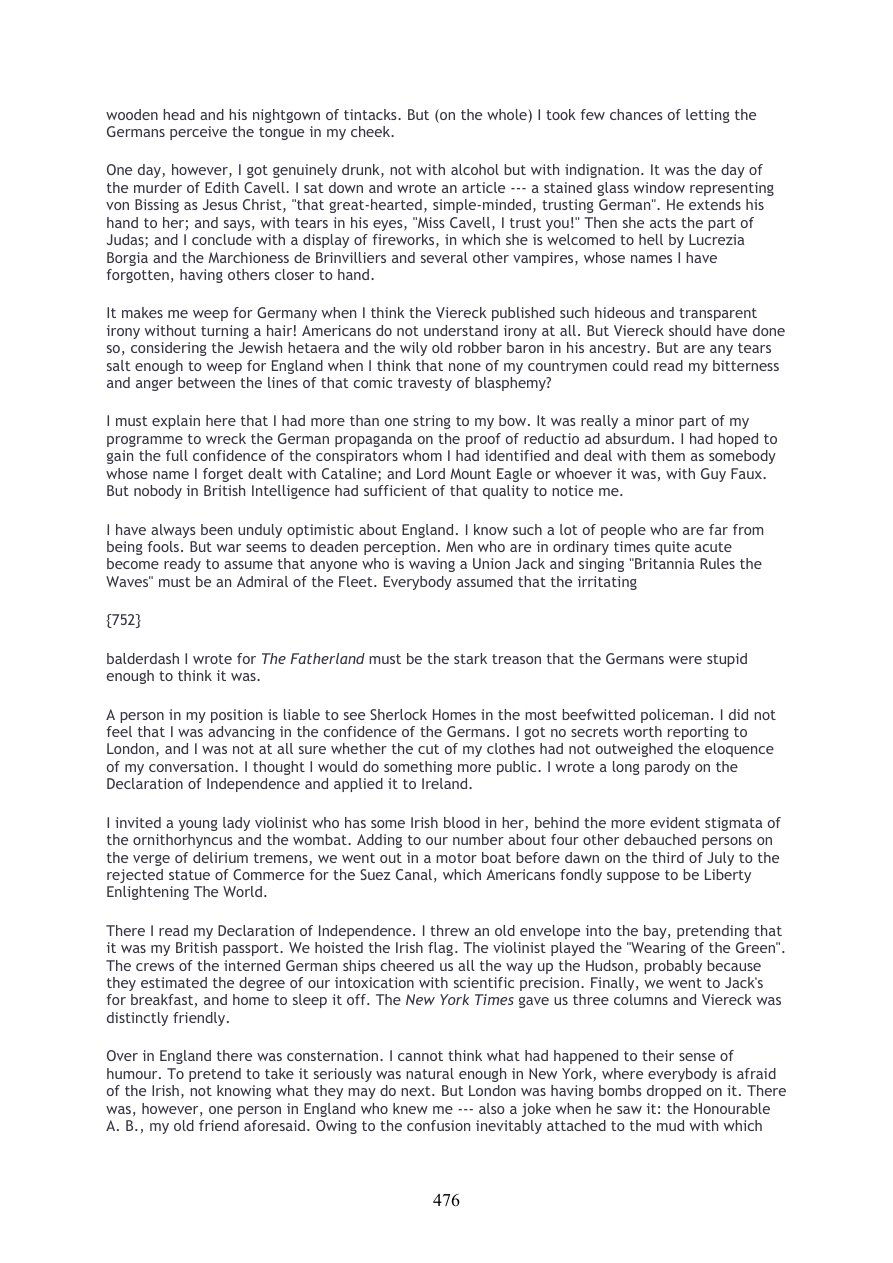
Highlights use the original PDF text layer. OCR-only matches may not be visible on the scan.
Transcription
Download text ↓raw extractionoriginal embedded textReview: unreviewed
476
wooden head and his nightgown of tintacks. But (on the whole) I took few chances of letting the
Germans perceive the tongue in my cheek.
One day, however, I got genuinely drunk, not with alcohol but with indignation. It was the day of
the murder of Edith Cavell. I sat down and wrote an article --- a stained glass window representing
von Bissing as Jesus Christ, "that great-hearted, simple-minded, trusting German". He extends his
hand to her; and says, with tears in his eyes, "Miss Cavell, I trust you!" Then she acts the part of
Judas; and I conclude with a display of fireworks, in which she is welcomed to hell by Lucrezia
Borgia and the Marchioness de Brinvilliers and several other vampires, whose names I have
forgotten, having others closer to hand.
It makes me weep for Germany when I think the Viereck published such hideous and transparent
irony without turning a hair! Americans do not understand irony at all. But Viereck should have done
so, considering the Jewish hetaera and the wily old robber baron in his ancestry. But are any tears
salt enough to weep for England when I think that none of my countrymen could read my bitterness
and anger between the lines of that comic travesty of blasphemy?
I must explain here that I had more than one string to my bow. It was really a minor part of my
programme to wreck the German propaganda on the proof of reductio ad absurdum. I had hoped to
gain the full confidence of the conspirators whom I had identified and deal with them as somebody
whose name I forget dealt with Cataline; and Lord Mount Eagle or whoever it was, with Guy Faux.
But nobody in British Intelligence had sufficient of that quality to notice me.
I have always been unduly optimistic about England. I know such a lot of people who are far from
being fools. But war seems to deaden perception. Men who are in ordinary times quite acute
become ready to assume that anyone who is waving a Union Jack and singing "Britannia Rules the
Waves" must be an Admiral of the Fleet. Everybody assumed that the irritating
{752}
balderdash I wrote for The Fatherland must be the stark treason that the Germans were stupid
enough to think it was.
A person in my position is liable to see Sherlock Homes in the most beefwitted policeman. I did not
feel that I was advancing in the confidence of the Germans. I got no secrets worth reporting to
London, and I was not at all sure whether the cut of my clothes had not outweighed the eloquence
of my conversation. I thought I would do something more public. I wrote a long parody on the
Declaration of Independence and applied it to Ireland.
I invited a young lady violinist who has some Irish blood in her, behind the more evident stigmata of
the ornithorhyncus and the wombat. Adding to our number about four other debauched persons on
the verge of delirium tremens, we went out in a motor boat before dawn on the third of July to the
rejected statue of Commerce for the Suez Canal, which Americans fondly suppose to be Liberty
Enlightening The World.
There I read my Declaration of Independence. I threw an old envelope into the bay, pretending that
it was my British passport. We hoisted the Irish flag. The violinist played the "Wearing of the Green".
The crews of the interned German ships cheered us all the way up the Hudson, probably because
they estimated the degree of our intoxication with scientific precision. Finally, we went to Jack's
for breakfast, and home to sleep it off. The New York Times gave us three columns and Viereck was
distinctly friendly.
Over in England there was consternation. I cannot think what had happened to their sense of
humour. To pretend to take it seriously was natural enough in New York, where everybody is afraid
of the Irish, not knowing what they may do next. But London was having bombs dropped on it. There
was, however, one person in England who knew me --- also a joke when he saw it: the Honourable
A. B., my old friend aforesaid. Owing to the confusion inevitably attached to the mud with which
Page provenance & review flags
Stable page ID: 5ef44b98d8f9c4af5f6f86e1:p00476
Line breaks are preserved. Reading order and OCR accuracy may need review.
Printed page label has not been verified.
- No automated review flags. This does not establish transcription accuracy.