1929 · CLOSE READING
Confessions of Aleister Crowley
Confessions of Aleister Crowley (1929), PDF p. 474
Original page
Enlarge ↗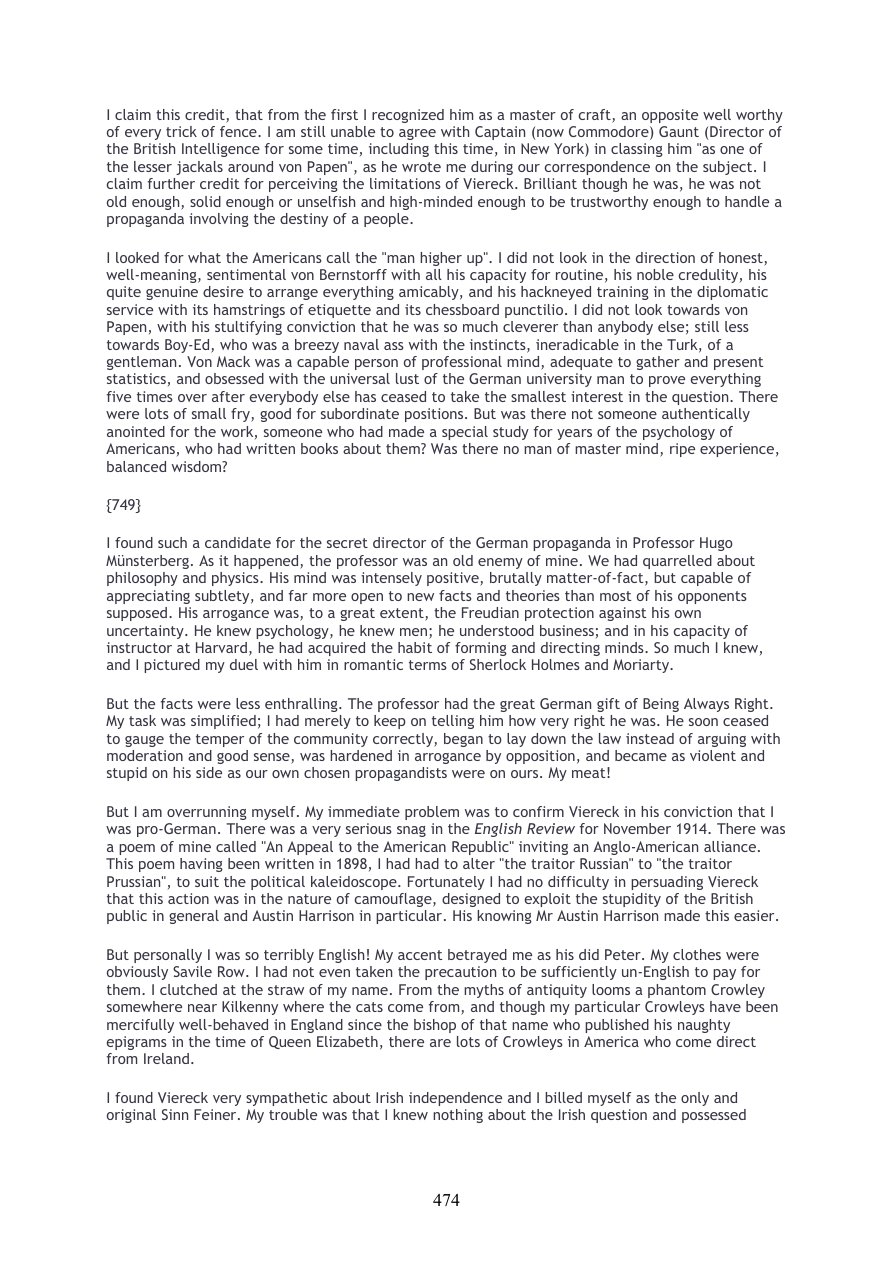
Highlights use the original PDF text layer. OCR-only matches may not be visible on the scan.
Transcription
Download text ↓raw extractionoriginal embedded textReview: unreviewed
474
I claim this credit, that from the first I recognized him as a master of craft, an opposite well worthy
of every trick of fence. I am still unable to agree with Captain (now Commodore) Gaunt (Director of
the British Intelligence for some time, including this time, in New York) in classing him "as one of
the lesser jackals around von Papen", as he wrote me during our correspondence on the subject. I
claim further credit for perceiving the limitations of Viereck. Brilliant though he was, he was not
old enough, solid enough or unselfish and high-minded enough to be trustworthy enough to handle a
propaganda involving the destiny of a people.
I looked for what the Americans call the "man higher up". I did not look in the direction of honest,
well-meaning, sentimental von Bernstorff with all his capacity for routine, his noble credulity, his
quite genuine desire to arrange everything amicably, and his hackneyed training in the diplomatic
service with its hamstrings of etiquette and its chessboard punctilio. I did not look towards von
Papen, with his stultifying conviction that he was so much cleverer than anybody else; still less
towards Boy-Ed, who was a breezy naval ass with the instincts, ineradicable in the Turk, of a
gentleman. Von Mack was a capable person of professional mind, adequate to gather and present
statistics, and obsessed with the universal lust of the German university man to prove everything
five times over after everybody else has ceased to take the smallest interest in the question. There
were lots of small fry, good for subordinate positions. But was there not someone authentically
anointed for the work, someone who had made a special study for years of the psychology of
Americans, who had written books about them? Was there no man of master mind, ripe experience,
balanced wisdom?
{749}
I found such a candidate for the secret director of the German propaganda in Professor Hugo
Münsterberg. As it happened, the professor was an old enemy of mine. We had quarrelled about
philosophy and physics. His mind was intensely positive, brutally matter-of-fact, but capable of
appreciating subtlety, and far more open to new facts and theories than most of his opponents
supposed. His arrogance was, to a great extent, the Freudian protection against his own
uncertainty. He knew psychology, he knew men; he understood business; and in his capacity of
instructor at Harvard, he had acquired the habit of forming and directing minds. So much I knew,
and I pictured my duel with him in romantic terms of Sherlock Holmes and Moriarty.
But the facts were less enthralling. The professor had the great German gift of Being Always Right.
My task was simplified; I had merely to keep on telling him how very right he was. He soon ceased
to gauge the temper of the community correctly, began to lay down the law instead of arguing with
moderation and good sense, was hardened in arrogance by opposition, and became as violent and
stupid on his side as our own chosen propagandists were on ours. My meat!
But I am overrunning myself. My immediate problem was to confirm Viereck in his conviction that I
was pro-German. There was a very serious snag in the English Review for November 1914. There was
a poem of mine called "An Appeal to the American Republic" inviting an Anglo-American alliance.
This poem having been written in 1898, I had had to alter "the traitor Russian" to "the traitor
Prussian", to suit the political kaleidoscope. Fortunately I had no difficulty in persuading Viereck
that this action was in the nature of camouflage, designed to exploit the stupidity of the British
public in general and Austin Harrison in particular. His knowing Mr Austin Harrison made this easier.
But personally I was so terribly English! My accent betrayed me as his did Peter. My clothes were
obviously Savile Row. I had not even taken the precaution to be sufficiently un-English to pay for
them. I clutched at the straw of my name. From the myths of antiquity looms a phantom Crowley
somewhere near Kilkenny where the cats come from, and though my particular Crowleys have been
mercifully well-behaved in England since the bishop of that name who published his naughty
epigrams in the time of Queen Elizabeth, there are lots of Crowleys in America who come direct
from Ireland.
I found Viereck very sympathetic about Irish independence and I billed myself as the only and
original Sinn Feiner. My trouble was that I knew nothing about the Irish question and possessed
Page provenance & review flags
Stable page ID: 5ef44b98d8f9c4af5f6f86e1:p00474
Line breaks are preserved. Reading order and OCR accuracy may need review.
Printed page label has not been verified.
- No automated review flags. This does not establish transcription accuracy.