1929 · CLOSE READING
Confessions of Aleister Crowley
Confessions of Aleister Crowley (1929), PDF p. 471
Original page
Enlarge ↗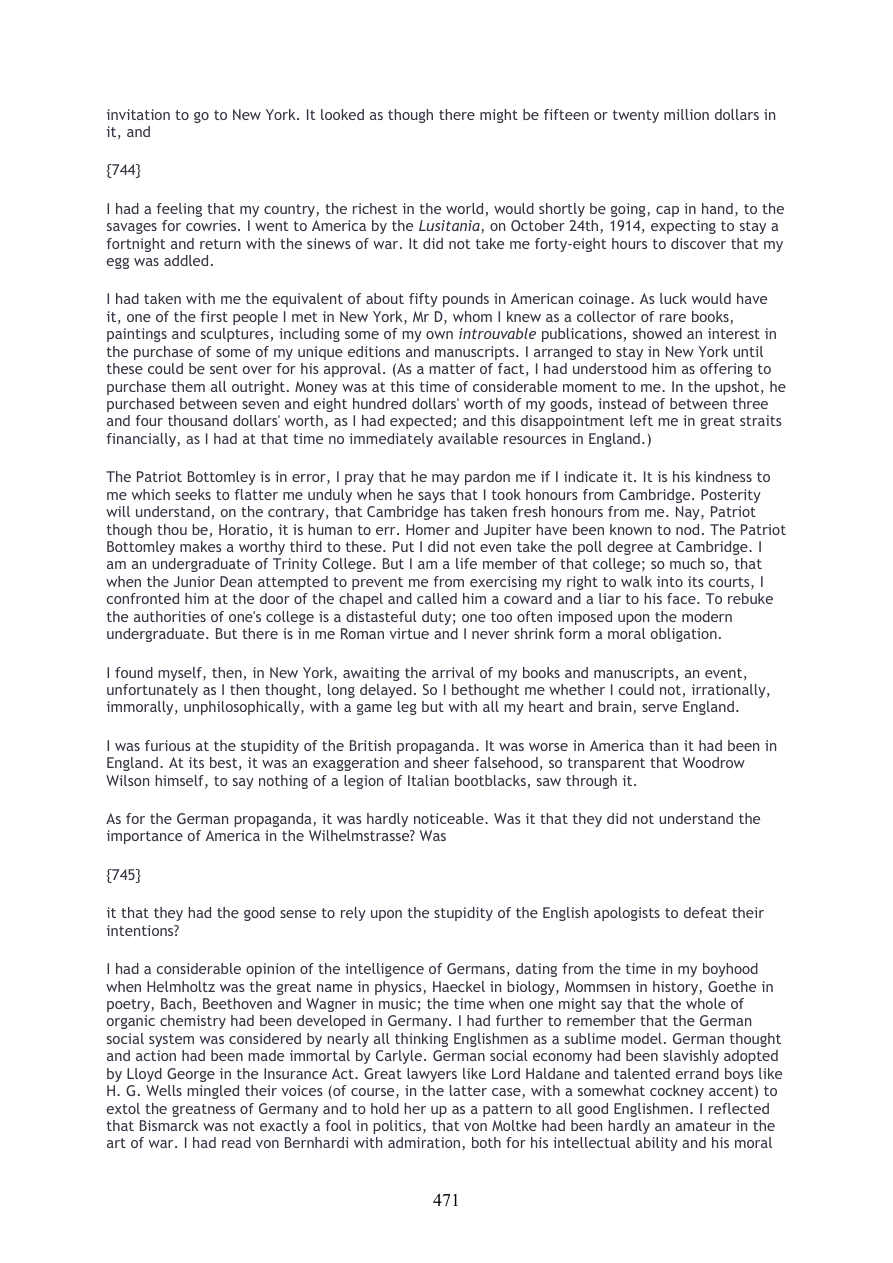
Highlights use the original PDF text layer. OCR-only matches may not be visible on the scan.
Transcription
Download text ↓raw extractionoriginal embedded textReview: unreviewed
471
invitation to go to New York. It looked as though there might be fifteen or twenty million dollars in
it, and
{744}
I had a feeling that my country, the richest in the world, would shortly be going, cap in hand, to the
savages for cowries. I went to America by the Lusitania, on October 24th, 1914, expecting to stay a
fortnight and return with the sinews of war. It did not take me forty-eight hours to discover that my
egg was addled.
I had taken with me the equivalent of about fifty pounds in American coinage. As luck would have
it, one of the first people I met in New York, Mr D, whom I knew as a collector of rare books,
paintings and sculptures, including some of my own introuvable publications, showed an interest in
the purchase of some of my unique editions and manuscripts. I arranged to stay in New York until
these could be sent over for his approval. (As a matter of fact, I had understood him as offering to
purchase them all outright. Money was at this time of considerable moment to me. In the upshot, he
purchased between seven and eight hundred dollars' worth of my goods, instead of between three
and four thousand dollars' worth, as I had expected; and this disappointment left me in great straits
financially, as I had at that time no immediately available resources in England.)
The Patriot Bottomley is in error, I pray that he may pardon me if I indicate it. It is his kindness to
me which seeks to flatter me unduly when he says that I took honours from Cambridge. Posterity
will understand, on the contrary, that Cambridge has taken fresh honours from me. Nay, Patriot
though thou be, Horatio, it is human to err. Homer and Jupiter have been known to nod. The Patriot
Bottomley makes a worthy third to these. Put I did not even take the poll degree at Cambridge. I
am an undergraduate of Trinity College. But I am a life member of that college; so much so, that
when the Junior Dean attempted to prevent me from exercising my right to walk into its courts, I
confronted him at the door of the chapel and called him a coward and a liar to his face. To rebuke
the authorities of one's college is a distasteful duty; one too often imposed upon the modern
undergraduate. But there is in me Roman virtue and I never shrink form a moral obligation.
I found myself, then, in New York, awaiting the arrival of my books and manuscripts, an event,
unfortunately as I then thought, long delayed. So I bethought me whether I could not, irrationally,
immorally, unphilosophically, with a game leg but with all my heart and brain, serve England.
I was furious at the stupidity of the British propaganda. It was worse in America than it had been in
England. At its best, it was an exaggeration and sheer falsehood, so transparent that Woodrow
Wilson himself, to say nothing of a legion of Italian bootblacks, saw through it.
As for the German propaganda, it was hardly noticeable. Was it that they did not understand the
importance of America in the Wilhelmstrasse? Was
{745}
it that they had the good sense to rely upon the stupidity of the English apologists to defeat their
intentions?
I had a considerable opinion of the intelligence of Germans, dating from the time in my boyhood
when Helmholtz was the great name in physics, Haeckel in biology, Mommsen in history, Goethe in
poetry, Bach, Beethoven and Wagner in music; the time when one might say that the whole of
organic chemistry had been developed in Germany. I had further to remember that the German
social system was considered by nearly all thinking Englishmen as a sublime model. German thought
and action had been made immortal by Carlyle. German social economy had been slavishly adopted
by Lloyd George in the Insurance Act. Great lawyers like Lord Haldane and talented errand boys like
H. G. Wells mingled their voices (of course, in the latter case, with a somewhat cockney accent) to
extol the greatness of Germany and to hold her up as a pattern to all good Englishmen. I reflected
that Bismarck was not exactly a fool in politics, that von Moltke had been hardly an amateur in the
art of war. I had read von Bernhardi with admiration, both for his intellectual ability and his moral
Page provenance & review flags
Stable page ID: 5ef44b98d8f9c4af5f6f86e1:p00471
Line breaks are preserved. Reading order and OCR accuracy may need review.
Printed page label has not been verified.
- No automated review flags. This does not establish transcription accuracy.