1929 · CLOSE READING
Confessions of Aleister Crowley
Confessions of Aleister Crowley (1929), PDF p. 464
Original page
Enlarge ↗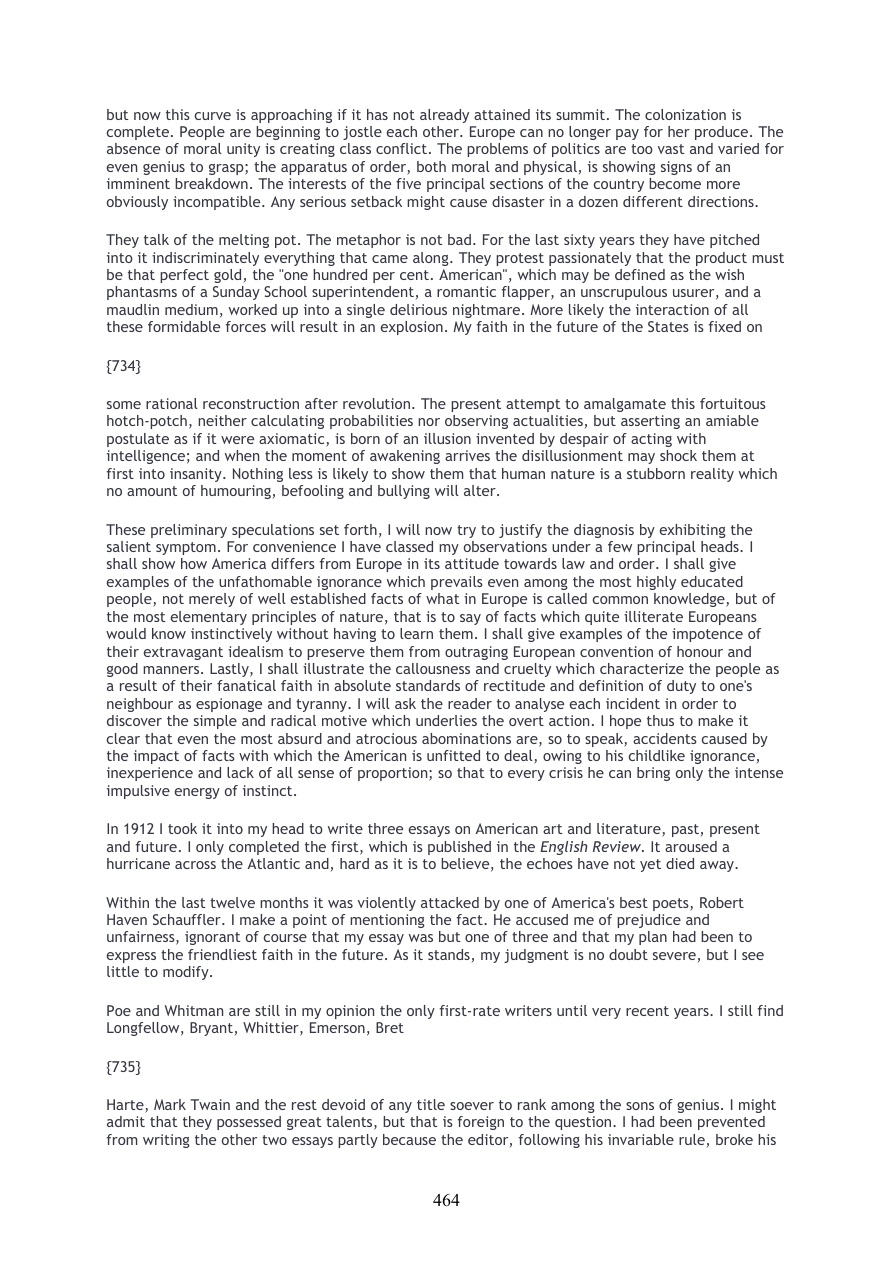
Highlights use the original PDF text layer. OCR-only matches may not be visible on the scan.
Transcription
Download text ↓raw extractionoriginal embedded textReview: unreviewed
464
but now this curve is approaching if it has not already attained its summit. The colonization is
complete. People are beginning to jostle each other. Europe can no longer pay for her produce. The
absence of moral unity is creating class conflict. The problems of politics are too vast and varied for
even genius to grasp; the apparatus of order, both moral and physical, is showing signs of an
imminent breakdown. The interests of the five principal sections of the country become more
obviously incompatible. Any serious setback might cause disaster in a dozen different directions.
They talk of the melting pot. The metaphor is not bad. For the last sixty years they have pitched
into it indiscriminately everything that came along. They protest passionately that the product must
be that perfect gold, the "one hundred per cent. American", which may be defined as the wish
phantasms of a Sunday School superintendent, a romantic flapper, an unscrupulous usurer, and a
maudlin medium, worked up into a single delirious nightmare. More likely the interaction of all
these formidable forces will result in an explosion. My faith in the future of the States is fixed on
{734}
some rational reconstruction after revolution. The present attempt to amalgamate this fortuitous
hotch-potch, neither calculating probabilities nor observing actualities, but asserting an amiable
postulate as if it were axiomatic, is born of an illusion invented by despair of acting with
intelligence; and when the moment of awakening arrives the disillusionment may shock them at
first into insanity. Nothing less is likely to show them that human nature is a stubborn reality which
no amount of humouring, befooling and bullying will alter.
These preliminary speculations set forth, I will now try to justify the diagnosis by exhibiting the
salient symptom. For convenience I have classed my observations under a few principal heads. I
shall show how America differs from Europe in its attitude towards law and order. I shall give
examples of the unfathomable ignorance which prevails even among the most highly educated
people, not merely of well established facts of what in Europe is called common knowledge, but of
the most elementary principles of nature, that is to say of facts which quite illiterate Europeans
would know instinctively without having to learn them. I shall give examples of the impotence of
their extravagant idealism to preserve them from outraging European convention of honour and
good manners. Lastly, I shall illustrate the callousness and cruelty which characterize the people as
a result of their fanatical faith in absolute standards of rectitude and definition of duty to one's
neighbour as espionage and tyranny. I will ask the reader to analyse each incident in order to
discover the simple and radical motive which underlies the overt action. I hope thus to make it
clear that even the most absurd and atrocious abominations are, so to speak, accidents caused by
the impact of facts with which the American is unfitted to deal, owing to his childlike ignorance,
inexperience and lack of all sense of proportion; so that to every crisis he can bring only the intense
impulsive energy of instinct.
In 1912 I took it into my head to write three essays on American art and literature, past, present
and future. I only completed the first, which is published in the English Review. It aroused a
hurricane across the Atlantic and, hard as it is to believe, the echoes have not yet died away.
Within the last twelve months it was violently attacked by one of America's best poets, Robert
Haven Schauffler. I make a point of mentioning the fact. He accused me of prejudice and
unfairness, ignorant of course that my essay was but one of three and that my plan had been to
express the friendliest faith in the future. As it stands, my judgment is no doubt severe, but I see
little to modify.
Poe and Whitman are still in my opinion the only first-rate writers until very recent years. I still find
Longfellow, Bryant, Whittier, Emerson, Bret
{735}
Harte, Mark Twain and the rest devoid of any title soever to rank among the sons of genius. I might
admit that they possessed great talents, but that is foreign to the question. I had been prevented
from writing the other two essays partly because the editor, following his invariable rule, broke his
Page provenance & review flags
Stable page ID: 5ef44b98d8f9c4af5f6f86e1:p00464
Line breaks are preserved. Reading order and OCR accuracy may need review.
Printed page label has not been verified.
- No automated review flags. This does not establish transcription accuracy.