1929 · CLOSE READING
Confessions of Aleister Crowley
Confessions of Aleister Crowley (1929), PDF p. 462
Original page
Enlarge ↗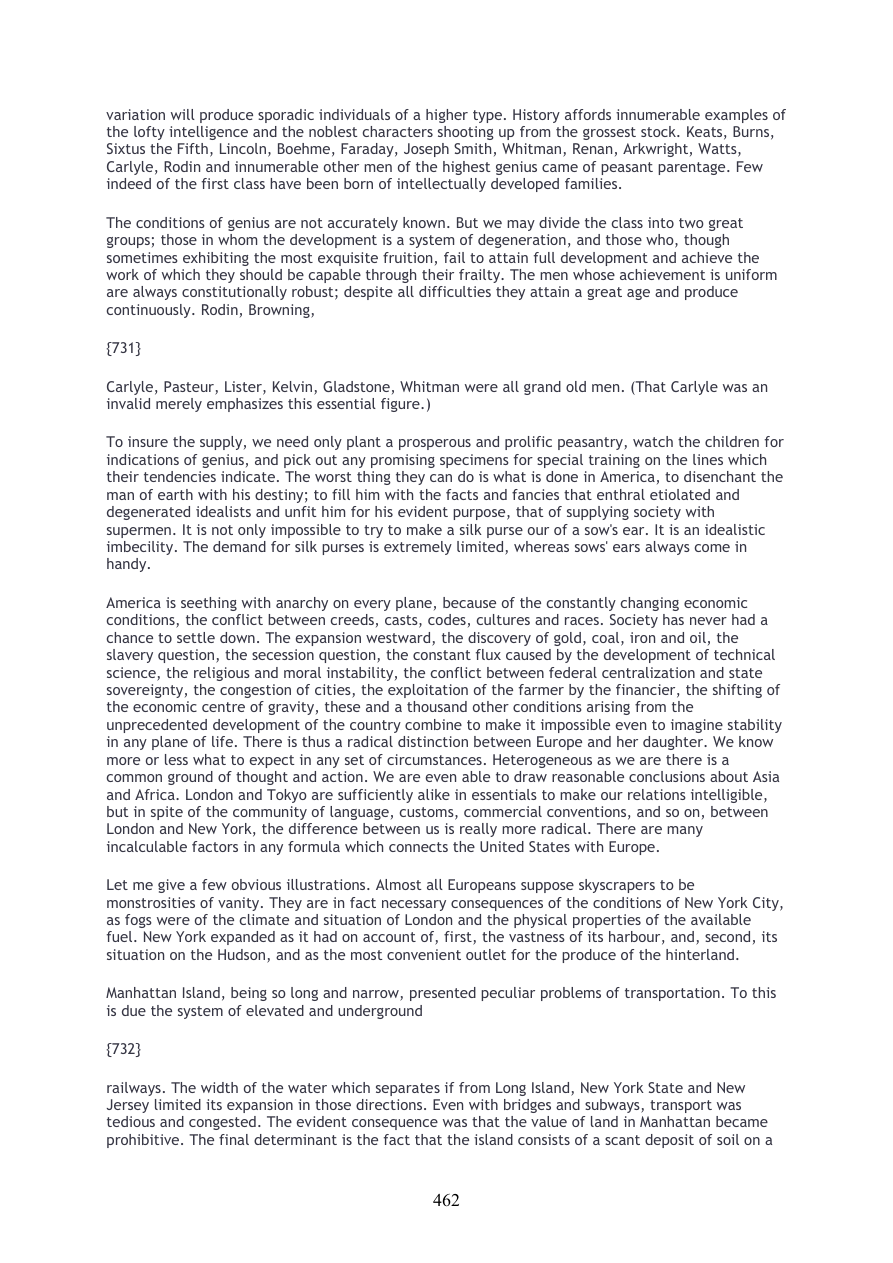
Highlights use the original PDF text layer. OCR-only matches may not be visible on the scan.
Transcription
Download text ↓raw extractionoriginal embedded textReview: unreviewed
462
variation will produce sporadic individuals of a higher type. History affords innumerable examples of
the lofty intelligence and the noblest characters shooting up from the grossest stock. Keats, Burns,
Sixtus the Fifth, Lincoln, Boehme, Faraday, Joseph Smith, Whitman, Renan, Arkwright, Watts,
Carlyle, Rodin and innumerable other men of the highest genius came of peasant parentage. Few
indeed of the first class have been born of intellectually developed families.
The conditions of genius are not accurately known. But we may divide the class into two great
groups; those in whom the development is a system of degeneration, and those who, though
sometimes exhibiting the most exquisite fruition, fail to attain full development and achieve the
work of which they should be capable through their frailty. The men whose achievement is uniform
are always constitutionally robust; despite all difficulties they attain a great age and produce
continuously. Rodin, Browning,
{731}
Carlyle, Pasteur, Lister, Kelvin, Gladstone, Whitman were all grand old men. (That Carlyle was an
invalid merely emphasizes this essential figure.)
To insure the supply, we need only plant a prosperous and prolific peasantry, watch the children for
indications of genius, and pick out any promising specimens for special training on the lines which
their tendencies indicate. The worst thing they can do is what is done in America, to disenchant the
man of earth with his destiny; to fill him with the facts and fancies that enthral etiolated and
degenerated idealists and unfit him for his evident purpose, that of supplying society with
supermen. It is not only impossible to try to make a silk purse our of a sow's ear. It is an idealistic
imbecility. The demand for silk purses is extremely limited, whereas sows' ears always come in
handy.
America is seething with anarchy on every plane, because of the constantly changing economic
conditions, the conflict between creeds, casts, codes, cultures and races. Society has never had a
chance to settle down. The expansion westward, the discovery of gold, coal, iron and oil, the
slavery question, the secession question, the constant flux caused by the development of technical
science, the religious and moral instability, the conflict between federal centralization and state
sovereignty, the congestion of cities, the exploitation of the farmer by the financier, the shifting of
the economic centre of gravity, these and a thousand other conditions arising from the
unprecedented development of the country combine to make it impossible even to imagine stability
in any plane of life. There is thus a radical distinction between Europe and her daughter. We know
more or less what to expect in any set of circumstances. Heterogeneous as we are there is a
common ground of thought and action. We are even able to draw reasonable conclusions about Asia
and Africa. London and Tokyo are sufficiently alike in essentials to make our relations intelligible,
but in spite of the community of language, customs, commercial conventions, and so on, between
London and New York, the difference between us is really more radical. There are many
incalculable factors in any formula which connects the United States with Europe.
Let me give a few obvious illustrations. Almost all Europeans suppose skyscrapers to be
monstrosities of vanity. They are in fact necessary consequences of the conditions of New York City,
as fogs were of the climate and situation of London and the physical properties of the available
fuel. New York expanded as it had on account of, first, the vastness of its harbour, and, second, its
situation on the Hudson, and as the most convenient outlet for the produce of the hinterland.
Manhattan Island, being so long and narrow, presented peculiar problems of transportation. To this
is due the system of elevated and underground
{732}
railways. The width of the water which separates if from Long Island, New York State and New
Jersey limited its expansion in those directions. Even with bridges and subways, transport was
tedious and congested. The evident consequence was that the value of land in Manhattan became
prohibitive. The final determinant is the fact that the island consists of a scant deposit of soil on a
Page provenance & review flags
Stable page ID: 5ef44b98d8f9c4af5f6f86e1:p00462
Line breaks are preserved. Reading order and OCR accuracy may need review.
Printed page label has not been verified.
- No automated review flags. This does not establish transcription accuracy.