1929 · CLOSE READING
Confessions of Aleister Crowley
Confessions of Aleister Crowley (1929), PDF p. 458
Original page
Enlarge ↗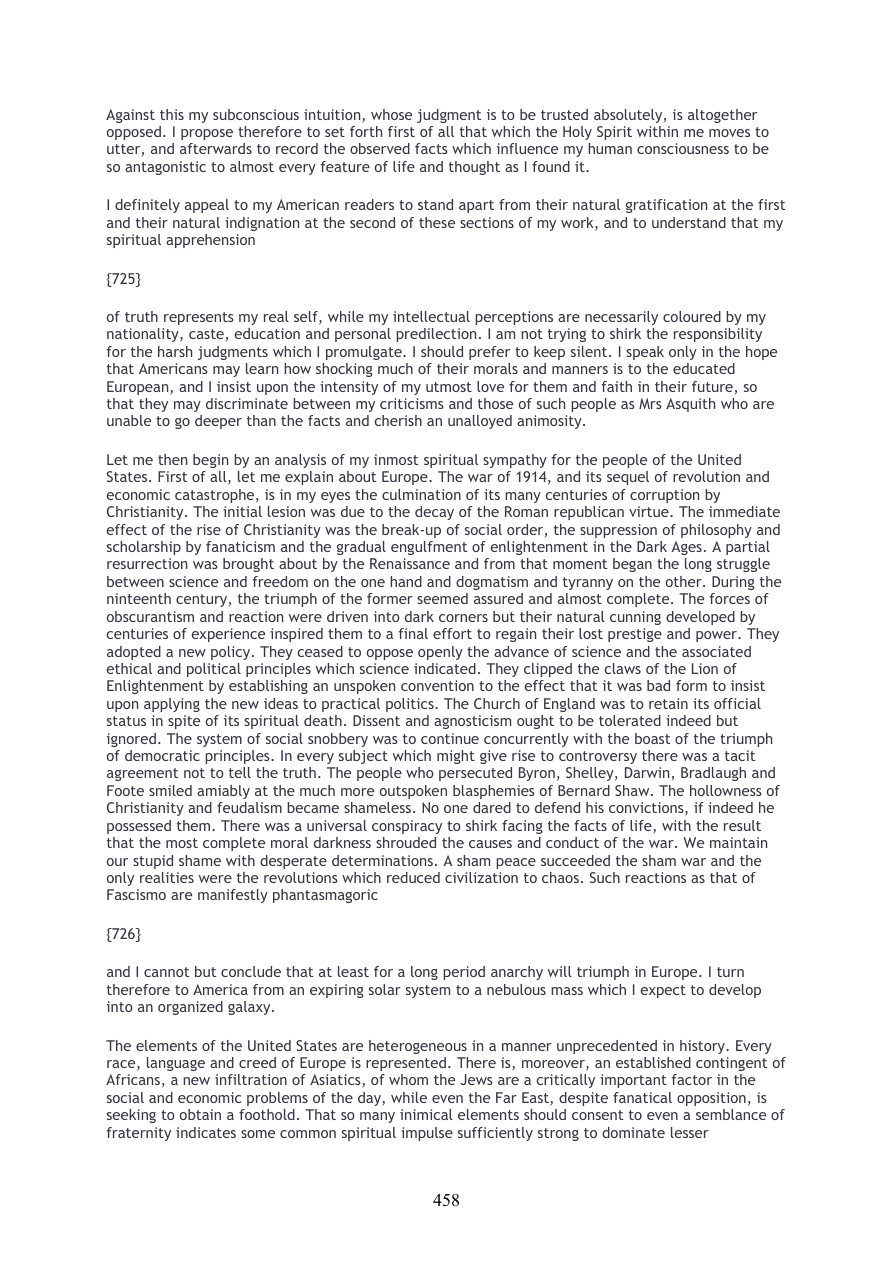
Highlights use the original PDF text layer. OCR-only matches may not be visible on the scan.
Transcription
Download text ↓raw extractionoriginal embedded textReview: unreviewed
458
Against this my subconscious intuition, whose judgment is to be trusted absolutely, is altogether
opposed. I propose therefore to set forth first of all that which the Holy Spirit within me moves to
utter, and afterwards to record the observed facts which influence my human consciousness to be
so antagonistic to almost every feature of life and thought as I found it.
I definitely appeal to my American readers to stand apart from their natural gratification at the first
and their natural indignation at the second of these sections of my work, and to understand that my
spiritual apprehension
{725}
of truth represents my real self, while my intellectual perceptions are necessarily coloured by my
nationality, caste, education and personal predilection. I am not trying to shirk the responsibility
for the harsh judgments which I promulgate. I should prefer to keep silent. I speak only in the hope
that Americans may learn how shocking much of their morals and manners is to the educated
European, and I insist upon the intensity of my utmost love for them and faith in their future, so
that they may discriminate between my criticisms and those of such people as Mrs Asquith who are
unable to go deeper than the facts and cherish an unalloyed animosity.
Let me then begin by an analysis of my inmost spiritual sympathy for the people of the United
States. First of all, let me explain about Europe. The war of 1914, and its sequel of revolution and
economic catastrophe, is in my eyes the culmination of its many centuries of corruption by
Christianity. The initial lesion was due to the decay of the Roman republican virtue. The immediate
effect of the rise of Christianity was the break-up of social order, the suppression of philosophy and
scholarship by fanaticism and the gradual engulfment of enlightenment in the Dark Ages. A partial
resurrection was brought about by the Renaissance and from that moment began the long struggle
between science and freedom on the one hand and dogmatism and tyranny on the other. During the
ninteenth century, the triumph of the former seemed assured and almost complete. The forces of
obscurantism and reaction were driven into dark corners but their natural cunning developed by
centuries of experience inspired them to a final effort to regain their lost prestige and power. They
adopted a new policy. They ceased to oppose openly the advance of science and the associated
ethical and political principles which science indicated. They clipped the claws of the Lion of
Enlightenment by establishing an unspoken convention to the effect that it was bad form to insist
upon applying the new ideas to practical politics. The Church of England was to retain its official
status in spite of its spiritual death. Dissent and agnosticism ought to be tolerated indeed but
ignored. The system of social snobbery was to continue concurrently with the boast of the triumph
of democratic principles. In every subject which might give rise to controversy there was a tacit
agreement not to tell the truth. The people who persecuted Byron, Shelley, Darwin, Bradlaugh and
Foote smiled amiably at the much more outspoken blasphemies of Bernard Shaw. The hollowness of
Christianity and feudalism became shameless. No one dared to defend his convictions, if indeed he
possessed them. There was a universal conspiracy to shirk facing the facts of life, with the result
that the most complete moral darkness shrouded the causes and conduct of the war. We maintain
our stupid shame with desperate determinations. A sham peace succeeded the sham war and the
only realities were the revolutions which reduced civilization to chaos. Such reactions as that of
Fascismo are manifestly phantasmagoric
{726}
and I cannot but conclude that at least for a long period anarchy will triumph in Europe. I turn
therefore to America from an expiring solar system to a nebulous mass which I expect to develop
into an organized galaxy.
The elements of the United States are heterogeneous in a manner unprecedented in history. Every
race, language and creed of Europe is represented. There is, moreover, an established contingent of
Africans, a new infiltration of Asiatics, of whom the Jews are a critically important factor in the
social and economic problems of the day, while even the Far East, despite fanatical opposition, is
seeking to obtain a foothold. That so many inimical elements should consent to even a semblance of
fraternity indicates some common spiritual impulse sufficiently strong to dominate lesser
Page provenance & review flags
Stable page ID: 5ef44b98d8f9c4af5f6f86e1:p00458
Line breaks are preserved. Reading order and OCR accuracy may need review.
Printed page label has not been verified.
- No automated review flags. This does not establish transcription accuracy.