1929 · CLOSE READING
Confessions of Aleister Crowley
Confessions of Aleister Crowley (1929), PDF p. 451
Original page
Enlarge ↗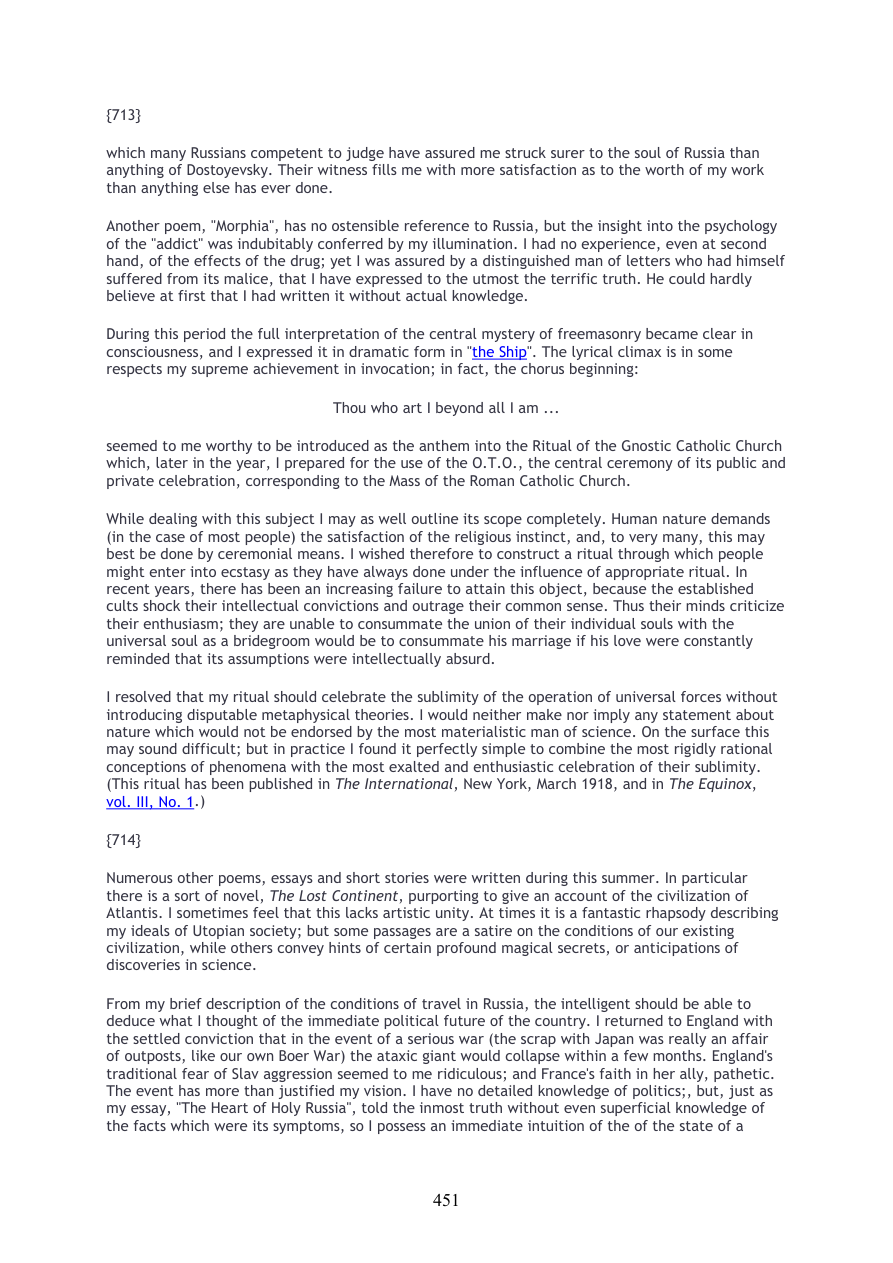
Highlights use the original PDF text layer. OCR-only matches may not be visible on the scan.
Transcription
Download text ↓raw extractionoriginal embedded textReview: unreviewed
451
{713}
which many Russians competent to judge have assured me struck surer to the soul of Russia than
anything of Dostoyevsky. Their witness fills me with more satisfaction as to the worth of my work
than anything else has ever done.
Another poem, "Morphia", has no ostensible reference to Russia, but the insight into the psychology
of the "addict" was indubitably conferred by my illumination. I had no experience, even at second
hand, of the effects of the drug; yet I was assured by a distinguished man of letters who had himself
suffered from its malice, that I have expressed to the utmost the terrific truth. He could hardly
believe at first that I had written it without actual knowledge.
During this period the full interpretation of the central mystery of freemasonry became clear in
consciousness, and I expressed it in dramatic form in "the Ship". The lyrical climax is in some
respects my supreme achievement in invocation; in fact, the chorus beginning:
Thou who art I beyond all I am ...
seemed to me worthy to be introduced as the anthem into the Ritual of the Gnostic Catholic Church
which, later in the year, I prepared for the use of the O.T.O., the central ceremony of its public and
private celebration, corresponding to the Mass of the Roman Catholic Church.
While dealing with this subject I may as well outline its scope completely. Human nature demands
(in the case of most people) the satisfaction of the religious instinct, and, to very many, this may
best be done by ceremonial means. I wished therefore to construct a ritual through which people
might enter into ecstasy as they have always done under the influence of appropriate ritual. In
recent years, there has been an increasing failure to attain this object, because the established
cults shock their intellectual convictions and outrage their common sense. Thus their minds criticize
their enthusiasm; they are unable to consummate the union of their individual souls with the
universal soul as a bridegroom would be to consummate his marriage if his love were constantly
reminded that its assumptions were intellectually absurd.
I resolved that my ritual should celebrate the sublimity of the operation of universal forces without
introducing disputable metaphysical theories. I would neither make nor imply any statement about
nature which would not be endorsed by the most materialistic man of science. On the surface this
may sound difficult; but in practice I found it perfectly simple to combine the most rigidly rational
conceptions of phenomena with the most exalted and enthusiastic celebration of their sublimity.
(This ritual has been published in The International, New York, March 1918, and in The Equinox,
vol. III, No. 1.)
{714}
Numerous other poems, essays and short stories were written during this summer. In particular
there is a sort of novel, The Lost Continent, purporting to give an account of the civilization of
Atlantis. I sometimes feel that this lacks artistic unity. At times it is a fantastic rhapsody describing
my ideals of Utopian society; but some passages are a satire on the conditions of our existing
civilization, while others convey hints of certain profound magical secrets, or anticipations of
discoveries in science.
From my brief description of the conditions of travel in Russia, the intelligent should be able to
deduce what I thought of the immediate political future of the country. I returned to England with
the settled conviction that in the event of a serious war (the scrap with Japan was really an affair
of outposts, like our own Boer War) the ataxic giant would collapse within a few months. England's
traditional fear of Slav aggression seemed to me ridiculous; and France's faith in her ally, pathetic.
The event has more than justified my vision. I have no detailed knowledge of politics;, but, just as
my essay, "The Heart of Holy Russia", told the inmost truth without even superficial knowledge of
the facts which were its symptoms, so I possess an immediate intuition of the of the state of a
Page provenance & review flags
Stable page ID: 5ef44b98d8f9c4af5f6f86e1:p00451
Line breaks are preserved. Reading order and OCR accuracy may need review.
Printed page label has not been verified.
- No automated review flags. This does not establish transcription accuracy.