1929 · CLOSE READING
Confessions of Aleister Crowley
Confessions of Aleister Crowley (1929), PDF p. 433
Original page
Enlarge ↗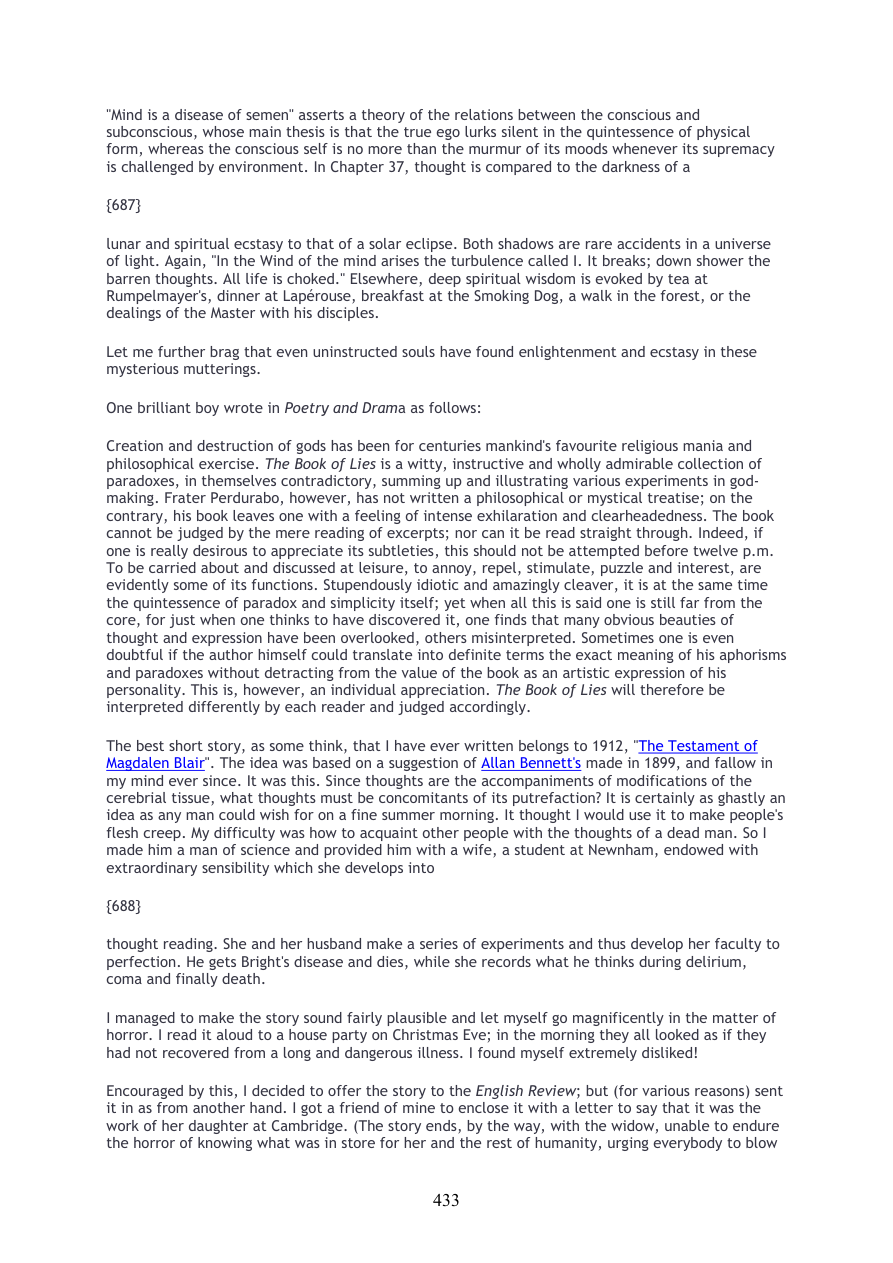
Highlights use the original PDF text layer. OCR-only matches may not be visible on the scan.
Transcription
Download text ↓raw extractionoriginal embedded textReview: unreviewed
433
"Mind is a disease of semen" asserts a theory of the relations between the conscious and
subconscious, whose main thesis is that the true ego lurks silent in the quintessence of physical
form, whereas the conscious self is no more than the murmur of its moods whenever its supremacy
is challenged by environment. In Chapter 37, thought is compared to the darkness of a
{687}
lunar and spiritual ecstasy to that of a solar eclipse. Both shadows are rare accidents in a universe
of light. Again, "In the Wind of the mind arises the turbulence called I. It breaks; down shower the
barren thoughts. All life is choked." Elsewhere, deep spiritual wisdom is evoked by tea at
Rumpelmayer's, dinner at Lapérouse, breakfast at the Smoking Dog, a walk in the forest, or the
dealings of the Master with his disciples.
Let me further brag that even uninstructed souls have found enlightenment and ecstasy in these
mysterious mutterings.
One brilliant boy wrote in Poetry and Drama as follows:
Creation and destruction of gods has been for centuries mankind's favourite religious mania and
philosophical exercise. The Book of Lies is a witty, instructive and wholly admirable collection of
paradoxes, in themselves contradictory, summing up and illustrating various experiments in god-
making. Frater Perdurabo, however, has not written a philosophical or mystical treatise; on the
contrary, his book leaves one with a feeling of intense exhilaration and clearheadedness. The book
cannot be judged by the mere reading of excerpts; nor can it be read straight through. Indeed, if
one is really desirous to appreciate its subtleties, this should not be attempted before twelve p.m.
To be carried about and discussed at leisure, to annoy, repel, stimulate, puzzle and interest, are
evidently some of its functions. Stupendously idiotic and amazingly cleaver, it is at the same time
the quintessence of paradox and simplicity itself; yet when all this is said one is still far from the
core, for just when one thinks to have discovered it, one finds that many obvious beauties of
thought and expression have been overlooked, others misinterpreted. Sometimes one is even
doubtful if the author himself could translate into definite terms the exact meaning of his aphorisms
and paradoxes without detracting from the value of the book as an artistic expression of his
personality. This is, however, an individual appreciation. The Book of Lies will therefore be
interpreted differently by each reader and judged accordingly.
The best short story, as some think, that I have ever written belongs to 1912, "The Testament of
Magdalen Blair". The idea was based on a suggestion of Allan Bennett's made in 1899, and fallow in
my mind ever since. It was this. Since thoughts are the accompaniments of modifications of the
cerebrial tissue, what thoughts must be concomitants of its putrefaction? It is certainly as ghastly an
idea as any man could wish for on a fine summer morning. It thought I would use it to make people's
flesh creep. My difficulty was how to acquaint other people with the thoughts of a dead man. So I
made him a man of science and provided him with a wife, a student at Newnham, endowed with
extraordinary sensibility which she develops into
{688}
thought reading. She and her husband make a series of experiments and thus develop her faculty to
perfection. He gets Bright's disease and dies, while she records what he thinks during delirium,
coma and finally death.
I managed to make the story sound fairly plausible and let myself go magnificently in the matter of
horror. I read it aloud to a house party on Christmas Eve; in the morning they all looked as if they
had not recovered from a long and dangerous illness. I found myself extremely disliked!
Encouraged by this, I decided to offer the story to the English Review; but (for various reasons) sent
it in as from another hand. I got a friend of mine to enclose it with a letter to say that it was the
work of her daughter at Cambridge. (The story ends, by the way, with the widow, unable to endure
the horror of knowing what was in store for her and the rest of humanity, urging everybody to blow
Page provenance & review flags
Stable page ID: 5ef44b98d8f9c4af5f6f86e1:p00433
Line breaks are preserved. Reading order and OCR accuracy may need review.
Printed page label has not been verified.
- No automated review flags. This does not establish transcription accuracy.