1929 · CLOSE READING
Confessions of Aleister Crowley
Confessions of Aleister Crowley (1929), PDF p. 43
Original page
Enlarge ↗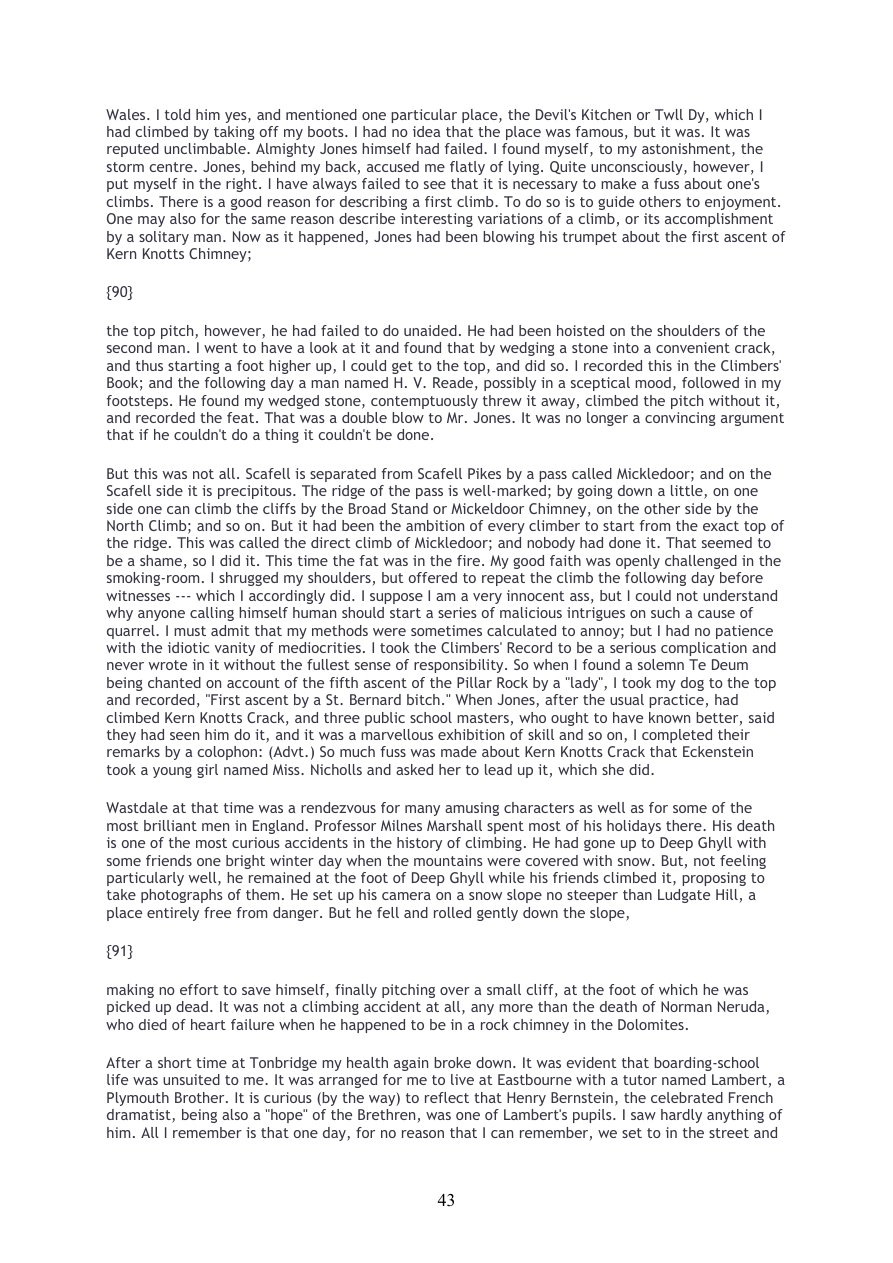
Highlights use the original PDF text layer. OCR-only matches may not be visible on the scan.
Transcription
Download text ↓raw extractionoriginal embedded textReview: unreviewed
43
Wales. I told him yes, and mentioned one particular place, the Devil's Kitchen or Twll Dy, which I
had climbed by taking off my boots. I had no idea that the place was famous, but it was. It was
reputed unclimbable. Almighty Jones himself had failed. I found myself, to my astonishment, the
storm centre. Jones, behind my back, accused me flatly of lying. Quite unconsciously, however, I
put myself in the right. I have always failed to see that it is necessary to make a fuss about one's
climbs. There is a good reason for describing a first climb. To do so is to guide others to enjoyment.
One may also for the same reason describe interesting variations of a climb, or its accomplishment
by a solitary man. Now as it happened, Jones had been blowing his trumpet about the first ascent of
Kern Knotts Chimney;
{90}
the top pitch, however, he had failed to do unaided. He had been hoisted on the shoulders of the
second man. I went to have a look at it and found that by wedging a stone into a convenient crack,
and thus starting a foot higher up, I could get to the top, and did so. I recorded this in the Climbers'
Book; and the following day a man named H. V. Reade, possibly in a sceptical mood, followed in my
footsteps. He found my wedged stone, contemptuously threw it away, climbed the pitch without it,
and recorded the feat. That was a double blow to Mr. Jones. It was no longer a convincing argument
that if he couldn't do a thing it couldn't be done.
But this was not all. Scafell is separated from Scafell Pikes by a pass called Mickledoor; and on the
Scafell side it is precipitous. The ridge of the pass is well-marked; by going down a little, on one
side one can climb the cliffs by the Broad Stand or Mickeldoor Chimney, on the other side by the
North Climb; and so on. But it had been the ambition of every climber to start from the exact top of
the ridge. This was called the direct climb of Mickledoor; and nobody had done it. That seemed to
be a shame, so I did it. This time the fat was in the fire. My good faith was openly challenged in the
smoking-room. I shrugged my shoulders, but offered to repeat the climb the following day before
witnesses --- which I accordingly did. I suppose I am a very innocent ass, but I could not understand
why anyone calling himself human should start a series of malicious intrigues on such a cause of
quarrel. I must admit that my methods were sometimes calculated to annoy; but I had no patience
with the idiotic vanity of mediocrities. I took the Climbers' Record to be a serious complication and
never wrote in it without the fullest sense of responsibility. So when I found a solemn Te Deum
being chanted on account of the fifth ascent of the Pillar Rock by a "lady", I took my dog to the top
and recorded, "First ascent by a St. Bernard bitch." When Jones, after the usual practice, had
climbed Kern Knotts Crack, and three public school masters, who ought to have known better, said
they had seen him do it, and it was a marvellous exhibition of skill and so on, I completed their
remarks by a colophon: (Advt.) So much fuss was made about Kern Knotts Crack that Eckenstein
took a young girl named Miss. Nicholls and asked her to lead up it, which she did.
Wastdale at that time was a rendezvous for many amusing characters as well as for some of the
most brilliant men in England. Professor Milnes Marshall spent most of his holidays there. His death
is one of the most curious accidents in the history of climbing. He had gone up to Deep Ghyll with
some friends one bright winter day when the mountains were covered with snow. But, not feeling
particularly well, he remained at the foot of Deep Ghyll while his friends climbed it, proposing to
take photographs of them. He set up his camera on a snow slope no steeper than Ludgate Hill, a
place entirely free from danger. But he fell and rolled gently down the slope,
{91}
making no effort to save himself, finally pitching over a small cliff, at the foot of which he was
picked up dead. It was not a climbing accident at all, any more than the death of Norman Neruda,
who died of heart failure when he happened to be in a rock chimney in the Dolomites.
After a short time at Tonbridge my health again broke down. It was evident that boarding-school
life was unsuited to me. It was arranged for me to live at Eastbourne with a tutor named Lambert, a
Plymouth Brother. It is curious (by the way) to reflect that Henry Bernstein, the celebrated French
dramatist, being also a "hope" of the Brethren, was one of Lambert's pupils. I saw hardly anything of
him. All I remember is that one day, for no reason that I can remember, we set to in the street and
Page provenance & review flags
Stable page ID: 5ef44b98d8f9c4af5f6f86e1:p00043
Line breaks are preserved. Reading order and OCR accuracy may need review.
Printed page label has not been verified.
- No automated review flags. This does not establish transcription accuracy.