1929 · CLOSE READING
Confessions of Aleister Crowley
Confessions of Aleister Crowley (1929), PDF p. 419
Original page
Enlarge ↗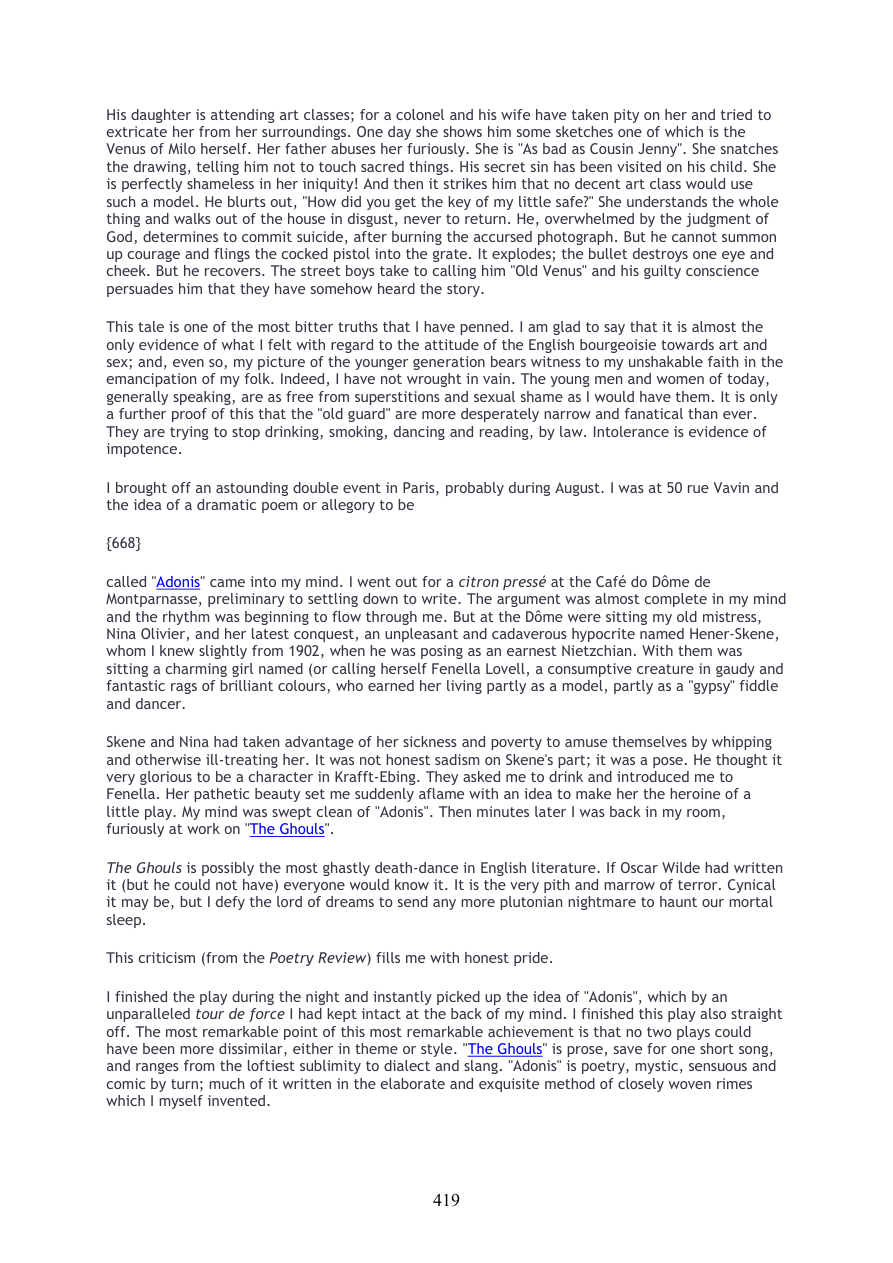
Highlights use the original PDF text layer. OCR-only matches may not be visible on the scan.
Transcription
Download text ↓raw extractionoriginal embedded textReview: unreviewed
419
His daughter is attending art classes; for a colonel and his wife have taken pity on her and tried to
extricate her from her surroundings. One day she shows him some sketches one of which is the
Venus of Milo herself. Her father abuses her furiously. She is "As bad as Cousin Jenny". She snatches
the drawing, telling him not to touch sacred things. His secret sin has been visited on his child. She
is perfectly shameless in her iniquity! And then it strikes him that no decent art class would use
such a model. He blurts out, "How did you get the key of my little safe?" She understands the whole
thing and walks out of the house in disgust, never to return. He, overwhelmed by the judgment of
God, determines to commit suicide, after burning the accursed photograph. But he cannot summon
up courage and flings the cocked pistol into the grate. It explodes; the bullet destroys one eye and
cheek. But he recovers. The street boys take to calling him "Old Venus" and his guilty conscience
persuades him that they have somehow heard the story.
This tale is one of the most bitter truths that I have penned. I am glad to say that it is almost the
only evidence of what I felt with regard to the attitude of the English bourgeoisie towards art and
sex; and, even so, my picture of the younger generation bears witness to my unshakable faith in the
emancipation of my folk. Indeed, I have not wrought in vain. The young men and women of today,
generally speaking, are as free from superstitions and sexual shame as I would have them. It is only
a further proof of this that the "old guard" are more desperately narrow and fanatical than ever.
They are trying to stop drinking, smoking, dancing and reading, by law. Intolerance is evidence of
impotence.
I brought off an astounding double event in Paris, probably during August. I was at 50 rue Vavin and
the idea of a dramatic poem or allegory to be
{668}
called "Adonis" came into my mind. I went out for a citron pressé at the Café do Dôme de
Montparnasse, preliminary to settling down to write. The argument was almost complete in my mind
and the rhythm was beginning to flow through me. But at the Dôme were sitting my old mistress,
Nina Olivier, and her latest conquest, an unpleasant and cadaverous hypocrite named Hener-Skene,
whom I knew slightly from 1902, when he was posing as an earnest Nietzchian. With them was
sitting a charming girl named (or calling herself Fenella Lovell, a consumptive creature in gaudy and
fantastic rags of brilliant colours, who earned her living partly as a model, partly as a "gypsy" fiddle
and dancer.
Skene and Nina had taken advantage of her sickness and poverty to amuse themselves by whipping
and otherwise ill-treating her. It was not honest sadism on Skene's part; it was a pose. He thought it
very glorious to be a character in Krafft-Ebing. They asked me to drink and introduced me to
Fenella. Her pathetic beauty set me suddenly aflame with an idea to make her the heroine of a
little play. My mind was swept clean of "Adonis". Then minutes later I was back in my room,
furiously at work on "The Ghouls".
The Ghouls is possibly the most ghastly death-dance in English literature. If Oscar Wilde had written
it (but he could not have) everyone would know it. It is the very pith and marrow of terror. Cynical
it may be, but I defy the lord of dreams to send any more plutonian nightmare to haunt our mortal
sleep.
This criticism (from the Poetry Review) fills me with honest pride.
I finished the play during the night and instantly picked up the idea of "Adonis", which by an
unparalleled tour de force I had kept intact at the back of my mind. I finished this play also straight
off. The most remarkable point of this most remarkable achievement is that no two plays could
have been more dissimilar, either in theme or style. "The Ghouls" is prose, save for one short song,
and ranges from the loftiest sublimity to dialect and slang. "Adonis" is poetry, mystic, sensuous and
comic by turn; much of it written in the elaborate and exquisite method of closely woven rimes
which I myself invented.
Page provenance & review flags
Stable page ID: 5ef44b98d8f9c4af5f6f86e1:p00419
Line breaks are preserved. Reading order and OCR accuracy may need review.
Printed page label has not been verified.
- No automated review flags. This does not establish transcription accuracy.