1929 · CLOSE READING
Confessions of Aleister Crowley
Confessions of Aleister Crowley (1929), PDF p. 410
Original page
Enlarge ↗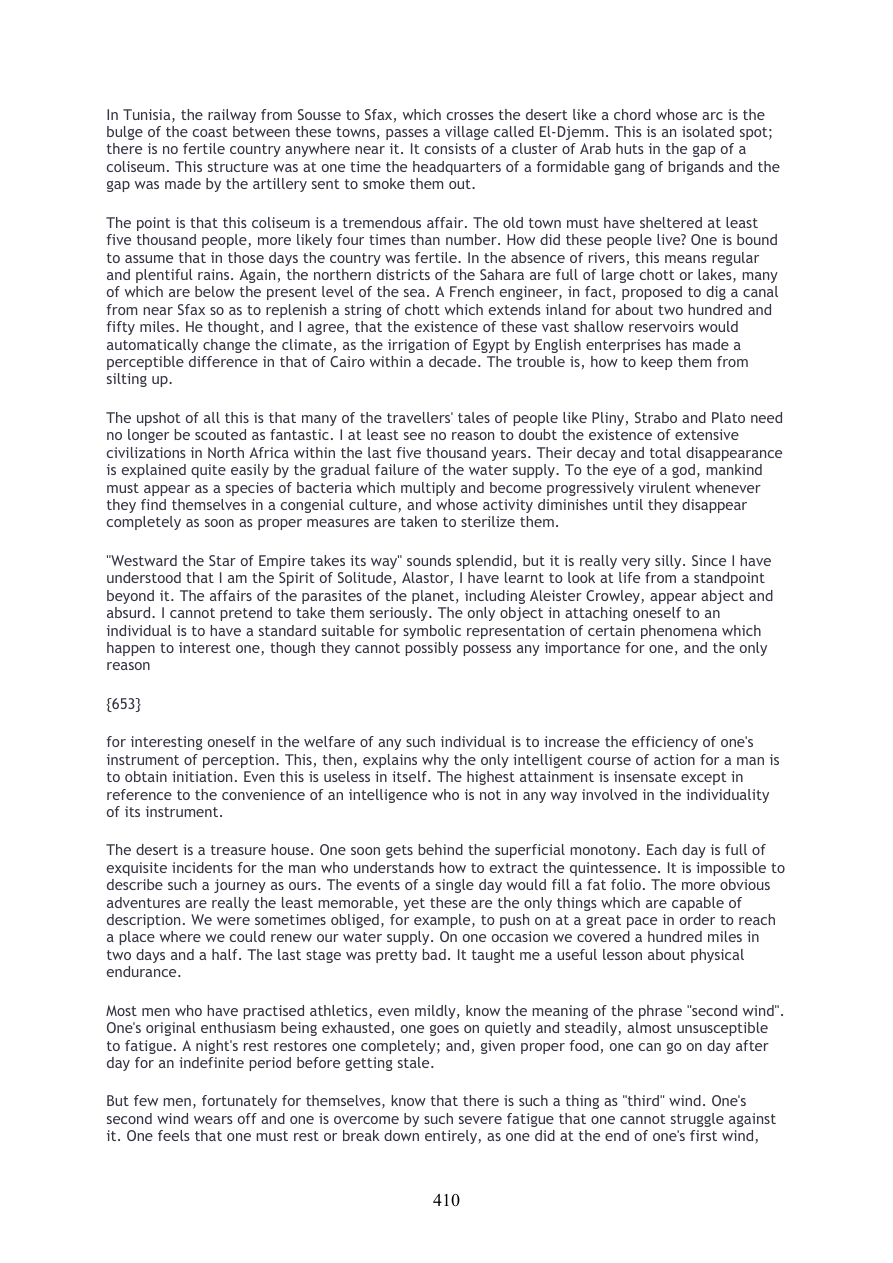
Highlights use the original PDF text layer. OCR-only matches may not be visible on the scan.
Transcription
Download text ↓raw extractionoriginal embedded textReview: unreviewed
410
In Tunisia, the railway from Sousse to Sfax, which crosses the desert like a chord whose arc is the
bulge of the coast between these towns, passes a village called El-Djemm. This is an isolated spot;
there is no fertile country anywhere near it. It consists of a cluster of Arab huts in the gap of a
coliseum. This structure was at one time the headquarters of a formidable gang of brigands and the
gap was made by the artillery sent to smoke them out.
The point is that this coliseum is a tremendous affair. The old town must have sheltered at least
five thousand people, more likely four times than number. How did these people live? One is bound
to assume that in those days the country was fertile. In the absence of rivers, this means regular
and plentiful rains. Again, the northern districts of the Sahara are full of large chott or lakes, many
of which are below the present level of the sea. A French engineer, in fact, proposed to dig a canal
from near Sfax so as to replenish a string of chott which extends inland for about two hundred and
fifty miles. He thought, and I agree, that the existence of these vast shallow reservoirs would
automatically change the climate, as the irrigation of Egypt by English enterprises has made a
perceptible difference in that of Cairo within a decade. The trouble is, how to keep them from
silting up.
The upshot of all this is that many of the travellers' tales of people like Pliny, Strabo and Plato need
no longer be scouted as fantastic. I at least see no reason to doubt the existence of extensive
civilizations in North Africa within the last five thousand years. Their decay and total disappearance
is explained quite easily by the gradual failure of the water supply. To the eye of a god, mankind
must appear as a species of bacteria which multiply and become progressively virulent whenever
they find themselves in a congenial culture, and whose activity diminishes until they disappear
completely as soon as proper measures are taken to sterilize them.
"Westward the Star of Empire takes its way" sounds splendid, but it is really very silly. Since I have
understood that I am the Spirit of Solitude, Alastor, I have learnt to look at life from a standpoint
beyond it. The affairs of the parasites of the planet, including Aleister Crowley, appear abject and
absurd. I cannot pretend to take them seriously. The only object in attaching oneself to an
individual is to have a standard suitable for symbolic representation of certain phenomena which
happen to interest one, though they cannot possibly possess any importance for one, and the only
reason
{653}
for interesting oneself in the welfare of any such individual is to increase the efficiency of one's
instrument of perception. This, then, explains why the only intelligent course of action for a man is
to obtain initiation. Even this is useless in itself. The highest attainment is insensate except in
reference to the convenience of an intelligence who is not in any way involved in the individuality
of its instrument.
The desert is a treasure house. One soon gets behind the superficial monotony. Each day is full of
exquisite incidents for the man who understands how to extract the quintessence. It is impossible to
describe such a journey as ours. The events of a single day would fill a fat folio. The more obvious
adventures are really the least memorable, yet these are the only things which are capable of
description. We were sometimes obliged, for example, to push on at a great pace in order to reach
a place where we could renew our water supply. On one occasion we covered a hundred miles in
two days and a half. The last stage was pretty bad. It taught me a useful lesson about physical
endurance.
Most men who have practised athletics, even mildly, know the meaning of the phrase "second wind".
One's original enthusiasm being exhausted, one goes on quietly and steadily, almost unsusceptible
to fatigue. A night's rest restores one completely; and, given proper food, one can go on day after
day for an indefinite period before getting stale.
But few men, fortunately for themselves, know that there is such a thing as "third" wind. One's
second wind wears off and one is overcome by such severe fatigue that one cannot struggle against
it. One feels that one must rest or break down entirely, as one did at the end of one's first wind,
Page provenance & review flags
Stable page ID: 5ef44b98d8f9c4af5f6f86e1:p00410
Line breaks are preserved. Reading order and OCR accuracy may need review.
Printed page label has not been verified.
- No automated review flags. This does not establish transcription accuracy.