1929 · CLOSE READING
Confessions of Aleister Crowley
Confessions of Aleister Crowley (1929), PDF p. 408
Original page
Enlarge ↗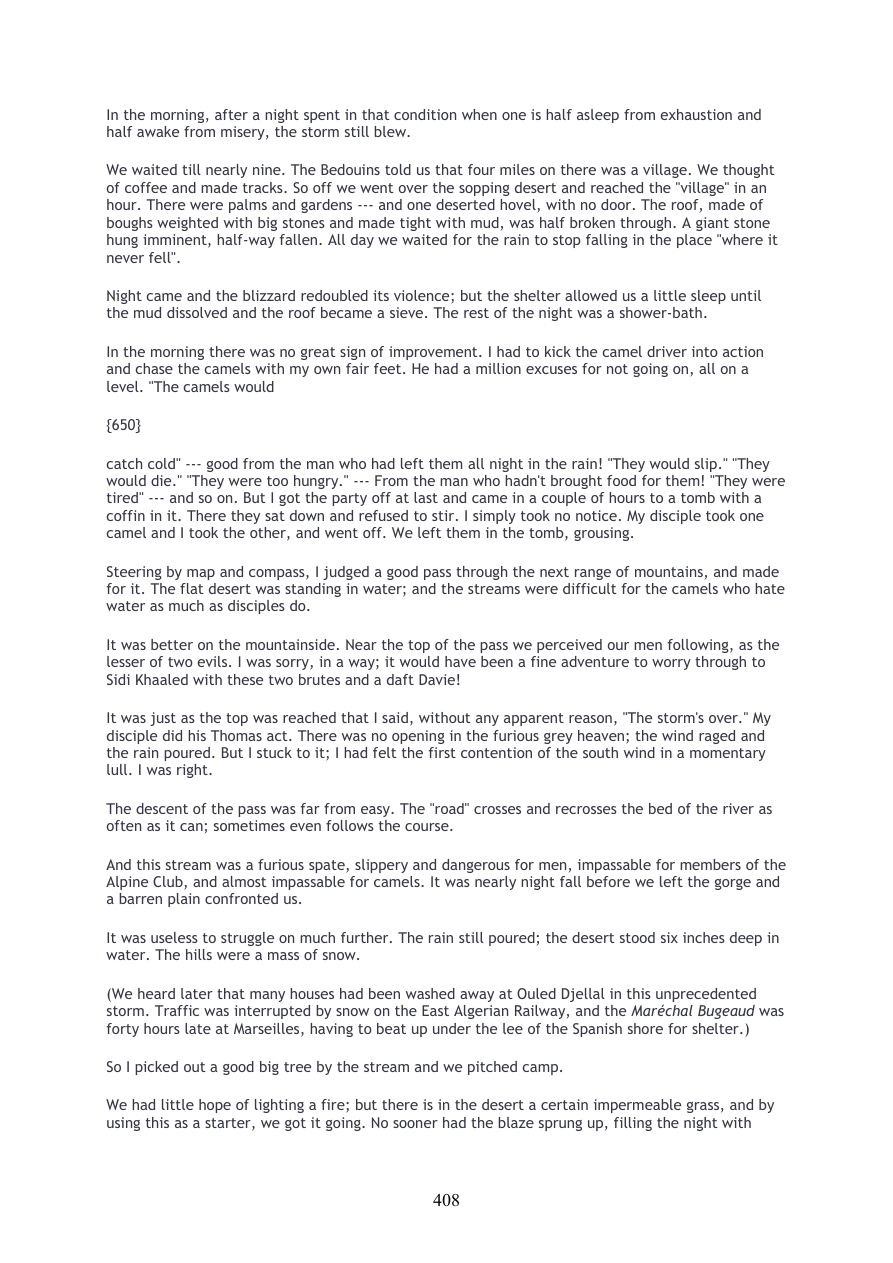
Highlights use the original PDF text layer. OCR-only matches may not be visible on the scan.
Transcription
Download text ↓raw extractionoriginal embedded textReview: unreviewed
408
In the morning, after a night spent in that condition when one is half asleep from exhaustion and
half awake from misery, the storm still blew.
We waited till nearly nine. The Bedouins told us that four miles on there was a village. We thought
of coffee and made tracks. So off we went over the sopping desert and reached the "village" in an
hour. There were palms and gardens --- and one deserted hovel, with no door. The roof, made of
boughs weighted with big stones and made tight with mud, was half broken through. A giant stone
hung imminent, half-way fallen. All day we waited for the rain to stop falling in the place "where it
never fell".
Night came and the blizzard redoubled its violence; but the shelter allowed us a little sleep until
the mud dissolved and the roof became a sieve. The rest of the night was a shower-bath.
In the morning there was no great sign of improvement. I had to kick the camel driver into action
and chase the camels with my own fair feet. He had a million excuses for not going on, all on a
level. "The camels would
{650}
catch cold" --- good from the man who had left them all night in the rain! "They would slip." "They
would die." "They were too hungry." --- From the man who hadn't brought food for them! "They were
tired" --- and so on. But I got the party off at last and came in a couple of hours to a tomb with a
coffin in it. There they sat down and refused to stir. I simply took no notice. My disciple took one
camel and I took the other, and went off. We left them in the tomb, grousing.
Steering by map and compass, I judged a good pass through the next range of mountains, and made
for it. The flat desert was standing in water; and the streams were difficult for the camels who hate
water as much as disciples do.
It was better on the mountainside. Near the top of the pass we perceived our men following, as the
lesser of two evils. I was sorry, in a way; it would have been a fine adventure to worry through to
Sidi Khaaled with these two brutes and a daft Davie!
It was just as the top was reached that I said, without any apparent reason, "The storm's over." My
disciple did his Thomas act. There was no opening in the furious grey heaven; the wind raged and
the rain poured. But I stuck to it; I had felt the first contention of the south wind in a momentary
lull. I was right.
The descent of the pass was far from easy. The "road" crosses and recrosses the bed of the river as
often as it can; sometimes even follows the course.
And this stream was a furious spate, slippery and dangerous for men, impassable for members of the
Alpine Club, and almost impassable for camels. It was nearly night fall before we left the gorge and
a barren plain confronted us.
It was useless to struggle on much further. The rain still poured; the desert stood six inches deep in
water. The hills were a mass of snow.
(We heard later that many houses had been washed away at Ouled Djellal in this unprecedented
storm. Traffic was interrupted by snow on the East Algerian Railway, and the Maréchal Bugeaud was
forty hours late at Marseilles, having to beat up under the lee of the Spanish shore for shelter.)
So I picked out a good big tree by the stream and we pitched camp.
We had little hope of lighting a fire; but there is in the desert a certain impermeable grass, and by
using this as a starter, we got it going. No sooner had the blaze sprung up, filling the night with
Page provenance & review flags
Stable page ID: 5ef44b98d8f9c4af5f6f86e1:p00408
Line breaks are preserved. Reading order and OCR accuracy may need review.
Printed page label has not been verified.
- No automated review flags. This does not establish transcription accuracy.