1929 · CLOSE READING
Confessions of Aleister Crowley
Confessions of Aleister Crowley (1929), PDF p. 401
Original page
Enlarge ↗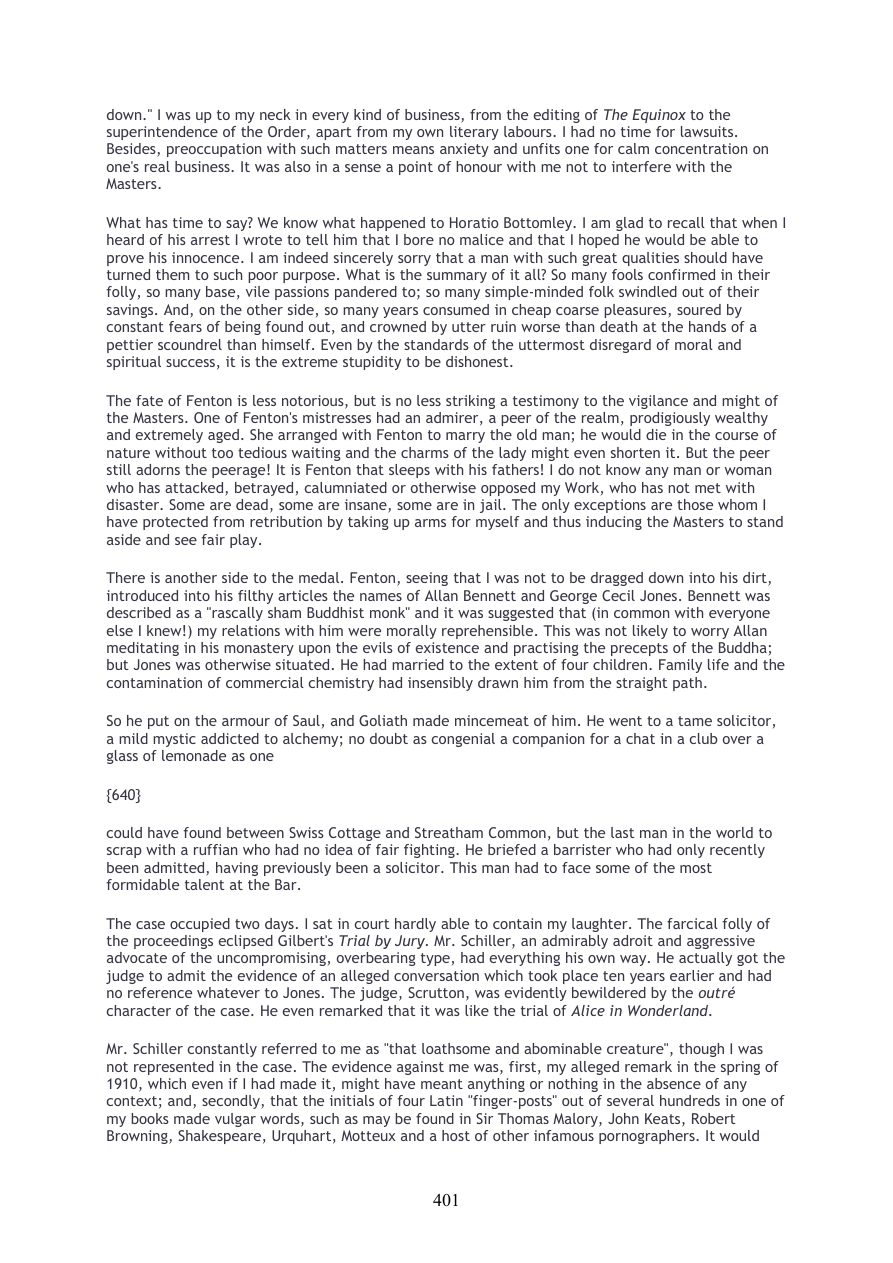
Highlights use the original PDF text layer. OCR-only matches may not be visible on the scan.
Transcription
Download text ↓raw extractionoriginal embedded textReview: unreviewed
401
down." I was up to my neck in every kind of business, from the editing of The Equinox to the
superintendence of the Order, apart from my own literary labours. I had no time for lawsuits.
Besides, preoccupation with such matters means anxiety and unfits one for calm concentration on
one's real business. It was also in a sense a point of honour with me not to interfere with the
Masters.
What has time to say? We know what happened to Horatio Bottomley. I am glad to recall that when I
heard of his arrest I wrote to tell him that I bore no malice and that I hoped he would be able to
prove his innocence. I am indeed sincerely sorry that a man with such great qualities should have
turned them to such poor purpose. What is the summary of it all? So many fools confirmed in their
folly, so many base, vile passions pandered to; so many simple-minded folk swindled out of their
savings. And, on the other side, so many years consumed in cheap coarse pleasures, soured by
constant fears of being found out, and crowned by utter ruin worse than death at the hands of a
pettier scoundrel than himself. Even by the standards of the uttermost disregard of moral and
spiritual success, it is the extreme stupidity to be dishonest.
The fate of Fenton is less notorious, but is no less striking a testimony to the vigilance and might of
the Masters. One of Fenton's mistresses had an admirer, a peer of the realm, prodigiously wealthy
and extremely aged. She arranged with Fenton to marry the old man; he would die in the course of
nature without too tedious waiting and the charms of the lady might even shorten it. But the peer
still adorns the peerage! It is Fenton that sleeps with his fathers! I do not know any man or woman
who has attacked, betrayed, calumniated or otherwise opposed my Work, who has not met with
disaster. Some are dead, some are insane, some are in jail. The only exceptions are those whom I
have protected from retribution by taking up arms for myself and thus inducing the Masters to stand
aside and see fair play.
There is another side to the medal. Fenton, seeing that I was not to be dragged down into his dirt,
introduced into his filthy articles the names of Allan Bennett and George Cecil Jones. Bennett was
described as a "rascally sham Buddhist monk" and it was suggested that (in common with everyone
else I knew!) my relations with him were morally reprehensible. This was not likely to worry Allan
meditating in his monastery upon the evils of existence and practising the precepts of the Buddha;
but Jones was otherwise situated. He had married to the extent of four children. Family life and the
contamination of commercial chemistry had insensibly drawn him from the straight path.
So he put on the armour of Saul, and Goliath made mincemeat of him. He went to a tame solicitor,
a mild mystic addicted to alchemy; no doubt as congenial a companion for a chat in a club over a
glass of lemonade as one
{640}
could have found between Swiss Cottage and Streatham Common, but the last man in the world to
scrap with a ruffian who had no idea of fair fighting. He briefed a barrister who had only recently
been admitted, having previously been a solicitor. This man had to face some of the most
formidable talent at the Bar.
The case occupied two days. I sat in court hardly able to contain my laughter. The farcical folly of
the proceedings eclipsed Gilbert's Trial by Jury. Mr. Schiller, an admirably adroit and aggressive
advocate of the uncompromising, overbearing type, had everything his own way. He actually got the
judge to admit the evidence of an alleged conversation which took place ten years earlier and had
no reference whatever to Jones. The judge, Scrutton, was evidently bewildered by the outré
character of the case. He even remarked that it was like the trial of Alice in Wonderland.
Mr. Schiller constantly referred to me as "that loathsome and abominable creature", though I was
not represented in the case. The evidence against me was, first, my alleged remark in the spring of
1910, which even if I had made it, might have meant anything or nothing in the absence of any
context; and, secondly, that the initials of four Latin "finger-posts" out of several hundreds in one of
my books made vulgar words, such as may be found in Sir Thomas Malory, John Keats, Robert
Browning, Shakespeare, Urquhart, Motteux and a host of other infamous pornographers. It would
Page provenance & review flags
Stable page ID: 5ef44b98d8f9c4af5f6f86e1:p00401
Line breaks are preserved. Reading order and OCR accuracy may need review.
Printed page label has not been verified.
- No automated review flags. This does not establish transcription accuracy.