1929 · CLOSE READING
Confessions of Aleister Crowley
Confessions of Aleister Crowley (1929), PDF p. 40
Original page
Enlarge ↗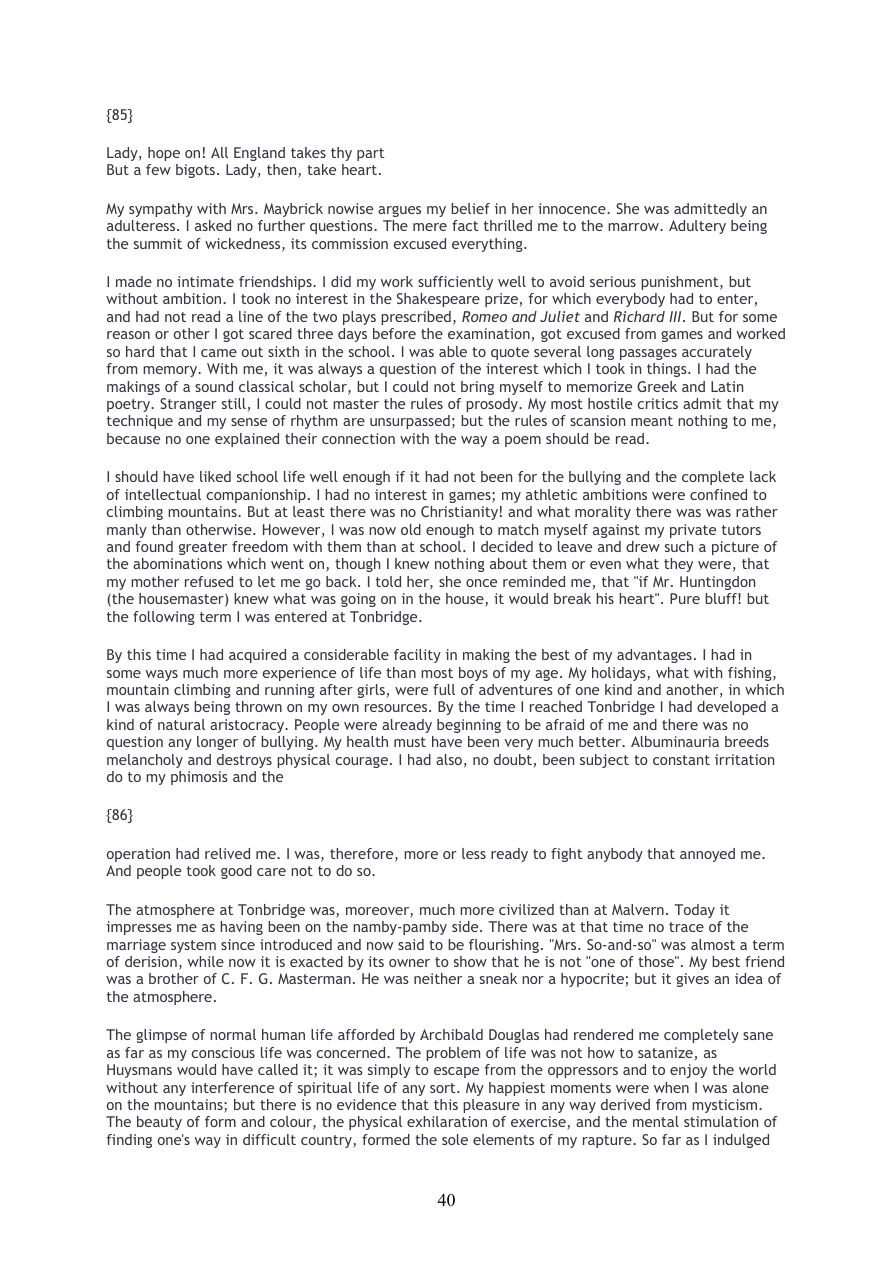
Highlights use the original PDF text layer. OCR-only matches may not be visible on the scan.
Transcription
Download text ↓raw extractionoriginal embedded textReview: unreviewed
40
{85}
Lady, hope on! All England takes thy part
But a few bigots. Lady, then, take heart.
My sympathy with Mrs. Maybrick nowise argues my belief in her innocence. She was admittedly an
adulteress. I asked no further questions. The mere fact thrilled me to the marrow. Adultery being
the summit of wickedness, its commission excused everything.
I made no intimate friendships. I did my work sufficiently well to avoid serious punishment, but
without ambition. I took no interest in the Shakespeare prize, for which everybody had to enter,
and had not read a line of the two plays prescribed, Romeo and Juliet and Richard III. But for some
reason or other I got scared three days before the examination, got excused from games and worked
so hard that I came out sixth in the school. I was able to quote several long passages accurately
from memory. With me, it was always a question of the interest which I took in things. I had the
makings of a sound classical scholar, but I could not bring myself to memorize Greek and Latin
poetry. Stranger still, I could not master the rules of prosody. My most hostile critics admit that my
technique and my sense of rhythm are unsurpassed; but the rules of scansion meant nothing to me,
because no one explained their connection with the way a poem should be read.
I should have liked school life well enough if it had not been for the bullying and the complete lack
of intellectual companionship. I had no interest in games; my athletic ambitions were confined to
climbing mountains. But at least there was no Christianity! and what morality there was was rather
manly than otherwise. However, I was now old enough to match myself against my private tutors
and found greater freedom with them than at school. I decided to leave and drew such a picture of
the abominations which went on, though I knew nothing about them or even what they were, that
my mother refused to let me go back. I told her, she once reminded me, that "if Mr. Huntingdon
(the housemaster) knew what was going on in the house, it would break his heart". Pure bluff! but
the following term I was entered at Tonbridge.
By this time I had acquired a considerable facility in making the best of my advantages. I had in
some ways much more experience of life than most boys of my age. My holidays, what with fishing,
mountain climbing and running after girls, were full of adventures of one kind and another, in which
I was always being thrown on my own resources. By the time I reached Tonbridge I had developed a
kind of natural aristocracy. People were already beginning to be afraid of me and there was no
question any longer of bullying. My health must have been very much better. Albuminauria breeds
melancholy and destroys physical courage. I had also, no doubt, been subject to constant irritation
do to my phimosis and the
{86}
operation had relived me. I was, therefore, more or less ready to fight anybody that annoyed me.
And people took good care not to do so.
The atmosphere at Tonbridge was, moreover, much more civilized than at Malvern. Today it
impresses me as having been on the namby-pamby side. There was at that time no trace of the
marriage system since introduced and now said to be flourishing. "Mrs. So-and-so" was almost a term
of derision, while now it is exacted by its owner to show that he is not "one of those". My best friend
was a brother of C. F. G. Masterman. He was neither a sneak nor a hypocrite; but it gives an idea of
the atmosphere.
The glimpse of normal human life afforded by Archibald Douglas had rendered me completely sane
as far as my conscious life was concerned. The problem of life was not how to satanize, as
Huysmans would have called it; it was simply to escape from the oppressors and to enjoy the world
without any interference of spiritual life of any sort. My happiest moments were when I was alone
on the mountains; but there is no evidence that this pleasure in any way derived from mysticism.
The beauty of form and colour, the physical exhilaration of exercise, and the mental stimulation of
finding one's way in difficult country, formed the sole elements of my rapture. So far as I indulged
Page provenance & review flags
Stable page ID: 5ef44b98d8f9c4af5f6f86e1:p00040
Line breaks are preserved. Reading order and OCR accuracy may need review.
Printed page label has not been verified.
- No automated review flags. This does not establish transcription accuracy.