1929 · CLOSE READING
Confessions of Aleister Crowley
Confessions of Aleister Crowley (1929), PDF p. 392
Original page
Enlarge ↗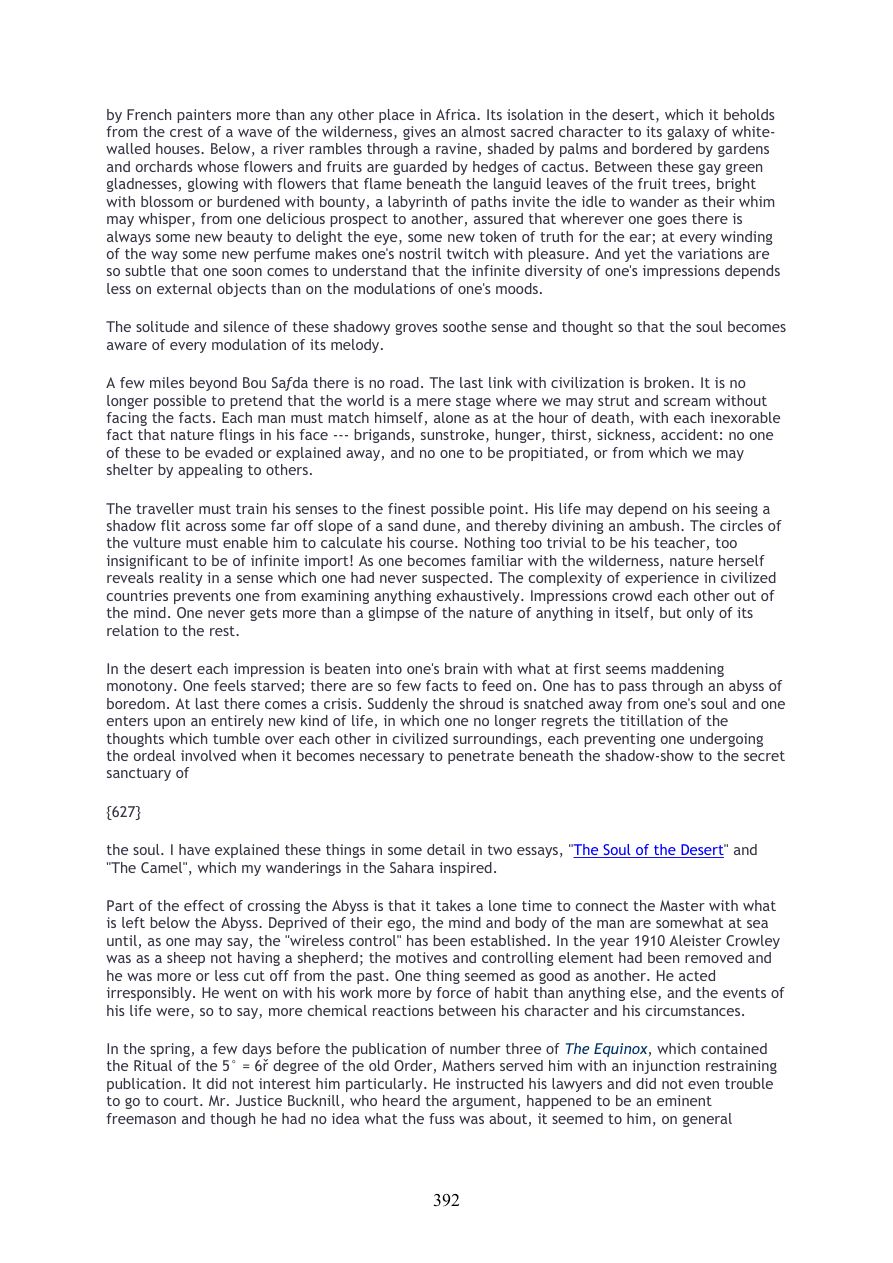
Highlights use the original PDF text layer. OCR-only matches may not be visible on the scan.
Transcription
Download text ↓raw extractionoriginal embedded textReview: unreviewed
392
by French painters more than any other place in Africa. Its isolation in the desert, which it beholds
from the crest of a wave of the wilderness, gives an almost sacred character to its galaxy of white-
walled houses. Below, a river rambles through a ravine, shaded by palms and bordered by gardens
and orchards whose flowers and fruits are guarded by hedges of cactus. Between these gay green
gladnesses, glowing with flowers that flame beneath the languid leaves of the fruit trees, bright
with blossom or burdened with bounty, a labyrinth of paths invite the idle to wander as their whim
may whisper, from one delicious prospect to another, assured that wherever one goes there is
always some new beauty to delight the eye, some new token of truth for the ear; at every winding
of the way some new perfume makes one's nostril twitch with pleasure. And yet the variations are
so subtle that one soon comes to understand that the infinite diversity of one's impressions depends
less on external objects than on the modulations of one's moods.
The solitude and silence of these shadowy groves soothe sense and thought so that the soul becomes
aware of every modulation of its melody.
A few miles beyond Bou Sada there is no road. The last link with civilization is broken. It is no
longer possible to pretend that the world is a mere stage where we may strut and scream without
facing the facts. Each man must match himself, alone as at the hour of death, with each inexorable
fact that nature flings in his face --- brigands, sunstroke, hunger, thirst, sickness, accident: no one
of these to be evaded or explained away, and no one to be propitiated, or from which we may
shelter by appealing to others.
The traveller must train his senses to the finest possible point. His life may depend on his seeing a
shadow flit across some far off slope of a sand dune, and thereby divining an ambush. The circles of
the vulture must enable him to calculate his course. Nothing too trivial to be his teacher, too
insignificant to be of infinite import! As one becomes familiar with the wilderness, nature herself
reveals reality in a sense which one had never suspected. The complexity of experience in civilized
countries prevents one from examining anything exhaustively. Impressions crowd each other out of
the mind. One never gets more than a glimpse of the nature of anything in itself, but only of its
relation to the rest.
In the desert each impression is beaten into one's brain with what at first seems maddening
monotony. One feels starved; there are so few facts to feed on. One has to pass through an abyss of
boredom. At last there comes a crisis. Suddenly the shroud is snatched away from one's soul and one
enters upon an entirely new kind of life, in which one no longer regrets the titillation of the
thoughts which tumble over each other in civilized surroundings, each preventing one undergoing
the ordeal involved when it becomes necessary to penetrate beneath the shadow-show to the secret
sanctuary of
{627}
the soul. I have explained these things in some detail in two essays, "The Soul of the Desert" and
"The Camel", which my wanderings in the Sahara inspired.
Part of the effect of crossing the Abyss is that it takes a lone time to connect the Master with what
is left below the Abyss. Deprived of their ego, the mind and body of the man are somewhat at sea
until, as one may say, the "wireless control" has been established. In the year 1910 Aleister Crowley
was as a sheep not having a shepherd; the motives and controlling element had been removed and
he was more or less cut off from the past. One thing seemed as good as another. He acted
irresponsibly. He went on with his work more by force of habit than anything else, and the events of
his life were, so to say, more chemical reactions between his character and his circumstances.
In the spring, a few days before the publication of number three of The Equinox, which contained
the Ritual of the 5° = 6ř degree of the old Order, Mathers served him with an injunction restraining
publication. It did not interest him particularly. He instructed his lawyers and did not even trouble
to go to court. Mr. Justice Bucknill, who heard the argument, happened to be an eminent
freemason and though he had no idea what the fuss was about, it seemed to him, on general
Page provenance & review flags
Stable page ID: 5ef44b98d8f9c4af5f6f86e1:p00392
Line breaks are preserved. Reading order and OCR accuracy may need review.
Printed page label has not been verified.
- No automated review flags. This does not establish transcription accuracy.